
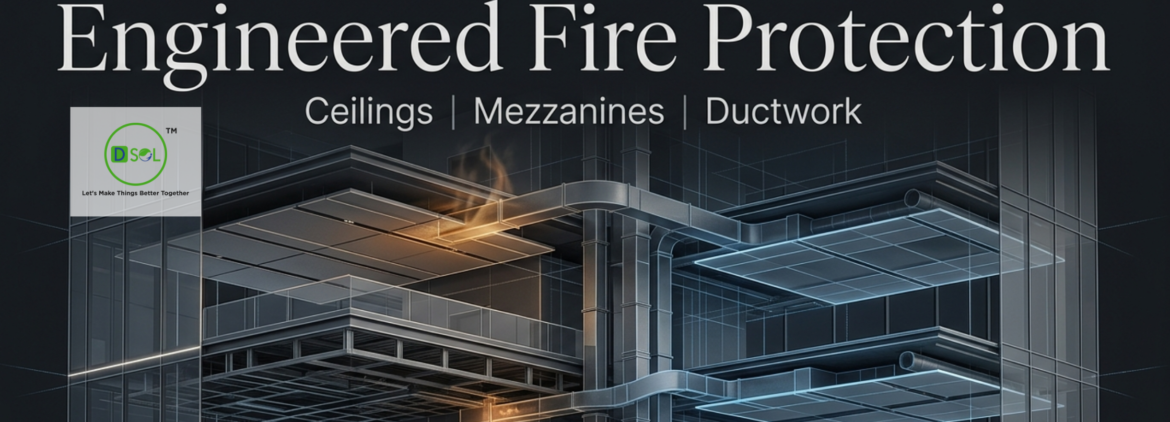
In the vertical landscapes of modern metropolises, high-rise buildings present unique fire safety challenges that demand meticulous engineering and advanced passive protection strategies. Unlike low-rise structures, skyscrapers rely on compartmentation, the practice of dividing a building into fire-resistance-rated zones to contain flames, limit smoke migration, and provide occupants with critical evacuation time. Among the most vulnerable yet often overlooked areas are ceilings, mezzanines, and ductwork systems. This article explores sophisticated fire safety solutions tailored to these high-risk zones, offering building owners, facility managers, and architects a roadmap to enhanced resilience and regulatory compliance.
The Critical Role of Fire-Resistant Ceilings in Vertical Compartments
Ceilings in high-rise buildings are not merely architectural finishes; they function as horizontal fire barriers that prevent the upward spread of flames and heat. When properly designed, a fire-resistant ceiling can maintain compartment integrity for up to two hours or more, shielding structural elements above while allowing occupants below to evacuate safely.
Self-Supporting Membrane Ceilings for Voluminous Spaces
For large atriums, auditoriums, or open-plan office floors, self-supporting membrane ceilings offer an elegant yet robust solution. These systems do not rely on additional hangers or suspension wires; instead, they derive structural stability from their own engineered framework. Key advantages include symmetrical or asymmetrical access for maintenance and the integration of fire-resistant access hatches. Under fire exposure, these ceilings remain stable, preventing flame propagation into upper compartments.
Suspended Ceilings and Steel Beam Protection
Steel beams supporting floor slabs are highly susceptible to heat-induced deformation. Suspended fire-resistant ceilings installed directly beneath these beams provide a protective envelope, delaying critical temperature rise. Modern systems utilize fire-rated boards fixed to galvanized steel grids, with careful attention to expansion joints. At elevated temperatures, steel expands significantly; therefore, professional installers incorporate slotted fixings and flexible sealants to accommodate movement without compromising fire resistance.
Trafficable Ceiling Systems for Maintenance Access
Certain high-rise facilities require personnel to walk above ceilings for inspection of HVAC equipment, cables, or lighting. Trafficable fire-resistant ceilings are designed to bear light maintenance loads while retaining their fire-rating. Constructed with high-density fire boards supported by reinforced steel frameworks, these systems offer safe access routes and are particularly valuable in data centers, hospitals, and commercial kitchens where frequent servicing is mandatory.
Mezzanine Fire Protection: Balancing Functionality and Safety
Mezzanines have become ubiquitous in warehouses, retail stores, and modern offices as a means to optimize vertical space. However, their open design often creates uninterrupted fire paths that can accelerate smoke and flame spread. Protecting mezzanines requires a dual approach: structural fire resistance and compartmentation.
Structural Integrity Under Fire Exposure
Mezzanines constructed from steel or timber must achieve a specified fire-resistance rating—typically 30 to 90 minutes depending on building height and occupancy. For steel-framed mezzanines, intumescent coatings or cementitious sprays are applied to delay heat transfer to the metal. Timber mezzanines, while aesthetically pleasing, demand fire-retardant impregnations or encapsulating fire boards. The supporting columns and beams of a mezzanine must also be protected, as their failure would lead to premature collapse.
Compartmentation Strategies for Open Mezzanines
To prevent fire from leaping across a mezzanine’s open edges, designers install fire-resistant barriers at perimeters and beneath the structure. These may include fire-rated gypsum boards, mineral wool-filled partitions, or fire-resistant curtains. Additionally, any openings for stairs or conveyors must be fitted with automatic fire shutters or dampers. A well-protected mezzanine not only contains fire but also preserves the usability of the floor below during an emergency.
Safeguarding Ductwork and HVAC Systems from Fire Spread
Heating, ventilation, and air conditioning (HVAC) ducts are among the most insidious pathways for fire and smoke propagation in high-rise buildings. A single unprotected duct can carry flames and toxic gases across multiple floors, bypassing compartment walls and ceilings entirely. Effective ductwork fire safety relies on three pillars: fire dampers, fire-resistant coatings, and smoke-sealed penetrations.
Fire Dampers and Smoke Dampers
Fire dampers are mechanical devices installed within ducts at points where they penetrate fire-resistance-rated walls or floors. Equipped with fusible links that melt at a predetermined temperature (usually 165°F or 212°F), these dampers close automatically to seal the opening. Smoke dampers, activated by smoke detectors, perform a similar function but focus on preventing smoke migration even in the absence of heat. In high-rise buildings, combination fire/smoke dampers are often mandated by codes such as NFPA 90A.
Fire-Resistant Coatings for GI Ducts
Galvanized iron (GI) ducts, commonly used in HVAC systems, can lose structural integrity rapidly under fire conditions. Applying an intumescent or fire-resistant coating to the exterior of GI ducts significantly delays heat penetration. These coatings expand when exposed to high temperatures, forming a charred insulating layer that keeps the duct surface cool. For ducts that must remain operational during a fire, such as those serving pressurization fans for stairwells a two-hour fire-resistive coating is recommended.
Sealing Duct Penetrations with Firestop Systems
Where ducts pass through fire-rated ceilings or mezzanine decks, the annular space between the duct and the surrounding structure must be sealed with a firestop system. Options include intumescent sealants, firestop pillows, or preformed firestop collars. These materials expand upon heating, closing any gaps and preventing flame passage. Properly installed firestop systems also maintain acoustic and smoke-tightness, contributing to overall building integrity.
Comprehensive Smoke Sealing for Building Integrity
In any fire scenario, smoke inhalation causes the majority of fatalities. Smoke sealing the practice of closing unintended gaps, joints, and penetrations is therefore as critical as flame containment. High-rise buildings contain thousands of potential smoke leakage paths: around pipe penetrations, electrical conduits, curtain wall joints, and even recessed lighting fixtures.
Intumescent Sealants and Firestop Barriers
For linear joints between fire-resistant ceilings and walls, an intumescent sealant provides an elegant solution. Under normal conditions, the sealant remains flexible to accommodate building movement. When heated, it expands up to ten times its original volume, forming a dense, heat-resistant crust. For larger openings, such as cable trays passing through a mezzanine floor, firestop barriers made of mineral wool coated with intumescent mastic offer robust protection. These barriers are tested to resist high-pressure hose streams during firefighting operations.
Protecting HT and LT Cable Penetrations
High-tension (HT) and low-tension (LT) cable bundles present a unique fire risk due to the potential for electrical arcing and the combustibility of PVC insulation. Fire stop barriers specifically designed for cable penetrations consist of intumescent wrap strips or pre-formed blocks that compress around cables. When exposed to fire, they expand to seal any interstices, preventing smoke and flame from migrating through the cable opening. Such systems are frequently deployed in electrical rooms and vertical riser shafts of high-rise buildings.
Advanced Fireproof Coatings for Critical Assets
Beyond structural elements, high-rise buildings contain numerous combustible materials, wooden finishes, fabric furnishings, paper storage, and corrugated packaging that can accelerate fire development. Fire-retardant coatings offer a passive yet highly effective means of mitigating this risk.
- For wood and plywood: Fire-retardant polishes and intumescent varnishes penetrate the surface, creating a char layer that insulates the underlying material.
- For structural steel: Intumescent coatings provide up to 120 minutes of protection, expanding into a thick foam when heated.
- For fabrics and drapes: Fire-retardant sprays reduce flame spread index and prevent afterglow.
- For paper and corrugated boxes: Specialized fireproof coatings can be applied to stored goods in high-rise warehouses, reducing the fire load.
Each coating must be applied by trained professionals according to manufacturer specifications, as improper thickness or coverage can render the system ineffective.
Conclusion: Integrating Professional Fire Safety Solutions
Protecting ceilings, mezzanines, and ductwork in high-rise buildings demands more than off-the-shelf products; it requires a holistic engineering approach that considers building geometry, occupancy type, evacuation routes, and regulatory frameworks. From self-supporting fire-resistant ceilings to intumescent sealants for cable penetrations, every component must work in harmony to achieve true compartmentation. Building owners who invest in these solutions not only comply with fire codes but also safeguard lives, assets, and business continuity.
About the Company
Specializing in advanced passive fire protection, the company offers a comprehensive portfolio of fire safety solutions tailored to high-rise buildings, industrial facilities, and commercial complexes. Their services encompass smoke sealing for buildings, fire-resistant ceiling installations, mezzanine fireproofing, fire stop barriers for HT and LT cables, fire-retardant coatings for wood, steel, fabrics, and GI ducts, as well as intumescent sealants, firestop boards, fire safety pillows, and a wide range of specialty coatings including anti-magnetic, conductive, and heat-resistant variants. The company’s unique selling proposition lies in its integration of globally certified materials, decades of technical expertise, and end-to-end project execution, from consultation and design to installation and maintenance. By combining rigorous compliance with international fire safety standards and a customer-centric approach, they deliver solutions that balance safety, functionality, and cost-effectiveness without compromising on aesthetic integration.
Contact Information
Call for reservation: +91 84483 96120 | +91 8448396121
Email: rohit@dsolfacilities.com | hemraj@dsolfacilities.com
Visit the website: dsolfacilities.com