
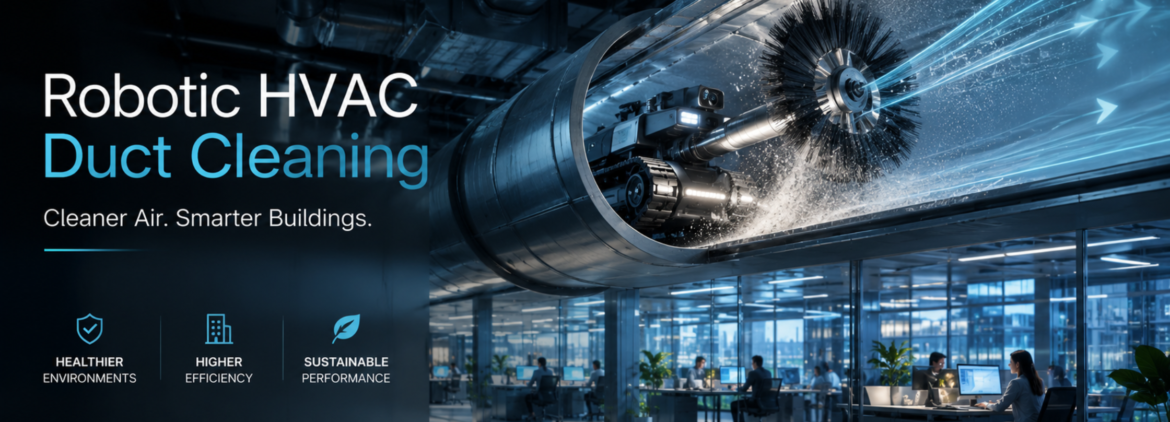
Bengaluru, the Silicon Valley of India, is home to some of the most advanced technological ecosystems in the world. Its tech parks, sprawling complexes housing thousands of professionals, sensitive server infrastructure, and round-the-clock operations, demand nothing less than absolute environmental precision. In 2026, a quiet but profound transformation is underway across these hubs: the widespread shift from conventional manual duct cleaning to robotic HVAC duct cleaning. This is not merely an operational upgrade; it is a strategic response to the unique challenges of indoor air quality, energy efficiency, and business continuity in one of India’s most dynamic urban landscapes.
The Hidden Challenge: Why Bengaluru’s Tech Parks Need a New Approach
Bengaluru’s climate, a blend of moderate temperatures, seasonal dust, and increasing pollution, creates a perfect environment for the accumulation of particulate matter, microbial growth, and debris within heating, ventilation, and air conditioning (HVAC) ductwork. Tech parks, with their large floor plates, 24/7 cooling requirements, and high-density occupancy, are particularly vulnerable. Over time, contaminated ducts lead to reduced airflow, increased energy consumption, uneven cooling, and, most critically, degraded indoor air quality (IAQ). For an industry where employee well-being and hardware reliability are paramount, these are not minor inconveniences.
Traditional manual duct cleaning, while familiar, has proven insufficient. Human access is limited by duct geometry; narrow passages, sharp bends, and vertical risers remain inaccessible, allowing biofilm and dust to persist. Moreover, manual methods often involve disruptive processes cutting access panels, extended downtime, and physical entry into occupied zones which are ill-suited to the sensitive, high-uptime environments of Bengaluru’s tech parks. The result has been a cycle of reactive maintenance, hidden contamination, and rising operational costs.
Robot Duct Cleaning in Bengaluru: Precision Meets Non‑Disruptive Technology
The adoption of robotic HVAC duct cleaning represents a paradigm shift. These specialised systems, compact, remotely operated, and equipped with high-resolution cameras, rotating brushes, and powerful HEPA-filtered vacuums, navigate the entire duct network without requiring human entry or structural modification. For tech parks in Bengaluru, the advantages are transformative.
First, precision and visibility are unmatched. The onboard camera provides real-time video feedback, allowing operators to inspect every millimetre of the duct interior before, during, and after cleaning. This eliminates guesswork and provides verifiable proof of cleanliness—a critical requirement for ISO-certified facilities and green building certifications such as LEED and IGBC.
Second, no disruption to operations. Robotic systems work through existing access points, often during off-peak hours or even while the HVAC system continues to operate at reduced capacity. For a tech park housing development teams, 24/7 data centres, or customer support operations, avoiding downtime is not a luxury, it is a business imperative.
Third, consistent and repeatable results. Unlike manual cleaning, where thoroughness depends on the technician’s skill and fatigue, robotic cleaning follows a programmable, standardised protocol. The brushes and vacuum heads adjust automatically to duct dimensions, ensuring uniform removal of loose debris, dust, mould spores, and even pest residues.
HVAC Duct Cleaning in Bengaluru: Beyond Aesthetics to Energy and Health
For facility managers overseeing large tech campuses, the business case for robotic cleaning rests on three pillars: energy efficiency, equipment longevity, and occupant health.
Energy efficiency is directly linked to duct cleanliness. Studies consistently show that even a thin layer of dust on duct surfaces increases frictional resistance, forcing fans to work harder. In a 500,000 sq. ft tech park, this can translate to a 15‑20% increase in fan energy consumption. Robotic cleaning restores design airflow, reducing the load on air handling units (AHUs) and delivering measurable savings on electricity bills, particularly relevant given Bengaluru’s rising commercial power tariffs.
Equipment longevity follows the same logic. Clean ducts mean less particulate matter reaching coils, filters, and fans. This reduces the frequency of filter changes, prevents coil fouling, and extends the life of expensive HVAC components. For a tech park with multiple chiller plants and AHUs, these savings compound rapidly.
Occupant health has become a non‑negotiable priority in the post‑pandemic workplace. Poor IAQ is linked to Sick Building Syndrome headaches, fatigue, respiratory irritation, which directly impacts productivity and absenteeism. Robotic duct cleaning removes accumulated allergens, fungal spores, and even volatile organic compounds that may have adhered to duct surfaces. For tech parks aiming to attract and retain top talent, a demonstrably clean indoor environment is now a competitive advantage.
The 2026 Guide: What to Look for in Robotic Duct Cleaning Services
As demand grows, not all robotic cleaning services are equal. Tech park facility managers in Bengaluru should evaluate providers on three criteria: robotic fleet capability, documentation standards, and post‑cleaning validation.
Advanced robotic systems should offer multi‑axis articulation to navigate bends, vertical lifts for riser ducts, and variable brush speeds to handle different contamination levels. The provider must furnish pre‑ and post‑cleaning video reports, clearly showing the internal condition before and after the service. Third‑party air quality testing measuring particulate matter (PM2.5 and PM10) and microbial counts, provides additional assurance.
Furthermore, the service should be integrated with the park’s preventative maintenance schedule. Robotic cleaning is not a one‑time fix but a periodic requirement, typically every 12 to 24 months for high‑occupancy commercial buildings, depending on outdoor air quality and filter efficiency.
A Trusted Partner in Bengaluru’s Transformation
Facility leaders seeking to implement robotic HVAC duct cleaning in Bengaluru’s tech parks require a partner with proven technical expertise, a robust robotic fleet, and a deep understanding of the unique constraints of live IT environments. D‑SOL Facilities has emerged as a reliable reference point in this specialised domain. Their approach combines advanced robotic systems with rigorous safety protocols and transparent reporting—qualities that align perfectly with the expectations of Bengaluru’s most demanding tech campuses.
For reservation enquiries and service consultations, the company can be reached via the following channels:
Call for reservation: +91 84483 96120 | +91 8448396121
Email: rohit@dsolfacilities.com | hemraj@dsolfacilities.com
About D‑SOL Facilities – Services and Unique Selling Propositions
D‑SOL Facilities specialises in high‑precision robotic HVAC duct cleaning, comprehensive air hygiene management, and mechanical system maintenance for commercial and industrial clients across India. With a specific focus on Bengaluru’s IT and tech park ecosystem, the company offers a differentiated value proposition: end‑to‑end service from initial inspection using robotic cameras to final certification with video evidence, all executed with zero disruption to client operations. Their USPs include a fleet of indigenously configured robotic systems capable of navigating complex duct geometries, trained technicians certified in industrial hygiene protocols, and a commitment to measurable outcomes, including energy savings and improved indoor air quality indices. By integrating robotic precision with deep domain knowledge, D‑SOL Facilities enables tech parks to achieve compliance, reduce operational costs, and create healthier workplaces without compromising on productivity.