
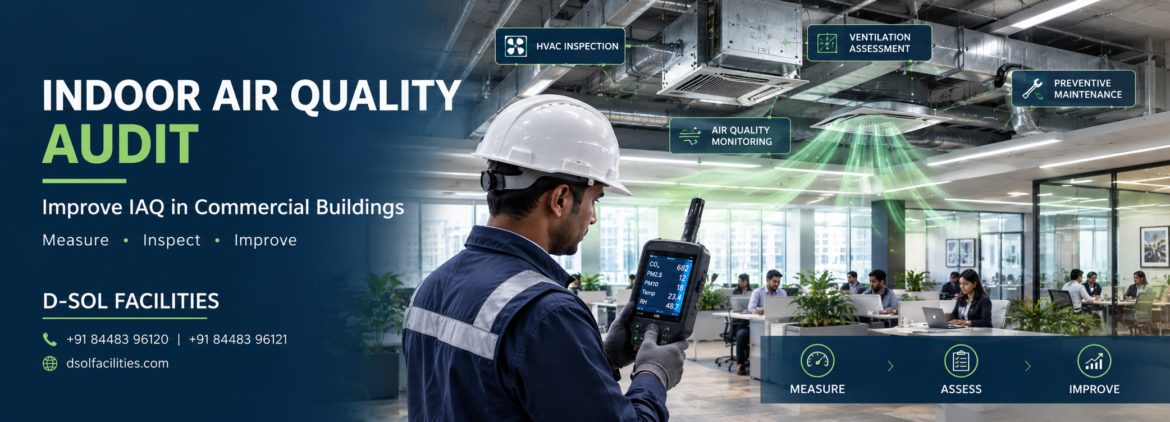
Indoor air quality has become an increasingly important consideration for modern commercial buildings. Offices, hospitals, hotels, schools, malls and industrial facilities depend on effective ventilation and HVAC systems to maintain a healthy and comfortable indoor environment.
Poor indoor air quality can be associated with inadequate ventilation, accumulated dust, HVAC maintenance issues, excessive humidity, airborne pollutants and ineffective air circulation. Because many of these problems are not immediately visible, a professional indoor air quality audit can help facility managers understand the actual condition of the indoor environment.
For businesses, IAQ assessment is not simply about comfort. It can form an important part of HVAC maintenance, workplace management, building hygiene and preventive facility management.
What Is an Indoor Air Quality Audit?
An indoor air quality audit is a systematic assessment of the conditions affecting air quality inside a building.
A professional IAQ assessment may examine factors such as ventilation, temperature, humidity, particulate matter, carbon dioxide levels and other relevant indoor environmental parameters depending on the facility and audit requirements.
The objective is to identify potential air-quality concerns and provide practical recommendations for improving the indoor environment.
Why Is Indoor Air Quality Important in Commercial Buildings?
Commercial buildings can accommodate hundreds or even thousands of people every day. Employees, visitors, customers and occupants may spend several hours indoors, making the quality of the indoor environment an important facility-management consideration.
Supports a Healthier Indoor Environment
Effective ventilation and appropriate HVAC maintenance help manage indoor environmental conditions. An IAQ audit can identify areas where ventilation, filtration or air circulation may need improvement.
Helps Identify Hidden Air Quality Problems
Poor indoor air quality is not always obvious. A building may look clean while its HVAC ducts, filters, air-handling equipment or ventilation systems require attention.
Professional testing provides facility managers with measurable information instead of relying only on visual inspection or occupant complaints.
Supports Employee Comfort
Temperature variations, poor ventilation and excessive humidity can make commercial spaces uncomfortable. An IAQ audit can help identify environmental conditions that may be contributing to these concerns.
Strengthens Preventive Facility Management
IAQ testing can be incorporated into a broader preventive maintenance strategy. Instead of waiting for recurring complaints, facility managers can monitor indoor conditions and take corrective action when required.
What Factors Are Checked During an IAQ Audit?
The exact parameters assessed depend on the building type, HVAC system and purpose of the audit. Depending on the requirement, an indoor air quality assessment may consider:
- Temperature
- Relative humidity
- Carbon dioxide levels
- Particulate matter
- Ventilation performance
- Air circulation
- HVAC filter condition
- Fresh-air supply
- Exhaust performance
- Visible dust accumulation
- Potential sources of indoor pollutants
Additional testing may be recommended when specific concerns are identified.
Common Causes of Poor Indoor Air Quality
Several factors can affect indoor air quality in commercial buildings.
Poor Ventilation
Insufficient fresh-air supply can contribute to elevated indoor carbon dioxide levels and an uncomfortable environment, particularly in densely occupied areas.
Dirty HVAC Filters and Ducts
Filters and duct systems can accumulate dust and other particles over time. Regular HVAC maintenance and professional duct cleaning can help maintain cleaner air distribution pathways.
Inadequate HVAC Maintenance
Poorly maintained air-handling units, cooling systems and ventilation equipment may affect airflow and overall environmental performance.
Excessive Humidity
High humidity can create an uncomfortable indoor environment and may contribute to moisture-related building concerns. Maintaining appropriate environmental conditions is therefore an important part of facility management.
Indoor Pollutant Sources
Cleaning products, construction materials, furnishings, combustion sources and other activities can contribute to indoor pollutants. Identifying potential sources is an important part of improving IAQ.
How Is an Indoor Air Quality Audit Conducted?
A professional IAQ audit generally begins with an assessment of the building, HVAC infrastructure, occupancy patterns and reported concerns.
Technicians may then conduct measurements at selected locations throughout the facility. The results are evaluated against appropriate requirements and operating conditions.
The final assessment can highlight areas requiring attention and provide recommendations such as HVAC servicing, duct cleaning, ventilation improvements, filtration changes, air balancing or further investigation.
Indoor Air Quality and HVAC Duct Cleaning
HVAC ductwork plays an important role in distributing conditioned air throughout a building. If ducts contain significant accumulated dust or debris, cleaning may become an important part of an overall HVAC maintenance strategy.
However, duct cleaning should not be viewed as a universal solution for every IAQ concern. A proper assessment helps determine whether ductwork, filtration, ventilation, humidity or another factor requires attention.
This is why combining indoor air quality audits with HVAC inspection and preventive maintenance can provide a more effective approach.
How Can Commercial Buildings Improve Indoor Air Quality?
Once an IAQ audit identifies potential issues, facility managers can consider several corrective measures.
Maintain HVAC Systems Regularly
Scheduled HVAC maintenance helps keep filters, AHUs, ventilation systems and other components in appropriate operating condition.
Clean HVAC Ducts When Required
Professional HVAC duct cleaning can help address accumulated dust and debris where inspection indicates that cleaning is necessary.
Improve Ventilation and Airflow
Air balancing and ventilation assessment can help determine whether different areas of the building are receiving appropriate airflow.
Monitor Indoor Conditions
Regular monitoring of relevant IAQ parameters can help facility teams identify changes before they become persistent operational concerns.
Address Moisture and Humidity Issues
Sources of excessive moisture should be investigated and corrected as part of building maintenance and indoor environmental management.
Indoor Air Quality Audit for Different Commercial Facilities
Offices
Corporate offices can benefit from IAQ assessments because employees may spend most of their working day indoors. Ventilation, occupancy and HVAC performance can all influence the indoor environment.
Hospitals
Healthcare facilities have specialised ventilation and environmental requirements. IAQ assessment can form part of a broader HVAC and facility-management strategy.
Hotels
Hotels require reliable HVAC and ventilation across guest rooms, kitchens, restaurants, lobbies and other occupied areas. Regular assessment can support consistent indoor conditions.
Schools and Educational Institutions
Classrooms can experience high occupancy for extended periods. Ventilation and indoor environmental conditions therefore deserve regular attention.
Malls and Retail Facilities
Large retail properties contain multiple HVAC zones, high visitor volumes and diverse indoor spaces. IAQ audits can help facility teams evaluate building-wide environmental performance.
Choosing an Indoor Air Quality Audit Company
When selecting an indoor air quality audit company, businesses should consider technical expertise, appropriate measurement equipment, commercial-building experience and the ability to provide practical corrective recommendations.
It is also beneficial to work with a provider capable of handling related HVAC requirements such as duct cleaning, robotic duct cleaning, AHU health audits, air balancing and HVAC AMC services.
This integrated approach allows facility managers to address the broader HVAC system rather than treating individual air-quality symptoms separately.
D-SOL Facilities: Commercial IAQ and HVAC Solutions
D-SOL Facilities provides professional indoor air quality audit and commercial HVAC solutions for businesses and institutions. Its services include IAQ audits, HVAC duct cleaning, robotic HVAC duct cleaning, AHU health audits, air balancing, kitchen exhaust duct cleaning, laundry duct cleaning, HVAC AMC, repair and maintenance, fire safety solutions, civil works, office interiors, design and build, and rainwater harvesting.
With specialised technical teams, advanced inspection and cleaning technology, preventive maintenance expertise and safety-focused execution, D-SOL Facilities helps commercial properties develop cleaner, safer and better-managed indoor environments.
Contact D-SOL Facilities
For professional indoor air quality audits, HVAC maintenance and commercial facility solutions, contact D-SOL Facilities:
Phone: +91 84483 96120 | +91 84483 96121
Website: dsolfacilities.com
A structured IAQ assessment can give facility managers a clearer understanding of indoor environmental conditions and help them take practical steps toward better ventilation, HVAC performance and building maintenance.