
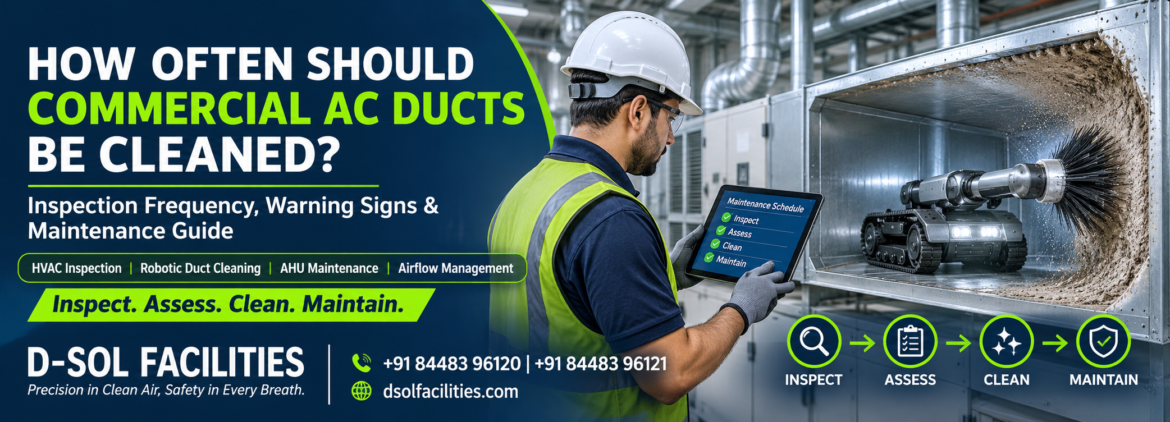
Commercial AC Duct Cleaning: Recommended Frequency, Warning Signs and Maintenance Guide
A commercial air conditioning system operates for long hours to maintain comfortable indoor conditions across offices, shopping centres, hospitals, hotels, factories and other business facilities. While regular servicing of AC units is common, the ductwork that distributes conditioned air throughout a building is often overlooked.
Over time, commercial AC ducts can accumulate dust, construction debris and other airborne particles. Moisture-related problems may also develop in parts of the system if drainage, insulation or humidity control is inadequate. These conditions can affect system cleanliness, airflow and overall HVAC performance.
This raises an important question for facility managers and building owners: how often should commercial AC ducts be cleaned?
The answer depends on the building’s purpose, occupancy, surrounding environment, operating hours and the actual condition of its HVAC system. A planned inspection and maintenance programme helps determine when professional commercial AC duct cleaning is necessary.
How Often Should Commercial AC Ducts Be Cleaned?
There is no single cleaning interval suitable for every commercial property. A building located in a relatively clean environment may accumulate contaminants more slowly than a facility operating in an industrial area or near a busy construction site.
A practical approach is to arrange regular cleanliness inspections and schedule cleaning when the findings indicate significant contamination. Industry guidance from the National Air Duct Cleaners Association (NADCA) recommends routine visual inspections of HVAC components. Its published commercial inspection schedule identifies annual inspections as a minimum recommendation for major commercial and industrial HVAC components.
This does not mean every commercial duct system automatically requires complete cleaning every year. The inspection should establish whether cleaning is necessary and identify the components that need attention.
Recommended Commercial AC Duct Cleaning Inspection Frequency
|
Commercial facility |
Suggested inspection approach |
|
Corporate offices |
Annual cleanliness inspection, with cleaning based on findings |
|
Shopping malls and retail centres |
Annual inspection, with additional checks in high-traffic areas |
|
Hotels and hospitality facilities |
Annual inspection and condition-based cleaning |
|
Hospitals and healthcare facilities |
Planned, risk-based inspections according to hygiene and operational requirements |
|
Factories and industrial units |
Annual inspection or more frequently where dust-generating processes are present |
|
Restaurants and commercial kitchens |
Regular checks of relevant ventilation and exhaust systems, with cleaning frequency based on grease and contaminant accumulation |
|
Warehouses and logistics facilities |
Periodic inspection based on dust levels, ventilation demand and operating conditions |
These are planning guidelines rather than mandatory cleaning intervals. Healthcare, food-processing and specialised industrial facilities may require additional procedures under their applicable operational and hygiene requirements.
Factors That Determine Commercial HVAC Duct Cleaning Frequency
The condition of an HVAC system is influenced by several factors. Understanding them helps businesses develop a maintenance schedule that reflects actual operating conditions.
1. Outdoor Air Pollution and Environmental Dust
Commercial buildings in busy urban and industrial locations may experience higher exposure to airborne dust, vehicle emissions, construction particles and other pollutants. These contaminants can enter HVAC systems through outdoor air intakes, leakage and normal building operations.
Properties near highways, construction zones, manufacturing clusters and dusty environments should pay particular attention to filter performance and duct cleanliness.
2. Building Occupancy and Operating Hours
An office operating eight hours a day may experience different contamination levels from a shopping mall, hotel or industrial facility operating continuously.
Higher occupancy can increase indoor particle loads through movement, clothing fibres and other everyday activities. Buildings with extended HVAC operating hours should maintain a structured inspection programme.
3. Construction and Renovation Activities
Renovation, drilling, ceiling work, interior fit-outs and building repairs can introduce substantial dust into HVAC systems. If air conditioning continues operating during construction, particles may enter return-air pathways and settle inside ducts.
After major construction or renovation, the HVAC system should be inspected before normal operation resumes. Cleaning should be carried out wherever contamination is identified.
4. Moisture, Condensation and Biological Contamination
Poor drainage, condensation, water leakage and damaged insulation can create conditions that support microbial growth. Visible moisture damage, persistent musty odours or suspected microbial contamination require prompt investigation.
Cleaning alone may not resolve the underlying issue. The source of moisture must also be identified and corrected.
Warning Signs That Commercial AC Ducts Need Cleaning
Even when a scheduled inspection is not due, certain signs may indicate that the HVAC system needs professional assessment.
Common warning signs include:
- Visible dust or debris around supply air diffusers and return-air grilles.
- Dust accumulation inside accessible duct sections.
- Unusual or persistent odours coming from the ventilation system.
- Reduced airflow from selected outlets.
- Visible moisture, water damage or suspected microbial growth.
- Construction debris or pest-related contamination inside the ductwork.
- Repeated cleanliness problems despite routine filter replacement.
These symptoms do not automatically confirm that duct cleaning is required. Airflow problems, for example, may also result from blocked filters, damaged dampers, fan issues or incorrect system balancing. A professional inspection helps identify the actual cause.
What Does Professional Commercial AC Duct Cleaning Include?
Effective commercial HVAC duct cleaning involves more than removing visible dust from air vents. The process should address the relevant components of the air distribution system and prevent dislodged contaminants from spreading into occupied spaces.
HVAC System Inspection
The process begins with an assessment of the air handling units, supply and return ducts, access points, grilles and other relevant components. The inspection helps establish contamination levels and define the cleaning requirements.
System Preparation and Containment
The affected HVAC sections are isolated as necessary. Suitable protection and containment measures are implemented to minimise disruption and prevent removed material from entering occupied areas.
Mechanical and Robotic Duct Cleaning
Specialised mechanical equipment, including robotic duct cleaning systems where appropriate, is used to dislodge accumulated dust and debris from internal duct surfaces. The removed material is collected using suitable vacuum equipment.
AHU and Associated Component Cleaning
Depending on the agreed scope, air handling units, coils, fans, drain pans and other accessible components may require cleaning. The condition of filters, insulation and drainage arrangements should also be assessed.
Final Inspection and Verification
After cleaning, the relevant sections are inspected to verify the results. Documentation of the completed work helps facility managers maintain service records and plan future inspections.
How to Maintain Clean Commercial AC Ducts Between Cleaning Cycles
A consistent HVAC maintenance programme can help reduce unnecessary contamination and improve system reliability.
Businesses should replace or clean air filters according to manufacturer recommendations and actual operating conditions. Outdoor air intake areas should remain free from avoidable dust sources and obstructions. Drain pans and condensate lines should be checked regularly to prevent standing water and moisture-related problems.
Facility managers should also maintain records of HVAC inspections, filter changes, repairs, renovation activities and previous cleaning work. These records make it easier to identify recurring problems and adjust maintenance schedules.
Importantly, duct cleaning should form part of a wider indoor air quality strategy. Proper filtration, ventilation, humidity management and pollutant source control are equally important.
Why Planned Commercial AC Duct Cleaning Matters
Waiting until airflow problems, visible contamination or persistent odours become serious can make HVAC maintenance more complicated. A planned inspection programme allows facility managers to identify developing issues, prioritise necessary cleaning and avoid unnecessary expenditure on services that the system may not currently require.
For commercial and industrial buildings, the objective should not simply be to clean ducts at fixed intervals. It should be to maintain a clean, properly functioning air distribution system through informed inspections and appropriate preventive maintenance.
Commercial AC Duct Cleaning Services by D-SOL Facilities
D-SOL Facilities provides professional building and HVAC maintenance solutions for commercial and industrial properties. Its services include robotic HVAC duct cleaning, commercial AC duct cleaning, kitchen exhaust and laundry duct cleaning, AHU health audits, air balancing, indoor air quality assessments and HVAC annual maintenance contracts. The company also supports businesses with fire safety, civil works, rainwater harvesting and integrated facility maintenance services.
With specialised cleaning equipment and a focus on inspection-led maintenance, D-SOL Facilities helps organisations plan HVAC cleaning according to building requirements, system conditions and operational priorities.
Contact D-SOL Facilities
Phone: +91 84483 96120 | +91 84483 96121
Email: tanmay@dsolfacilities.com
Website: https://dsolfacilities.com/
Precision in Clean Air, Safety in Every Breath.