
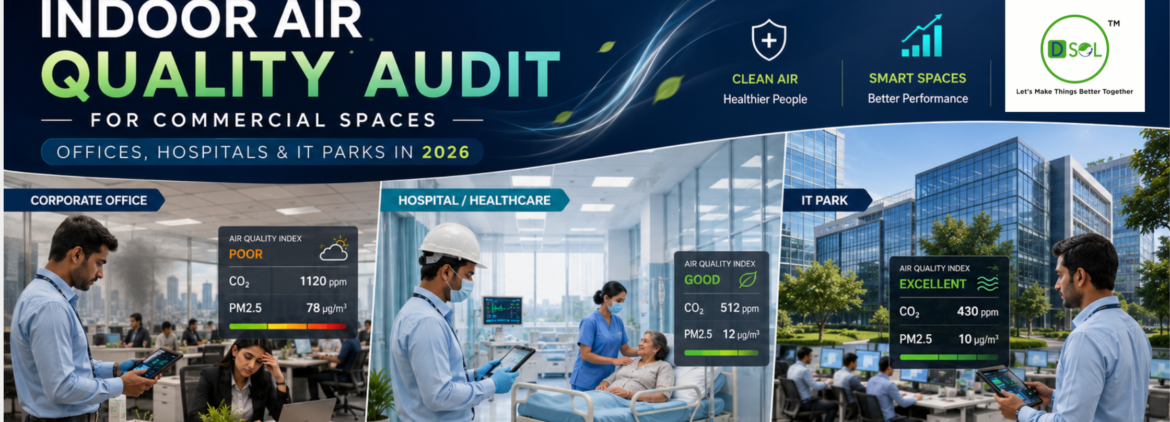
In the modern commercial landscape, the air circulating within a building is as critical to its success as its architectural grandeur or prime location. As of 2026, the concept of a comfortable workplace has fundamentally expanded to include a healthy, respiration-ready indoor environment, one that actively prevents disease, sustains cognitive alertness, and complies with emerging global regulations. For facility managers in offices, hospitals, and technology parks, a thorough indoor air quality (IAQ) audit is no longer a luxury; it is an operational imperative.
Why IAQ for Corporate Offices is a Business Imperative
The shift to hybrid and high-density working models has redefined employee expectations. In 2026, employees are acutely aware of their environmental rights, and studies have conclusively proven that poor ventilation drains productivity. Research indicates that elevating indoor air quality yields roughly 6,500 USD in estimated productivity benefit per person per year, while the cost to implement the necessary improvements is merely 40 USD per person. Suboptimal air quality costs the economy billions annually in lost productivity due to sick leave and reduced cognition.
Specifically, high levels of carbon dioxide (CO₂), often found in closed meeting rooms or poorly ventilated open offices, can reduce cognitive testing scores by up to 50 percent. Conversely, decreasing volatile organic compounds (VOCs) emitted from furniture, cleaning agents, and electronic equipment, has been linked to a notable increase in creative potential. At elevated levels of indoor PM2.5 fine particulate matter, even short-term exposure adversely impacts memory and attention, primarily by compromising autonomic nervous system function and lowering perceived productivity.
Key Parameters of a Commercial IAQ Assessment
A professional commercial building air quality assessment in 2026 goes far beyond temperature checks. It establishes a dynamic profile of the facility’s health.
Baseline audits are crucial for detecting issues like unstable humidity that can precede mold growth, or rising CO₂ levels indicating ventilation inadequacy. Key metrics measured include carbon dioxide (CO₂) for occupancy-level ventilation, temperature and relative humidity for microbial control and static safety, volatile organic compounds (VOCs) from daily office consumables, and Particulate Matter (PM10 & PM2.5).
Many leading IAQ professionals now utilize robotic precision and smart sensors to conduct these audits, deploying cyclical monitoring programs to gather real-time data across workspaces. This allows teams to address problems before occupants notice discomfort.
Indoor Air Quality Testing for Hospitals and Healthcare Facilities
For hospitals, IAQ is directly tied to infection prevention and patient survival. In healthcare facilities, poor ventilation can allow infectious agents to spread through airborne means, worsening patient ailments. A standard measure for these settings is the creation of a baseline IAQ profile under normal operating conditions to track compliance and deviations.
The specific challenges in healthcare require adhering to strict standards. The ANSI/ASHRAE/ASHE 170-2025 standard provides detailed guidelines for environmental control and asepsis, covering everything from outdoor air calculations to specific filtration requirements in operating theatres and isolation rooms. Monitoring in these facilities targets PM levels, with ISO Class 5 standards required for operating rooms, alongside specific microbial sampling for bacteria and fungi.
Monitoring Workplace Air Pollution in India’s IT Parks
As the “Silicon Valley of India,” Bengaluru’s IT parks present unique IAQ challenges. Here, high occupancy densities conflict with limited ventilation rates, while the density of electronic equipment generates heat and pollutants like VOCs. The architectural emphasis on open spaces often creates pockets of stale air, compromising employee health if not balanced by robust system performance.
Data from real-world IAQ assessments in Hyderabad and Bengaluru show that even well-maintained buildings frequently exhibit minor inefficiencies—such as peak-hour CO₂ levels approaching 950 ppm in sealed meeting rooms, or inconsistent ventilation rates across zones. Corrective measures range from adjusting HVAC filtration levels to introducing low-maintenance indoor plants and occupancy-based automated ventilation protocols.
IAQ Solutions for Healthcare Facilities and Beyond
Moving from detection to remediation requires a combination of advanced cleaning, filtration, and continuous monitoring. Adhering to the ASHRAE 62.1-2022 standard for commercial ventilation is the starting point, which includes procedures for air cleaning, filter labeling, and humidity control. In healthcare, upgrading to high-efficiency filters and ensuring proper airflow differentials between pressure zones is non-negotiable to prevent cross-contamination.
For offices and IT parks, solutions include:
- Duct and HVAC Sanitization: Using robotic inspections to eliminate dust and mold reservoirs that recirculate contaminants【64†L9-L15】.
- Smart Air Monitoring: Deploying fixed and portable IAQ monitors that trigger alerts the moment CO₂ or humidity levels breach healthy thresholds.
- Filtration Upgrades: Optimizing filters to trap specific pollutants identified during the initial audit.
The Future of Clean Air
In 2026, an indoor air quality audit is a strategic tool for building trust and resilience. More than 60 percent of occupants now report higher trust in spaces where air quality is actively monitored and communicated. For hospitals, this means safer patient outcomes. For IT parks, it means sharper, healthier talent. For corporate offices, it directly translates to financial returns and employee retention.
The data is conclusive: the air we breathe inside our commercial spaces determines how well we think, heal, and perform. It is time to bring those invisible risks into the light of rigorous science and professional action.
D-SOL Facilities Pvt. Ltd.
D-SOL Facilities Pvt. Ltd. is a premier provider of comprehensive facility management solutions, dedicated to enhancing safety, efficiency, and sustainability across residential, commercial, industrial, and healthcare sectors. With a specialized focus on duct cleaning and sanitization, the company employs cutting-edge technology, including robotic precision cleaning and high-pressure steam systems, to ensure the highest standards of hygiene and fire safety. Their services encompass critical areas such as HVAC Duct Cleaning, Laundry Duct Cleaning, Kitchen Exhaust Cleaning, and Indoor Air Quality (IAQ) Audits & Solutions. Committed to innovation and customer satisfaction, D-SOL provides detailed inspections with before-and-after imagery, ensuring complete transparency. Their unique value proposition lies in delivering a holistic approach to facility care, integrating clean air services, infrastructure maintenance, and sustainable practices like rainwater harvesting under one roof, making them the trusted partner for creating safer, smarter, and more sustainable spaces. For inquiries regarding their specialized IAQ audits and other expert services, Call for reservation: +91 84483 96120 | +91 8448396121, or via email at rohit@dsolfacilities.com or hemraj@dsolfacilities.com.