
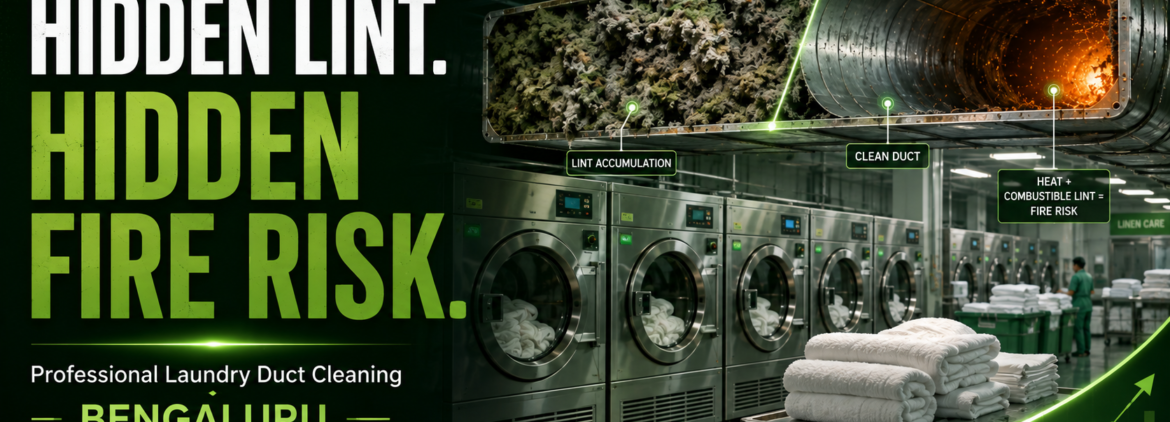
In a hospital, every clean bedsheet, surgical linen, patient gown and towel is part of a larger system of care. In a hotel, freshly processed linen quietly supports the guest experience long before a guest notices the room itself. Behind these essential operations are high-capacity commercial dryers that work continuously, generating heat, moisture and large quantities of lint.
Over time, lint and textile fibres can travel beyond the dryer filters and accumulate inside exhaust ducts, bends, fans and discharge points. When this hidden buildup is ignored, airflow can become restricted and the exhaust system may operate less efficiently. More importantly, accumulated dry lint represents a combustible material that deserves serious attention as part of a facility’s fire-risk management programme. Commercial laundry exhaust systems are specifically recognised as areas where lint accumulation can create airflow and fire-safety concerns.
For hospitals and hotels in Bengaluru, laundry duct cleaning should therefore be viewed as an important preventive maintenance activity rather than an occasional housekeeping task.
Why Laundry Duct Cleaning in Bengaluru Matters for Commercial Facilities
Bengaluru’s hospitals, hotels, serviced apartments, healthcare institutions and large hospitality facilities depend on reliable laundry operations. Many of these facilities process substantial volumes of linen every day, which means their dryers and exhaust systems operate for extended periods.
Every drying cycle can release fibres and lint into the exhaust pathway. While dryer filters capture a significant portion of this material, some particles can continue into the duct system. Over time, deposits may form along internal duct surfaces, particularly around bends, transitions, fans and areas where airflow changes.
A heavily contaminated duct can restrict airflow and reduce dryer performance. Professional laundry exhaust cleaning removes this accumulated material and helps the system maintain a clearer exhaust pathway.
For facility managers, this translates into an important principle: the visible cleanliness of a laundry room does not necessarily indicate the condition of the exhaust ductwork hidden behind walls, ceilings or equipment.
Lint Accumulation in Hospital Laundry Exhaust Systems
Hospital laundries have unique operational requirements. Linen processing may involve bedsheets, towels, uniforms, patient garments and other textiles that must move through washing and drying processes efficiently.
Commercial dryers operating at high capacity can generate considerable lint. If exhaust ductwork is not inspected and maintained, fibres can accumulate inside concealed sections of the system.
A documented safety incident involving a commercial laundry exhaust system found an exhaust outlet approximately 85% blocked by lint, demonstrating how substantial accumulation can become even when a dryer has a lint filter. The incident investigation highlighted the importance of checking ventilation systems and keeping exhaust pathways free from obstruction.
For hospitals, the consequences of poorly maintained laundry exhaust systems can extend beyond equipment performance. Unexpected dryer shutdowns can affect linen availability, create operational delays and place additional pressure on already busy laundry departments.
That makes hospital laundry duct cleaning in Bengaluru an important part of planned facility maintenance.
Hotel Laundry Duct Cleaning for Safer Linen Operations
Hotels operate according to a different rhythm, but the dependence on laundry infrastructure is equally strong.
Large hotels may process substantial quantities of towels, bed linen, uniforms, bathrobes and other textiles every day. Laundry rooms often operate continuously during busy periods, placing significant demands on dryers and exhaust systems.
When lint accumulates inside exhaust ductwork, airflow can gradually become restricted. Poor ventilation may contribute to longer drying cycles, increased heat retention and additional mechanical stress. Regular cleaning helps maintain an unobstructed exhaust pathway and supports more consistent laundry operations.
For hotel management, hotel laundry duct cleaning is therefore not simply about cleanliness. It is about protecting operational continuity, equipment performance and the safety of a critical back-of-house department.
The Hidden Fire Risk of Lint in Laundry Ducts
Lint may look harmless when it is sitting inside a dryer filter, but large accumulations inside an exhaust system should not be ignored.
Dry lint is combustible, and the combination of accumulated fibres, heat and restricted airflow can create an undesirable fire-risk environment. Safety investigations have documented cases where lint accumulation inside dryer exhaust pathways contributed to potentially hazardous conditions.
This does not mean that every lint deposit will result in a fire. Rather, it demonstrates why lint removal from commercial laundry ducts should form part of a proactive safety strategy.
The objective is straightforward: remove combustible accumulation before it becomes a significant operational or safety concern.
How Blocked Laundry Ducts Affect Dryer Performance
A commercial dryer depends on effective airflow to remove hot, moisture-laden air from the drying chamber.
When the exhaust pathway becomes restricted, the dryer may struggle to remove this air efficiently. This can affect drying performance and potentially increase operating time and energy consumption.
A professional inspection can identify issues such as excessive lint accumulation, restricted duct sections, contaminated exhaust fans or obstructed termination points. Specialist laundry exhaust cleaning services commonly inspect the complete system rather than concentrating only on the visible dryer area.
For a large hotel or hospital, even relatively small efficiency problems can become significant when multiple dryers operate for long hours.
What Does Professional Laundry Duct Cleaning Include?
Effective commercial laundry duct cleaning should begin with an assessment of the system rather than immediately starting the cleaning process.
Technicians should understand the duct layout, dryer connections, access points, exhaust fans, vertical or horizontal runs and the level of contamination. This helps determine the appropriate cleaning method and safety requirements.
The cleaning process may involve mechanical brushing, vacuum extraction and specialised tools designed to remove lint and fibre deposits from internal duct surfaces. Connected components such as exhaust fans, grilles and accessible filters may also require attention.
After cleaning, inspection and photographic documentation can provide facility managers with a record of the condition of the system and the work completed.
This approach is particularly useful for hospitals and hotels where maintenance records, contractor documentation and preventive maintenance schedules are important components of facility management.
Signs Your Laundry Exhaust Duct Needs Cleaning
Laundry managers should not wait for a major problem before inspecting the exhaust system.
Warning signs can include longer drying cycles, reduced exhaust airflow, excessive heat in the laundry room, unusual exhaust fan behaviour, visible lint around exhaust outlets, repeated dryer performance issues, increased humidity or persistent odours.
A sudden change in dryer performance should be investigated rather than assuming that the problem is simply related to the machine itself. A restricted exhaust duct can produce symptoms that appear to originate from the dryer.
Routine inspection helps identify these issues earlier and supports more predictable maintenance planning.
Why Preventive Laundry Duct Maintenance Is Better Than Emergency Cleaning
Emergency maintenance usually happens when something has already gone wrong.
For a hospital, an unexpected laundry shutdown can create pressure on linen availability. For a hotel, laundry delays can affect housekeeping schedules, room turnover and guest service.
Preventive maintenance changes this approach. Instead of waiting for significant lint buildup, facilities can establish a planned inspection and cleaning programme based on dryer usage, duct configuration, operating hours and contamination levels.
The appropriate frequency should be determined through inspection and operational conditions rather than applying the same schedule to every facility.
Regular professional inspection and cleaning are widely recommended for commercial laundry exhaust systems because lint accumulation can develop inside concealed ductwork over time.
Choosing a Laundry Duct Cleaning Company in Bengaluru
Selecting a professional service provider is an important part of the maintenance strategy.
Hospitals and hotels should look for a contractor with experience in commercial laundry exhaust cleaning, trained technicians, suitable mechanical cleaning equipment, proper vacuum extraction capability and structured safety procedures.
The contractor should understand that laundry duct cleaning is different from ordinary HVAC duct cleaning. The primary contamination in these systems is typically lint and textile fibre generated by drying operations, requiring an approach specifically suited to exhaust ductwork.
It is also valuable to choose a provider that can document the cleaning process through inspection findings, photographs and service reports.
This documentation can help facility teams maintain maintenance histories and demonstrate that preventive measures are being actively managed.
Laundry Duct Cleaning as Part of a Larger Facility Safety Strategy
A clean laundry exhaust duct should not be considered a replacement for daily operational controls.
Laundry teams should continue to maintain dryer filters according to equipment requirements, inspect accessible areas, keep combustible materials away from heat-producing equipment and report unusual dryer behaviour promptly.
Professional duct cleaning complements these routine practices by addressing contamination that normal daily housekeeping cannot reach.
For hospitals and hotels, the strongest approach combines daily operational housekeeping, equipment maintenance, exhaust inspection and scheduled professional duct cleaning.
Conclusion
Laundry duct cleaning in Bengaluru is an essential consideration for hospitals, hotels and other commercial facilities operating high-capacity laundry systems. Lint accumulation inside exhaust ducts can restrict airflow, affect drying performance and create an avoidable combustible-material concern.
Professional cleaning helps remove hidden lint and fibre deposits from the exhaust pathway, supports efficient airflow and contributes to a proactive fire-risk prevention strategy.
For facility managers, the value extends beyond the duct itself. Reliable laundry ventilation supports equipment performance, operational continuity and the smooth delivery of clean linen to patients, guests and staff.
The most effective strategy is not to wait until airflow is severely restricted or equipment performance deteriorates. Instead, regular inspection and planned professional cleaning can keep the exhaust system in better condition and help facilities manage risk before it becomes an operational disruption.
About D-SOL Facilities
D-SOL Facilities is a professional facility-management and HVAC hygiene company providing specialised cleaning and maintenance solutions for hospitals, hotels, commercial buildings, corporate offices, industries and other large facilities. Its service portfolio includes Laundry Duct Cleaning, HVAC Duct Cleaning, Robotic HVAC Duct Cleaning, Kitchen Exhaust Duct Cleaning, AHU Health Audits, Indoor Air Quality Audits, Air Balancing, AC and Exhaust Duct Cleaning, Fire Safety Solutions and AC AMC Services. The company combines experienced technical teams with specialised cleaning technology and structured maintenance methodologies to address hidden contamination, improve airflow, support safer working environments and reduce operational risks. Its focus on professional execution, detailed inspection, technology-driven cleaning and minimal disruption makes D-SOL Facilities a suitable partner for organisations that require dependable commercial duct-cleaning and facility-management solutions across India.
Contact Us
D-SOL Facilities
Call for Reservation: +91 84483 96120 | +91 84483 96120
Email: rohit@dsolfacilities.com | hemraj@dsolfacilities.com
Website: dsolfacilities.com