
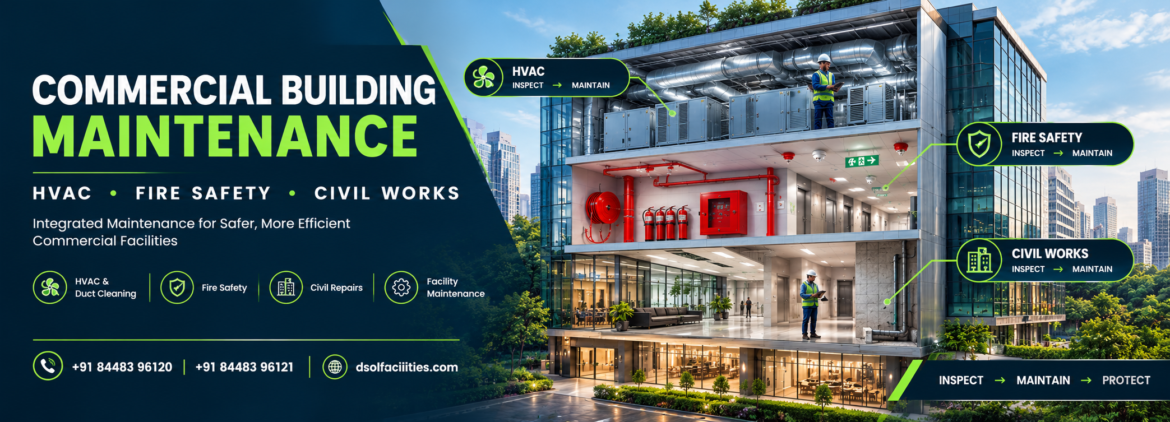
Commercial buildings require continuous maintenance to remain safe, efficient and operational. From HVAC systems and fire safety infrastructure to electrical, plumbing and civil works, every building component plays an important role in maintaining a reliable working environment.
A structured commercial building maintenance program helps facility managers identify issues early, reduce unexpected breakdowns and protect the long-term value of the property. For offices, hospitals, hotels, malls, restaurants and other commercial facilities, preventive maintenance is often more effective than responding to problems only after they occur.
What Is Commercial Building Maintenance?
Commercial building maintenance includes the inspection, servicing, repair and upkeep of building systems, infrastructure and common areas. It covers both technical equipment and physical building components.
A comprehensive maintenance program may include:
- HVAC system maintenance
- HVAC duct cleaning
- AHU inspection and health audits
- Air balancing
- Indoor air quality assessment
- Fire safety inspection and maintenance
- Kitchen exhaust and laundry duct cleaning
- Civil works and repairs
- Plumbing and general facility maintenance
- Waterproofing and building repairs
- Preventive and corrective maintenance
The objective is to keep the building functional, safe and comfortable while reducing avoidable operational disruptions.
Why Is Commercial Building Maintenance Important?
Regular maintenance is not simply a repair activity. It is an important part of facility management and operational planning.
Helps Prevent Unexpected Breakdowns
Regular inspections can identify equipment deterioration, airflow problems, leaks, damaged components and other issues before they develop into major failures.
Supports Building Safety
Fire safety systems, exhaust systems, electrical infrastructure and structural elements require regular inspection. Proper maintenance helps reduce operational risks and supports a safer environment for employees, visitors and occupants.
Improves HVAC Performance
Poorly maintained HVAC systems may experience restricted airflow, reduced cooling performance and unnecessary energy consumption. Regular servicing, duct cleaning, AHU audits and air balancing help maintain system performance.
Protects Property Value
Timely civil repairs, waterproofing, maintenance and infrastructure improvements can help prevent small building defects from becoming expensive restoration projects.
HVAC Maintenance for Commercial Buildings
HVAC maintenance is one of the most important components of commercial facility management. Air-conditioning systems operate for long hours in offices, hospitals, hotels, malls and other commercial properties.
A professional commercial HVAC maintenance program may include equipment inspection, preventive servicing, duct cleaning, filter assessment, AHU health audits and airflow evaluation.
HVAC duct cleaning can also be scheduled when dust accumulation, restricted airflow or indoor air quality concerns indicate the need for cleaning. In larger facilities, robotic HVAC duct cleaning can provide controlled access to difficult duct sections.
Air balancing is another important part of HVAC performance. It helps evaluate whether conditioned air is being distributed appropriately throughout different areas of the building.
Fire Safety Maintenance for Commercial Buildings
Fire safety requires continuous attention rather than occasional inspection. Fire detection systems, extinguishers, emergency systems, evacuation infrastructure and other safety provisions should be maintained according to the building’s requirements and applicable safety practices.
Commercial facilities should also pay attention to ventilation and exhaust systems that may contribute to fire risk when improperly maintained.
For example, commercial kitchen exhaust duct cleaning is particularly important in restaurants, hotels, cloud kitchens and institutional kitchens where grease and residue can accumulate inside exhaust systems.
Laundry facilities should similarly consider laundry duct cleaning to manage lint accumulation and support safer exhaust operation.
Civil Works and Repair Maintenance
Civil maintenance is another essential part of commercial building upkeep. Even when HVAC and safety systems are operating properly, damaged building infrastructure can affect the appearance, functionality and safety of a property.
Commercial civil works may include:
- Waterproofing and leakage repairs
- Flooring and wall repairs
- Ceiling and partition work
- Masonry and plaster repairs
- Drainage-related works
- Structural surface repairs
- Painting and finishing
- General repair and maintenance
- Rainwater harvesting infrastructure
Regular inspections allow facility teams to address deterioration before it affects larger areas of the building.
Preventive Maintenance vs Reactive Maintenance
Reactive maintenance begins after a failure occurs. While emergency repairs are sometimes unavoidable, relying entirely on reactive maintenance can result in higher costs, operational disruption and longer equipment downtime.
Preventive maintenance, on the other hand, involves scheduled inspections and servicing based on equipment requirements, operating conditions and facility needs.
A strong commercial maintenance strategy combines planned preventive maintenance with responsive repair services when unexpected issues arise.
Commercial Building Maintenance for Different Facilities
Different commercial properties have different maintenance requirements.
Offices and Corporate Buildings
Corporate facilities typically require HVAC maintenance, indoor air quality management, fire safety inspections, civil repairs and regular infrastructure upkeep.
Hospitals and Healthcare Facilities
Hospitals require particularly structured maintenance because HVAC performance, ventilation, air quality, fire safety and building services are closely connected with daily operations.
Hotels and Hospitality Facilities
Hotels need continuous maintenance across guest areas, kitchens, laundry facilities, HVAC systems, fire safety infrastructure and common spaces.
Malls, Retail and Commercial Complexes
Large commercial properties require coordinated maintenance for HVAC systems, common areas, fire safety infrastructure, exhaust systems, civil works and other building services.
How to Build an Effective Commercial Building Maintenance Plan
A practical maintenance plan should begin with a complete assessment of the property and its critical systems.
Facility managers should identify:
- Critical HVAC and mechanical equipment
- Fire safety systems and inspection requirements
- HVAC duct and exhaust cleaning requirements
- Civil infrastructure requiring regular inspection
- High-use and high-risk areas
- Preventive maintenance schedules
- Emergency repair procedures
- Documentation and maintenance records
Maintenance schedules should then be prioritised according to equipment condition, operational importance and building usage.
Choosing a Commercial Building Maintenance Company
The right maintenance partner should have experience working with commercial and institutional facilities rather than relying only on general repair services.
When evaluating a commercial building maintenance company, consider its technical expertise, service capabilities, safety practices, inspection methodology and ability to manage multiple facility requirements.
An integrated provider can also simplify coordination by combining HVAC maintenance, duct cleaning, fire safety, civil works and other facility services through one structured approach.
D-SOL Facilities: Integrated Commercial Facility Solutions
D-SOL Facilities provides integrated technical and facility solutions for commercial buildings, offices, hospitals, hotels, restaurants, malls and other professional environments.
Its services include HVAC duct cleaning, robotic HVAC duct cleaning, kitchen exhaust duct cleaning, laundry duct cleaning, AHU health audits, air balancing, indoor air quality audits, HVAC AMC and repair, fire safety solutions, civil works, office interiors, design and build, rainwater harvesting and facility maintenance solutions.
D-SOL combines specialised technical teams, advanced cleaning and inspection technology, preventive maintenance expertise and safety-focused execution to support reliable commercial facility operations.
Contact D-SOL Facilities
For professional commercial building maintenance, HVAC maintenance, fire safety, civil works and integrated facility solutions, contact D-SOL Facilities.
Phone: +91 84483 96120 | +91 84483 96121
Website: dsolfacilities.com
A structured approach to HVAC, fire safety and civil maintenance can help commercial property owners and facility managers maintain safer, more efficient and better-performing buildings while reducing avoidable operational disruptions.