
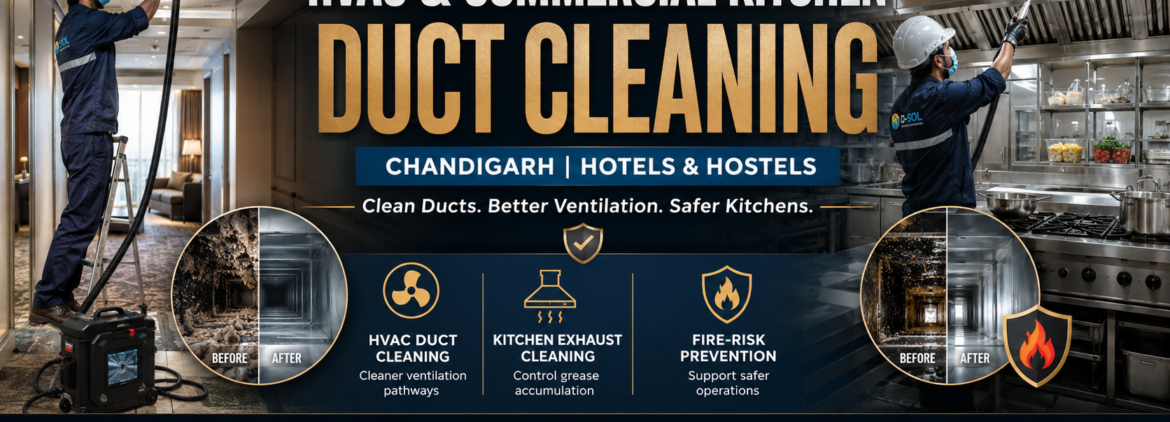
Hotels and hostels in Chandigarh operate in an environment where comfort, hygiene, safety and uninterrupted service are equally important. From guest rooms and reception areas to restaurants, cafeterias, kitchens and common spaces, ventilation systems work continuously to maintain a comfortable indoor environment. Over time, however, HVAC ducts can accumulate dust and airborne contaminants, while commercial kitchen exhaust systems can collect grease, oil and carbon deposits.
This makes HVAC and commercial kitchen duct cleaning in Chandigarh an important part of preventive facility maintenance. For hotels, hostels, restaurants and institutional properties, professional duct cleaning can support better ventilation, operational efficiency and fire-risk management.
Why HVAC Duct Cleaning Is Important for Hotels and Hostels in Chandigarh
Modern hotels and hostels depend heavily on air-conditioning and ventilation systems. HVAC ducts distribute conditioned air throughout rooms, corridors, lounges, restaurants, offices and other occupied areas.
As the system operates, dust and other airborne particles can accumulate within components of the ventilation system. If maintenance is neglected, restricted or contaminated ductwork may affect airflow and overall system performance.
Professional HVAC duct cleaning in Chandigarh can form part of a planned maintenance programme designed to:
- Maintain cleaner ventilation pathways
- Support effective airflow
- Improve indoor environmental quality
- Reduce dust accumulation
- Support HVAC system efficiency
- Identify maintenance concerns before they become major problems
For hospitality properties, this is particularly important because guests expect a clean, comfortable and well-maintained environment throughout their stay.
Commercial Kitchen Duct Cleaning in Chandigarh: A Fire Safety Priority
The kitchen presents a different type of ventilation challenge. Commercial kitchens generate heat, smoke, grease-laden vapours and cooking residues. These materials are captured by hoods and carried through exhaust ductwork.
With repeated cooking, grease can deposit on the internal surfaces of hoods, filters, fans and ducts. If cleaning and maintenance are neglected, these deposits can become a significant fire-risk concern.
The National Building Code’s fire and life-safety provisions specifically address commercial kitchens and identify grease residues in hoods and exhaust ventilation systems as potential fire hazards. The provisions also require cooking equipment, hoods, exhaust ducts, fans and fire-protection systems to be maintained in working condition.
Therefore, commercial kitchen duct cleaning in Chandigarh should be treated as an essential component of hotel and hostel fire-risk management rather than simply a cleaning service.
Why Grease Accumulation in Kitchen Exhaust Ducts Is Dangerous
A commercial kitchen exhaust system is designed to remove smoke, heat and grease-laden vapours from the cooking area. However, not every contaminant is captured by the filtration system.
Some grease particles travel into the ductwork and gradually adhere to its internal surfaces. As deposits become thicker, they can reduce the effectiveness of the exhaust system and create additional combustible material within the ventilation pathway.
A kitchen fire can become particularly serious when flames or high temperatures reach grease deposits inside an exhaust system.
This is why regular kitchen exhaust duct cleaning is an important preventive measure for hotels, hostels, restaurants, food courts and institutional kitchens.
HVAC and Kitchen Duct Cleaning: Two Different Systems, Two Different Risks
It is important for facility managers to understand that HVAC duct cleaning and kitchen exhaust duct cleaning are not interchangeable services.
HVAC systems primarily handle conditioned air and can accumulate dust, particulate matter and other airborne contaminants. Kitchen exhaust systems handle grease-laden cooking vapours and therefore require specialised degreasing and exhaust-system cleaning procedures.
A comprehensive hotel maintenance programme should evaluate both systems independently.
For HVAC systems, attention may include ducts, AHUs, diffusers and related components. For kitchen systems, professional cleaning may involve the hood, filters, exhaust fan, ductwork and accessible exhaust components.
Using the appropriate cleaning methodology for each system helps protect equipment and achieve more effective maintenance results.
Fire Safety Compliance for Hotels and Hostels
Fire safety in a hospitality property extends far beyond fire extinguishers and alarms. Building infrastructure, electrical systems, kitchen equipment, ventilation and exhaust systems all contribute to the overall safety environment.
For commercial kitchens, the National Building Code includes specific provisions concerning kitchen exhaust systems and fire protection. It also provides for periodic cleaning of kitchen exhaust systems to reduce the accumulation of combustible deposits and associated fire risk.
Hotels and hostels should therefore maintain proper records of inspection, cleaning and preventive maintenance. Documentation can help facility managers demonstrate that important safety systems are being actively maintained.
It is important to note that duct cleaning alone does not guarantee statutory compliance. Properties should follow the requirements applicable to their building, local authorities, fire department, equipment manufacturers and other relevant regulations.
How Often Should Hotel Kitchen Ducts Be Cleaned?
There is no single cleaning frequency that is appropriate for every hotel or hostel.
The required frequency can depend on:
- Kitchen operating hours
- Number of cooking cycles
- Type of food preparation
- Volume of grease production
- Number and size of exhaust systems
- Duct length and configuration
- Previous cleaning history
- Inspection findings
High-volume hotel kitchens may require more frequent attention than smaller kitchens.
A useful approach is to combine scheduled professional cleaning with routine inspection. India’s National Council for Hotel Management and Catering Technology has highlighted regular maintenance and cleaning of kitchen exhaust ventilation systems as important for safety and efficiency, including periodic cleaning of grease filters and ducts.
Signs Your Hotel or Hostel Needs Duct Cleaning
Facility managers should watch for operational warning signs instead of waiting until a serious problem develops.
Common indicators can include reduced exhaust performance, excessive grease around kitchen exhaust components, persistent cooking odours, visible deposits, unusually high dust levels around HVAC outlets, inconsistent airflow or repeated HVAC performance complaints.
In a commercial kitchen, visible grease accumulation around the hood or exhaust fan should receive particular attention.
Similarly, if hotel guests or staff repeatedly report dust, odours or poor airflow, the HVAC system should be assessed as part of the investigation.
Professional HVAC Duct Cleaning for Hospitality Properties
Professional HVAC duct cleaning services in Chandigarh should begin with a system assessment rather than immediately cleaning every component.
A structured process may include inspection of accessible duct sections, assessment of contamination, identification of access requirements and selection of appropriate cleaning equipment.
For complex HVAC systems, robotic inspection and cleaning technology can provide access to internal duct sections while allowing technicians to assess conditions that may not be visible from conventional access points.
The objective should be to clean the system effectively while minimising disruption to hotel or hostel operations.
Professional Kitchen Exhaust Duct Cleaning Process
Commercial kitchen exhaust cleaning requires a specialised approach because grease deposits are substantially different from ordinary dust.
A professional service typically begins with an inspection of the exhaust system. The surrounding kitchen area is then protected before cleaning activities begin.
Depending on the system, technicians may clean and degrease accessible sections of the hood, filters, ductwork and exhaust fan using suitable equipment and cleaning methods.
After the cleaning process, a final inspection can help verify the condition of the system. Before-and-after photographs and service documentation can also provide useful records for facility-management teams.
For hospitality properties, scheduling the work during low-occupancy or non-operational hours can help reduce disruption to guests and kitchen operations.
Benefits of Regular Duct Cleaning for Chandigarh Hotels and Hostels
A planned duct-maintenance programme can provide several operational advantages.
Better Ventilation Performance
Clean and properly maintained exhaust pathways can support effective removal of heat, smoke and cooking vapours.
Fire-Risk Reduction
Removing accumulated combustible grease deposits can reduce one source of fire risk within commercial kitchen exhaust systems.
Improved Indoor Environment
Maintaining HVAC systems can help support cleaner and more comfortable indoor spaces for guests, employees and residents.
Equipment Protection
Preventive cleaning can help identify accumulation, restrictions and maintenance issues before they contribute to larger operational problems.
Better Maintenance Documentation
Regular inspections, cleaning reports and photographic records create a useful maintenance history for facility managers.
Why Chandigarh Hospitality Properties Need a Preventive Approach
Chandigarh’s hospitality sector includes hotels, hostels, restaurants, institutional facilities and properties with high-volume kitchens. These buildings often operate for long hours, meaning ventilation and exhaust systems experience continuous demand.
Waiting for an HVAC breakdown or kitchen exhaust problem to become obvious can result in greater operational disruption. A preventive approach allows facility teams to identify potential concerns earlier and schedule maintenance according to actual system requirements.
For hotel owners and facility managers, the objective is simple: maintain ventilation systems before they become a guest-comfort issue, and maintain kitchen exhaust systems before accumulated grease becomes a serious safety concern.
Choosing the Right Duct Cleaning Partner in Chandigarh
The quality of duct cleaning depends significantly on the service provider’s technical capability, equipment, cleaning methodology and understanding of commercial environments.
Hotels and hostels should look for a professional service partner capable of handling both HVAC and commercial kitchen environments, with trained personnel, appropriate equipment, documented processes and the ability to work around operational schedules.
D-SOL Facilities provides specialised duct-cleaning and facility-maintenance solutions for commercial and institutional properties, using technology-driven approaches for HVAC and kitchen exhaust systems. Its experience across hospitality, healthcare, corporate and other large facilities allows cleaning programmes to be planned around operational requirements.
Conclusion
HVAC and commercial kitchen duct cleaning in Chandigarh should be an integral part of preventive maintenance for hotels and hostels. HVAC systems require attention to maintain effective ventilation and indoor environmental quality, while commercial kitchen exhaust systems require specialised cleaning to control grease accumulation and support fire-risk management.
Regular inspection, professional cleaning, proper equipment maintenance and accurate documentation can help hospitality businesses maintain safer, cleaner and more efficient facilities.
For hotel and hostel operators, duct cleaning is not simply about appearance. It is an investment in ventilation performance, operational continuity, guest comfort and responsible fire-safety management.
About D-SOL Facilities
D-SOL Facilities is a specialised facility-services company providing professional HVAC duct cleaning, robotic HVAC duct cleaning, commercial kitchen exhaust duct cleaning, laundry duct cleaning, AHU health audits, indoor air quality audits and related ventilation-maintenance solutions across India. Its USP is its technology-driven approach, specialised technical teams and ability to deliver professional cleaning solutions for demanding environments such as hotels, hospitals, corporate offices, shopping malls, universities, commercial kitchens and industrial facilities. The company focuses on preventive maintenance, detailed inspection, professional cleaning and documented service delivery, helping clients improve ventilation performance while supporting their broader hygiene and fire-risk management programmes.
Contact D-SOL Facilities
Call: +91 84483 96120 | +91 84483 96121
Email: rohit@dsolfacilities.com | hemraj@dsolfacilities.com
Website: dsolfacilities.com