
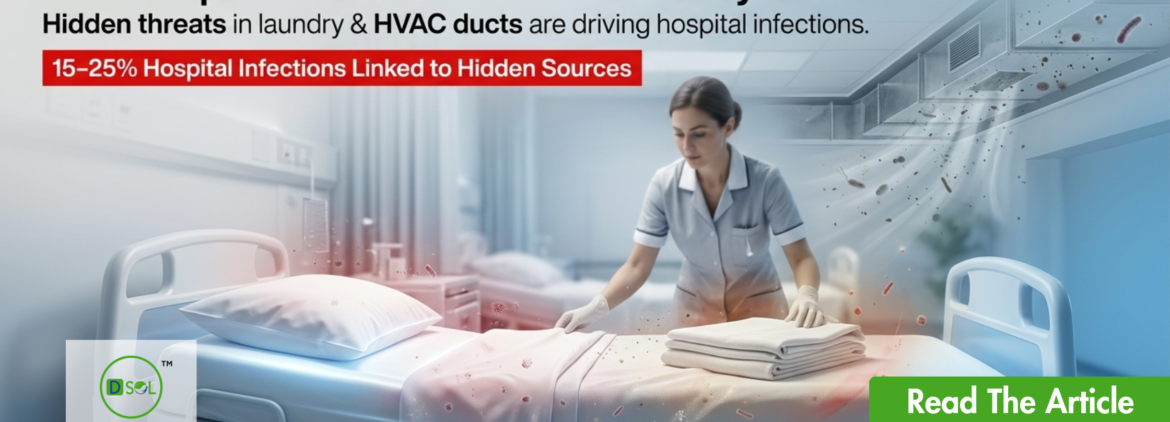
In the sophisticated ecosystem of a modern metropolitan hospital, where advanced surgical suites and cutting-edge diagnostic equipment often take centre stage, the most formidable threats to patient safety are frequently invisible. While considerable resources are devoted to sterilising instruments and disinfecting surfaces, two critical domains remain alarmingly under-prioritised: the hospital laundry and the ventilation ductwork. These systems, if neglected, do not merely represent operational oversights; they become reservoirs of pathogens, silently compromising every infection control measure a hospital implements.
The Silent Epidemic of Healthcare-Associated Infections in Indian Metros
India is confronting a persistent and escalating crisis of healthcare-associated infections (HAIs). Studies indicate that the incidence of HAIs in Indian cardiac care units (CCUs) ranges from 15 to 25 per cent, a figure significantly higher than the global average. The clinical reality is stark: device-associated infections remain the primary contributors, with nearly all patients in intensive care requiring mechanical ventilation, central venous lines, and urinary catheters, each serving as a potential portal for pathogens.
The economic toll of these preventable infections is staggering. A prospective study in a tertiary care hospital in western India found that the direct total costs for patients with hospital-acquired infections were significantly higher 752,859 ± 92,233 INR compared to 290,500 ± 92,233 INR for uninfected patients. Ventilator-associated pneumonia (VAP) was identified as the most common and costly infection, accounting for over 54 per cent of cases. A separate analysis focusing on Pseudomonas aeruginosa infections revealed a per-patient average economic burden of approximately 1,09,158 INR, underscoring the immense financial strain on both families and the healthcare system.
These statistics, however, only tell part of the story. The true origin of many of these infections can be traced back to two critical yet often overlooked vectors: contaminated linens and contaminated air.
The Hidden Threat Within Hospital Laundry
A hospital’s laundry facility handles vast quantities of textiles daily, including bed sheets, patient gowns, surgical drapes, and staff uniforms. While often considered a routine support service, the laundry is a high-risk zone where infection control can either succeed or fail dramatically.
Contaminated healthcare textiles can contain staggering bacterial loads, with studies documenting up to 10⁶ to 10⁸ colony-forming units per 100 cm² of fabric from body substances including blood, urine, and other fluids. This is not merely a theoretical concern. Contamination of linens after laundering has been directly linked to outbreaks of severe infections, including mucormycosis, a devastating fungal disease with high mortality rates that primarily affects immunocompromised patients.
Recognising this grave risk, Indian regulatory authorities have taken decisive action. The Ministry of Health and Family Welfare has introduced the updated standard WS/T 508-2025, (Standard for Washing and Disinfection Technique of Medical Textiles in Healthcare Facilities) , which is set to take effect on February 1, 2026. This comprehensive framework replaces the 2016 version and introduces significantly more rigorous requirements. Key updates include enhanced protocols for the classification, collection, and transportation of soiled linens; stricter specifications for the physical layout and equipment within laundering facilities; the introduction of digital intelligent system requirements for process tracking; and new mandates for wastewater treatment and microbial monitoring. These provisions reflect a fundamental shift in policy, acknowledging that hygienically clean laundry is not a luxury but an absolute prerequisite for patient safety.
The Unseen Pathways of Contaminated Ventilation
If laundry represents a visible, tangible threat, the hospital HVAC system poses an even more insidious danger. Ventilation ducts, concealed behind ceilings and within walls, can become reservoirs for dust, fungal spores, bacteria, and other allergens. As air circulates through these contaminated pathways, it can disseminate pathogens directly into operating theatres, intensive care units, and patient wards.
The risks are profound. As experts have noted, any medical facility can maintain the most sparkling floors and surfaces, but if the ventilation ducts are dirty, infection will inevitably spread. Highly infectious pathogens such as methicillin-resistant Staphylococcus aureus (MRSA) and Clostridium difficile are not only transported through ventilation systems but can also thrive within them, feeding on flakes of dead, dry human skin, a major component of hospital dust. This creates a continuous cycle of recontamination, where even the most diligent surface cleaning is undermined by the very air circulating throughout the facility.
To address this challenge, Indian authorities have also published WS/T 368-2025, (Hospital Air Purification Management Standard) , which outlines new requirements for air cleanliness in healthcare settings. Internationally, standards such as the UK’s TR 19® provide clear, auditable benchmarks for ductwork cleanliness, specifying that supply air ducts must not exceed 60 microns of surface dust, while recirculation and extract ducts should remain below 180 microns. Industry best practices recommend that hospital ducts be cleaned every three to six months, depending on the room type and function, with filters ideally replaced on a semi-annual basis.
A Call for Comprehensive Action
The evidence is unequivocal. The financial and human costs of healthcare-associated infections in India are far too great to be ignored. For hospital administrators and healthcare providers in metropolitan centres, the path forward requires a fundamental re-evaluation of infection control priorities. It is no longer sufficient to focus solely on visible cleanliness. A truly robust infection prevention strategy must extend to the laundry facility and the ventilation system, ensuring that every linen, every sheet, and every breath of air within the hospital environment is free from preventable contamination. The standards have been set; the time for comprehensive action is now.
About D Sol Facilities
D Sol Facilities is a premier provider of specialised environmental hygiene solutions, dedicated to creating safer and healthier indoor environments across India. The company’s core expertise lies in two critical domains that are essential for hospital infection control: professional HVAC duct cleaning and comprehensive IAQ audits. D Sol Facilities employs advanced cleaning methodologies and state-of-the-art equipment to ensure ventilation systems operate at peak cleanliness, significantly reducing the risk of airborne pathogen transmission. Additionally, the company offers detailed IAQ assessments to identify and mitigate hidden contaminants, empowering healthcare facilities to achieve and maintain the highest standards of patient and staff safety. With a commitment to quality, compliance, and measurable results, D Sol Facilities serves as a trusted partner for hospitals and healthcare institutions seeking to fortify their infection control protocols against both visible and invisible threats.
Contact Us
📞 +91 8527548444 | +91 97178 81177 | +91 84483 96120
📧 rohit@dsolfacilities.com | hemraj@dsolfacilities.com