
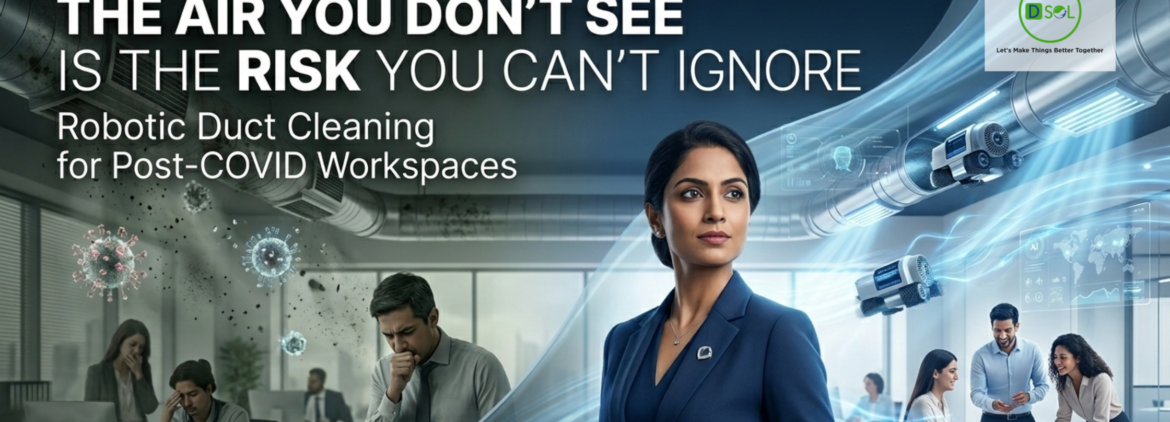
The Unseen Threat in Your Air Ducts
The global pandemic fundamentally altered how the world perceives indoor air. While offices across India have reopened and employee attendance has normalised, a silent legacy of COVID-19 persists within the very walls of commercial workspaces: the unchecked accumulation of bioaerosols within heating, ventilation, and air conditioning (HVAC) systems.
Post-COVID workspaces demand a paradigm shift in facility management. It is no longer sufficient to merely wipe down surfaces or install hand sanitizer stations. The air that employees breathe for eight to ten hours daily must be actively managed to prevent the recirculation of harmful biological contaminants. This is not merely a matter of hygiene; it is a strategic imperative for productivity, legal compliance, and corporate responsibility. This article explores why Indian offices urgently require robotic duct cleaning to combat bioaerosol buildup, the specific risks involved, and the technological solutions available today.
The Invisible Danger: Understanding Bioaerosol Buildup in HVAC Systems
To understand the urgency, one must first appreciate the nature of the threat. Bioaerosols are airborne particles that are either living, such as bacteria, viruses, and fungi—or originate from living organisms. In an office environment, these particles are continuously generated from human occupancy, dust, paper fibers, and external pollution seeping into the building. When these particles are drawn into the return air intakes of an HVAC system, they do not simply disappear. Instead, they settle and proliferate within the labyrinth of ductwork, especially in the presence of moisture, creating a breeding ground for microbial colonies.
The health effects of bioaerosols are severe and multifaceted, ranging from infectious diseases and acute toxic effects to allergies and long-term respiratory conditions. The primary mode of transmission for many respiratory illnesses, including COVID-19, occurs via recirculation-based air conditioning systems. In India, where the excessive use of ductless and centralized AC systems often leads to insufficient air ventilation (typically low 2-3 air changes per hour), the rapid buildup of infectious aerosols is a widespread, under-addressed crisis. This creates a high-risk environment for office workers, leading to increased absenteeism and reduced cognitive function.
Why Your Office’s HVAC System May Be a Health Hazard
The standard office building in India’s metropolitan hubs presents a perfect storm for poor indoor air quality. Studies have shown that indoor air can be two to five times more polluted than outdoor air if not managed correctly. This is exacerbated by modern, energy-efficient architectural designs that utilize airtight envelopes, which trap pollutants indoors. When ventilation systems are poorly operated or maintained, they fail to remove this polluted indoor air, directly contributing to a phenomenon known as Sick Building Syndrome (SBS).
SBS is a condition where occupants of a building experience acute health issues, such as headache (affecting up to 51% of workers in some studies), lethargy (50%), and dryness in mucous membranes (33%) that are linked to time spent in the building, with no specific illness or cause identified. The culprit is often a poorly maintained HVAC system circulating dust, mold, and bacteria. This situation directly impacts the bottom line, contributing to fatigue, decreased productivity, and increased medical insurance expenses.
The Shift from Manual to Robotic: How Technology Ensures Cleaner Air
Traditional manual duct cleaning methods have proven inadequate for the complex duct geometries found in modern commercial buildings. Human access is limited, and conventional brush systems often fail to reach 90% of pipeline blind areas. This leaves vast swaths of the ductwork untouched, allowing bioaerosol colonies to persist and regrow. The industry has reached a technological inflection point: the transition to advanced robotic cleaning solutions.
Robotic duct cleaning technology is revolutionizing HVAC maintenance by offering precision, efficiency, and safety that manual methods cannot match. These sophisticated robots are engineered to access hard-to-reach areas within HVAC systems, ensuring thorough cleaning while minimizing human exposure to hazardous contaminants. They navigate long distances, vertical drops, and complex duct geometries while providing high-quality real-time monitoring via onboard cameras. This technology not only removes existing debris but also provides documented proof of cleanliness through high-quality video or still image reports, establishing a complete “health” (health record) for the air conditioning system.
The Tangible Benefits of Robotic Duct Cleaning for Businesses
Investing in robotic duct cleaning is not an expense; it is a strategic investment with measurable returns. For any business leader, the data is compelling. Robotic systems can achieve a microbial removal rate of up to 99.6%, drastically reducing the biological load in the air. This leads to a direct improvement in Indoor Air Quality (IAQ), which has been linked to higher attendance, improved employee morale, and enhanced cognitive performance across the workforce.
Furthermore, robotic cleaning improves HVAC system efficiency by removing the insulating layer of dust and debris that forces systems to work harder. This can reduce energy consumption and lower utility bills. By preventing the spread of airborne illnesses, companies can also see a reduction in sick days and associated costs, creating a healthier and more resilient work environment.
Post-COVID Regulatory Guidelines for Indian Workplaces
In response to the pandemic, Indian regulatory and scientific bodies have issued clear directives that indirectly mandate rigorous duct maintenance. The Council of Scientific and Industrial Research (CSIR) and NITI Aayog published specific guidelines for the ventilation of residential and office buildings for the SARS-CoV-2 virus, emphasizing the need for increased fresh air and improved system hygiene. The Indian Society of Heating, Refrigerating and Air Conditioning Engineers (ISHRAE) also released COVID-19 guidance, recommending that facilities carry out complete safety audits and cleaning of all equipment, including air handling units and ductwork, before restarting operations. These guidelines have now become the de facto standard for responsible building management in India.
Proactive Prevention: A Roadmap for Facility Managers
To transform an office from a potential health hazard into a wellness-promoting environment, facility managers should adopt a proactive three-pronged strategy:
1. Schedule Professional Robotic Duct Cleaning and Decontamination: HVAC duct systems act as the lungs of a building. It is recommended that professional cleaning with HEPA-filtered vacuums and anti-microbial treatments be conducted at scheduled intervals, particularly in high-occupancy environments.
2. Upgrade to Advanced Air Filtration: Standard filters are no longer sufficient. Buildings should upgrade to high-efficiency filtration systems capable of capturing fine particulate matter and biological contaminants.
3. Implement Routine IAQ Audits: Establish a baseline of your building’s air quality by monitoring key parameters, including particulate matter (PM2.5 and PM10), CO₂ levels, and volatile organic compounds (VOCs). Regular audits and reporting demonstrate compliance and a commitment to occupant well-being.
Conclusion
The era of neglecting the air quality within India’s office buildings must end. The buildup of bioaerosols in HVAC ducts poses a direct, measurable threat to the health and productivity of the workforce. While the pandemic accelerated the adoption of many safety protocols, the invisible threat of contaminated air ducts has largely remained unaddressed. The solution lies in embracing advanced, robotic duct cleaning technology to ensure thorough, verifiable, and lasting cleanliness.
By modernizing facility management practices and prioritizing indoor air quality, Indian businesses can protect their most valuable asset: their people. It is time to clear the air, not just for regulatory compliance, but for a safer, more productive future.
About the Company
D-SOL Facilities is a premier provider of advanced facility management and hygiene solutions, dedicated to transforming Indian workplaces into healthier, more efficient environments. The company specializes in a comprehensive suite of services, including state-of-the-art robotic HVAC duct cleaning, kitchen exhaust cleaning, Air Handling Unit (AHU) maintenance, air balancing, and complete indoor air quality (IAQ) solutions tailored for commercial, healthcare, and industrial spaces across Delhi NCR. With a focus on technical precision and minimal operational disruption, their unique selling proposition (USP) lies in combining cutting-edge robotic technology with trained specialists who follow strict hygiene protocols. This approach delivers measurable cleanliness, improved airflow efficiency, reliable long-term system performance, and verifiable before-and-after reporting, ensuring every client receives a safe, energy-efficient, and professionally maintained environment.
Contact Us
Call for reservation: +91 84483 96120 | +91 8448396121
Email: rohit@dsolfacilities.com | hemraj@dsolfacilities.com