
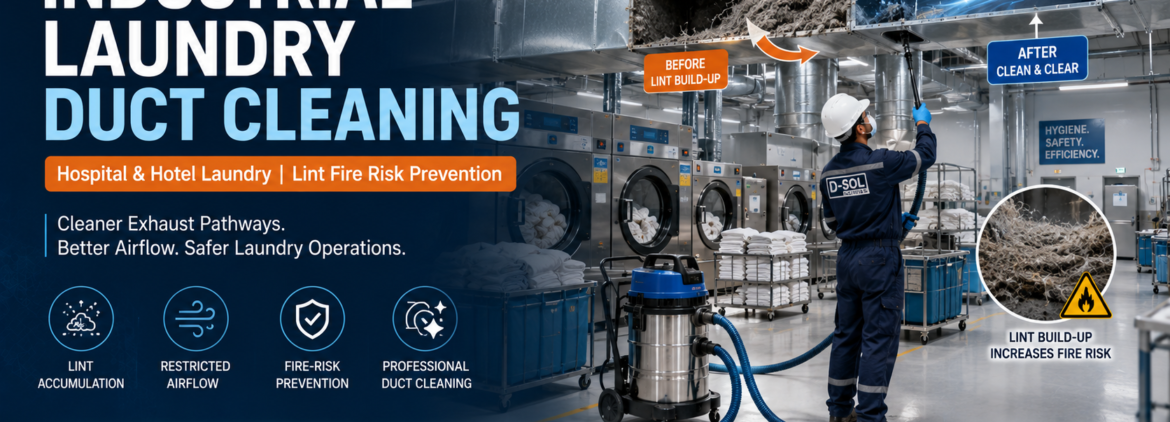
Behind every well-run hospital or hotel laundry operation is a ventilation system working continuously to move hot, humid air away from industrial dryers. These systems are essential for productivity, but they can also become a hidden maintenance and fire-safety concern when lint, textile fibres and dust accumulate inside exhaust ducts.
For facilities operating commercial laundry equipment every day, industrial laundry duct cleaning is not simply a housekeeping activity. It is an important part of preventive maintenance, ventilation performance and fire-risk management.
National Fire Protection Association research on dryer fires has identified failure to clean as a significant contributing factor, with dust, fibre and lint among commonly identified materials first ignited in dryer fires.
For hospitals, hotels, resorts, large institutions and industrial laundries, the lesson is straightforward: a laundry exhaust system should be treated as an operational and safety-critical system rather than an overlooked duct.
Why Commercial Laundry Duct Cleaning Matters
Commercial laundry facilities operate very differently from residential laundry rooms. Large-capacity dryers process substantial volumes of towels, bed linen, uniforms, gowns, sheets and other textiles. Every drying cycle can release lint and fibres into the exhaust pathway.
Over time, accumulated material can restrict airflow and reduce ventilation efficiency. A restricted exhaust system can contribute to longer drying cycles, increased equipment workload and inefficient operation.
Professional commercial laundry duct cleaning focuses on removing accumulated lint and debris from the exhaust pathway so that the system can maintain effective airflow.
The requirement becomes even more important in hospitals and hotels, where laundry operations may continue for long hours and equipment utilisation can be consistently high.
Laundry Lint and Fire Risk: What Facility Managers Should Know
Lint is lightweight, fibrous and combustible. When it accumulates inside an exhaust system, the material can create an unnecessary fire hazard.
NFPA research found that 32% of analysed home dryer fires were attributed to failure to clean, while dust, fibre or lint was identified as the item first ignited in 27% of those fires. Although these figures relate to residential dryer fires rather than industrial laundry facilities, they clearly demonstrate why lint accumulation and dryer exhaust maintenance deserve attention.
Industrial facilities should therefore avoid assuming that a powerful exhaust fan automatically keeps ducts clean. Air movement can transport lint, but it does not guarantee that the entire duct system remains free from accumulation.
Effective laundry fire risk prevention requires a combination of equipment maintenance, appropriate ventilation, housekeeping, inspection and professional duct cleaning.
Hospital Laundry Exhaust Cleaning: A Critical Maintenance Requirement
Hospital laundry departments handle a continuous flow of textiles, including patient bedding, towels, uniforms and healthcare fabrics. Drying equipment can operate under demanding conditions, making reliable exhaust performance essential.
Hospital laundry exhaust cleaning helps address the accumulation of lint and textile debris within dryer exhaust pathways. A professionally maintained system can support consistent airflow and reduce the likelihood of restrictions developing within the ductwork.
Hospital facility managers should consider laundry exhaust maintenance as part of a wider preventive-maintenance programme alongside dryer servicing, lint-filter maintenance, ventilation inspection and fire-safety procedures.
The objective is not simply to clean visible equipment. The entire exhaust pathway should be considered, including accessible duct sections, bends, transitions, discharge points and areas where lint accumulation may be more likely.
Hotel Lint Trap Duct Maintenance for Continuous Laundry Operations
Hotels generate enormous volumes of laundry. Bed linen, towels, uniforms, restaurant textiles and housekeeping materials can place substantial demands on commercial laundry equipment.
For this reason, hotel lint trap duct maintenance should form part of a structured facility-management schedule.
A lint trap may capture a significant portion of fibres, but it should not be considered a substitute for duct inspection and cleaning. Material can still travel beyond the primary filtration point and accumulate inside the exhaust system.
Hotels should establish maintenance procedures based on equipment usage, duct configuration, operating conditions and inspection findings rather than relying exclusively on an arbitrary cleaning interval.
Industrial Dryer Vent Cleaning Improves Airflow and Equipment Performance
Fire prevention is an important reason to maintain laundry exhaust systems, but it is not the only consideration.
Industrial dryer vent cleaning can also support effective exhaust airflow. When ducts become restricted, dryers may need longer operating cycles to achieve the desired drying result. This can affect productivity and operational costs.
A properly maintained exhaust pathway allows hot, moist air to leave the dryer efficiently. Better airflow can support consistent drying performance and reduce unnecessary strain associated with restricted ventilation.
Facility managers should also remember that duct cleaning is only one component of dryer maintenance. Filters, fans, motors, temperature controls and the dryer itself should be inspected and serviced according to manufacturer recommendations and facility procedures.
NFPA safety guidance similarly stresses maintaining dryers properly and ensuring exhaust pathways are not restricted.
Signs Your Laundry Exhaust Duct May Need Cleaning
Facility managers should not wait for a serious operational problem before inspecting laundry exhaust systems.
Several warning signs may indicate that professional cleaning or inspection is required. These can include unusually long drying cycles, reduced exhaust airflow, excessive lint around the laundry area, increased dryer operating temperatures, recurring lint accumulation, unusual odours or visible debris around exhaust outlets.
Repeated performance problems should be investigated rather than treated simply by increasing dryer operating time.
A professional inspection can help determine whether the issue originates from the ductwork, dryer, exhaust fan, filter system or another component.
What Professional Laundry Duct Cleaning Should Include
A professional commercial laundry duct cleaning service should begin with an assessment of the laundry exhaust system rather than immediately starting the cleaning process.
The service may include reviewing the duct configuration, identifying access points, examining visible accumulation, assessing airflow-related concerns and determining appropriate cleaning methods.
Depending on the system design, specialist equipment can then be used to remove lint and debris from the ductwork. The cleaning approach should be selected according to the size, material, configuration and condition of the exhaust system.
Documentation is also valuable for facility managers. A professional service report can record the areas inspected, cleaning performed, observations and recommendations for future maintenance.
Laundry Fire Safety Compliance and Preventive Maintenance
Laundry fire safety compliance should never be viewed as a single checklist item. It is an ongoing process involving equipment condition, housekeeping, ventilation, inspection, staff awareness and maintenance.
Facilities should follow applicable local fire-safety requirements, building regulations, equipment manufacturers’ instructions and relevant standards applicable to their specific installation.
It is also important to distinguish between general fire-risk prevention and formal regulatory compliance. Professional duct cleaning can support a facility’s preventive-maintenance programme, but it should not be presented as a guarantee of compliance with every applicable regulation.
A well-maintained documentation trail can nevertheless make it easier for facility teams to demonstrate that preventive maintenance is being actively managed.
How Often Should Industrial Laundry Ducts Be Cleaned?
There is no universal cleaning interval suitable for every commercial laundry.
The appropriate frequency depends on factors such as laundry volume, number of dryers, operating hours, textile types, duct length, number of bends, exhaust configuration, lint-control systems and previous inspection findings.
A hotel processing hundreds of loads daily may require a very different maintenance schedule from a smaller institutional laundry.
The most effective approach is inspection-led preventive maintenance. Regular visual and operational checks can identify accumulation before it develops into a major restriction or safety concern.
A Proactive Approach to Laundry Fire Risk Prevention
For hospitals and hotels, the cost of preventive maintenance is generally easier to manage than the operational disruption and potential consequences associated with a laundry fire or major equipment failure.
A proactive programme should combine regular lint-filter cleaning, dryer maintenance, exhaust airflow checks, professional duct inspection, scheduled duct cleaning and appropriate record keeping.
This approach transforms laundry duct maintenance from an occasional reactive service into part of the facility’s overall risk-management strategy.
Choosing a Professional Industrial Laundry Duct Cleaning Partner
Industrial laundry systems require more than basic duct vacuuming. The service provider should understand commercial exhaust systems, lint accumulation, access requirements, operational safety and the importance of working around critical hospital or hospitality operations.
For large facilities, the ability to coordinate cleaning around operating schedules is equally important. A professional team should minimise disruption while maintaining appropriate safety procedures throughout the work.
D-SOL Facilities approaches laundry duct cleaning as a specialist facility-maintenance requirement, with services designed for commercial and industrial environments where ventilation performance and fire-risk prevention are important operational priorities.
Conclusion: Clean Laundry Ducts Are Part of a Safer Facility
Laundry exhaust ducts are often hidden from everyday view, but their condition can directly influence airflow, dryer performance, maintenance requirements and fire-risk management.
For hospitals, hotels, resorts, industrial laundries and large institutional facilities, industrial laundry duct cleaning should therefore be included within a structured preventive-maintenance programme.
Regular inspection, appropriate cleaning, proper dryer maintenance and documented safety procedures can help facility managers identify problems before they become costly operational or safety issues.
A clean exhaust pathway is not merely about cleanliness. It is about maintaining a dependable laundry operation and creating a more proactive approach to lint fire risk prevention, commercial laundry duct cleaning and laundry fire safety compliance.
About D-SOL Facilities
D-SOL Facilities is a professional facility-services company providing specialised HVAC and ventilation cleaning solutions across India. Its service portfolio includes commercial laundry duct cleaning, hospital laundry exhaust cleaning, hotel lint trap and exhaust duct maintenance, industrial dryer vent cleaning, HVAC duct cleaning, robotic HVAC duct cleaning, kitchen exhaust duct cleaning, AHU health audits and indoor air quality services. The company’s USP lies in combining specialised cleaning expertise, advanced inspection and cleaning technology, trained technical teams and a preventive-maintenance approach for demanding commercial and institutional environments. D-SOL Facilities works with hospitals, hotels, corporate offices, shopping malls, industrial facilities, commercial kitchens and other large establishments where air quality, ventilation performance and fire-risk management are critical. For professional laundry exhaust and duct cleaning requirements, the team can be contacted for service assessment and site requirements.
Contact D-SOL Facilities
Call: +91 84483 96120 | +91 84483 96121
Email: rohit@dsolfacilities.com | hemraj@dsolfacilities.com