
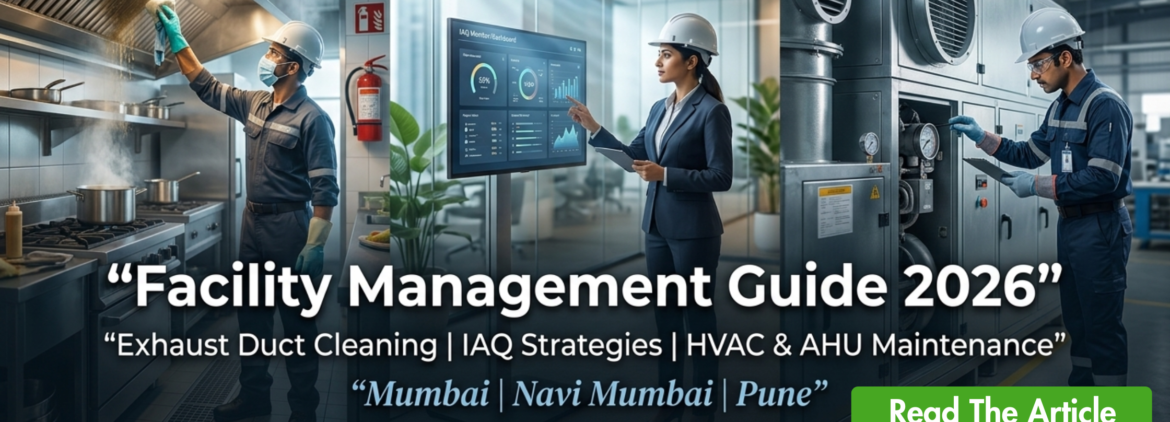
Why 2026 Demands a New Standard in Facility Management
The facility management landscape across Mumbai, Navi Mumbai, and Pune has undergone a profound transformation. No longer viewed as a back-office support function, facility management now stands at the intersection of regulatory compliance, occupant health, operational efficiency, and fire safety. For hoteliers, corporate real estate directors, and industrial plant managers operating in these three metropolitan hubs, the year 2026 presents both unprecedented challenges and strategic opportunities.
Mumbai’s coastal humidity accelerates microbial growth in HVAC systems. Navi Mumbai’s rapidly expanding corporate corridors demand world-class indoor air quality. Pune’s industrial heartland requires rigorous maintenance of air handling infrastructure to meet statutory obligations. This comprehensive guide synthesises the latest regulatory standards, engineering best practices, and technology-driven strategies to help facility managers across the Mumbai Metropolitan Region and Pune maintain compliant, efficient, and safe environments.
Part One: Hotel Kitchens – Exhaust Duct Cleaning Frequency & Fire Safety Compliance
The Critical Importance of Grease-Free Exhaust Systems
In the high-stakes environment of a commercial hotel kitchen, grease accumulation within exhaust ducts represents one of the most underappreciated yet catastrophic hazards. Grease-laden vapours generated during cooking operations condense on the interior surfaces of hoods, ducts, and exhaust fans, forming a highly combustible layer. Left unaddressed, this buildup transforms a kitchen exhaust system into a potential ignition source capable of spreading fire rapidly throughout a building’s vertical shaft.
The National Fire Protection Association (NFPA) Standard 96 universally recognised as the authoritative code for ventilation control and fire protection of commercial cooking operations mandates that hoods, ducts, and fans must be cleaned to bare metal at frequent intervals to prevent dangerous grease accumulation. The code further stipulates that when routine inspections reveal contamination from grease-laden vapours, the entire exhaust system must undergo professional cleaning by properly trained and certified personnel.
NFPA 96 Cleaning Frequency Guidelines for Hotel Kitchens
The required cleaning frequency under NFPA 96 is not arbitrary; it is determined by the volume and type of cooking operations. For high-volume hotel kitchens operating 24 hours or those using charbroilers, deep fryers, and solid fuel cooking equipment, cleaning is typically required weekly to every 30 days. Kitchens with standard daily service operating typical hotel restaurant equipment can maintain hood cleanliness on a 30 to 90-day cycle, provided regular inspections confirm safety and cleanliness.
For exhaust systems serving solid fuel cooking operations such as tandoor ovens or wood-fired grills monthly cleaning is mandated by the code. The complete exhaust system degreasing must extend from the hood canopy, through the ductwork, to the exhaust fan housing and blades, leaving no component untreated.
Documentation & Inspection Protocols
Insurance providers and fire inspectors increasingly require documented proof of cleaning in accordance with NFPA 96 regulations. Facility managers in Mumbai, Navi Mumbai, and Pune should maintain comprehensive logs of all exhaust system cleanings, including service dates, components addressed, and the current system condition. These records should be stored either digitally or near the system’s electrical panel to ensure immediate availability during inspections.
Local Regulatory Considerations in Maharashtra
Beyond NFPA compliance, hotel kitchens across Maharashtra must adhere to guidelines issued by the Central Pollution Control Board (CPCB), which has released fresh standards for pollution control at hotels, banquet halls, restaurants, and motels. The Pune Municipal Corporation has further mandated that food business operators transition from conventional fuel sources to cleaner alternatives such as LPG and electricity, alongside implementing preventive measures to curtail air pollution. Facility managers in Mumbai and Navi Mumbai should similarly anticipate increased scrutiny from the Brihanmumbai Municipal Corporation (BMC) regarding kitchen exhaust emissions and grease management.
Part Two: Corporate Towers – Indoor Air Quality Strategies for 2026
The Evolving IAQ Landscape in Indian Commercial Real Estate
Indoor Air Quality (IAQ) has emerged as a defining factor in how corporate towers across Mumbai, Navi Mumbai, and Pune are designed, operated, and valued. As we progress through 2026, air quality inside buildings is no longer viewed as a comfort feature, it is a health, compliance, and productivity requirement. With India’s rapid urbanisation leading to denser cities and sealed buildings, indoor air can be two to five times more polluted than outdoor air if not managed correctly.
For corporate occupiers, the stakes are substantial. Poor IAQ is increasingly linked to headaches, fatigue, allergies, asthma, and long-term respiratory conditions, directly impacting employee productivity, attendance, and cognitive performance. Consequently, building owners and facility managers must treat air quality as a core operational responsibility rather than an ancillary concern.
Key IAQ Parameters & Regulatory Benchmarks
While India does not yet possess a single consolidated IAQ law, 2026 marks a decisive shift toward stricter enforcement of guidelines and building-level accountability. The key parameters now monitored in corporate environments include:
- Particulate Matter (PM2.5 and PM10): Fine particles capable of penetrating deep into lung tissue
- Carbon Dioxide (CO₂) Levels: Indicators of ventilation adequacy and occupant density
- Volatile Organic Compounds (VOCs): Off-gassed from furnishings, cleaning products, and building materials
- Relative Humidity and Temperature Control: Critical for occupant comfort and microbial prevention
- Microbial Contamination within HVAC Systems: A hidden source of airborne pathogens
The Indian Society of Heating, Refrigerating and Air Conditioning Engineers (ISHRAE) IAQ Guidelines, along with ASHRAE Standard 62.1 for ventilation and ASHRAE Standard 55 for thermal comfort, have become the de facto benchmarks for institutional and commercial buildings across India.
WELL Certification & Wellness-Led Workspaces
The WELL Building Standard has gained significant traction among premium corporate towers in Mumbai’s Bandra Kurla Complex, Navi Mumbai’s business districts, and Pune’s IT parks. The Air concept within WELL which contains more preconditions than any other building concept requires ventilation rate monitoring and indoor air quality tracking, reflecting the fundamental importance of air quality to occupant health. Buildings that achieve WELL certification demonstrate measurable compliance across air quality, water, lighting, thermal comfort, acoustics, and overall wellness parameters.
Technology-Enabled IAQ Management: Smart Sensors & AI
The integration of smart sensors and AI-powered IAQ monitoring systems has become a defining trend in 2026. Modern IAQ monitors offer real-time information about pollutants including PM2.5, PM10, VOCs, carbon dioxide, humidity, and temperature. These sensors continuously feed data to building management systems, enabling demand-controlled ventilation where fresh air intake modulates based on real-time occupancy and pollutant levels.
AI-driven predictive maintenance algorithms can identify early signs of coil fouling, filter choking, valve leakage, and pump inefficiency, reducing downtime and lifecycle costs. For corporate towers across Mumbai, Navi Mumbai, and Pune, adopting these technologies is no longer a competitive advantage, it is rapidly becoming a baseline expectation for tenant retention and regulatory readiness.
HVAC Duct Cleaning & Filtration Upgrades
Professional HVAC duct cleaning and decontamination are essential for IAQ compliance. Over time, dust, mold spores, bacteria, and allergens accumulate inside ductwork, continuously circulating contaminated air throughout a building. Buildings across the MMR and Pune are now expected to implement scheduled professional duct cleaning, particularly in commercial and institutional facilities.
Furthermore, standard filters are no longer sufficient for modern IAQ expectations. Buildings must upgrade to high-efficiency filtration systems including MERV-rated filters and HEPA filtration where appropriate capable of capturing fine particulate matter and biological contaminants. These upgrades directly contribute to healthier indoor environments and reduced HVAC strain, leading to lower energy consumption over time.
Part Three: Industrial Units – HVAC & AHU Maintenance Schedules
Statutory Framework Under the Factories Act, 1948
Industrial facility managers in Mumbai, Navi Mumbai, and Pune must navigate a complex regulatory environment governing workplace air quality and ventilation. Section 11 of the Factories Act, 1948 provides for the general cleanliness of factory premises, mandating that dust, fumes, and refuse be removed daily. Section 13 further empowers state governments to prescribe standards of adequate ventilation and reasonable temperature for factories, requiring proper measuring instruments to be provided and records to be maintained.
These statutory provisions impose a clear duty on industrial occupiers to maintain HVAC and air handling systems in a condition that ensures worker health and safety. Non-compliance can result in regulatory action, legal liability, and increased occupational health claims.
AHU Maintenance Frequency: A Practical Schedule
Air Handling Units (AHUs) form the core of industrial HVAC systems, and their maintenance directly impacts air quality, energy efficiency, and equipment longevity. Based on industry best practices and standard operating procedures for manufacturing environments, the following maintenance schedule is recommended:
- Daily: Visual inspection of filters, removal of surface dust, monitoring of temperature and humidity levels, and verification of differential pressure readings
- Weekly: Inspection and cleaning of pre-filters, checking for abnormal noise or vibrations in AHUs, and inspecting coils for dirt buildup
- Monthly: Comprehensive cleaning of all AHU components, replacement of worn-out pre-filters, and inspection of ductwork for leaks
- Quarterly: Replacement of carbon filters, inspection of HEPA filter integrity, calibration of temperature and humidity sensors, and checking belt tension and bearing lubrication
- Annually: Deep cleaning of the entire HVAC system, complete system validation, HEPA filter integrity testing, and thorough inspection of unit casing for corrosion
Cooling Coil & Condensate Drain Maintenance
Dirty cooling coils significantly reduce heat transfer efficiency, causing higher chiller loads and energy wastage. Facility managers should employ approved coil cleaners or low-pressure water jets for periodic coil cleaning, ensuring that the middle sections of coils receive adequate attention to prevent blockage. Condensate drain pans must be regularly inspected and cleaned to prevent microbial growth, bad odours, and water overflow issues. Stagnant water within drain pans serves as a breeding ground for Legionella and other pathogenic microorganisms, posing serious health risks to industrial workers.
NFPA 90B Considerations for Industrial HVAC
While NFPA 90B specifically addresses warm air heating and air conditioning systems, its provisions for construction, installation, operation, and maintenance of HVAC equipment, including filters, ducts, and related components, offer valuable guidance for industrial facility managers. The standard emphasises the protection of life and property from fire, smoke, and gases, which is particularly relevant for industrial units handling flammable materials or operating in high-heat environments.
Compliance Documentation & Record-Keeping
Regulatory authorities increasingly expect industrial facilities to demonstrate compliance through comprehensive documentation. Recommended records include:
- AHU cleaning logs detailing components cleaned, dates, and personnel
- Filter replacement reports with dates and filter specifications
- Calibration logs for temperature, humidity, and pressure sensors
- HEPA filter validation logs with integrity test results
- HVAC incident logs for unexpected failures with root cause analysis
These documents serve as evidence of due diligence during factory inspections and can significantly mitigate liability in the event of an occupational health complaint or regulatory audit.
About D-SOL Facilities
D-SOL Facilities is a distinguished provider of integrated facility management services, specialising in exhaust duct cleaning for hotel kitchens, indoor air quality management for corporate towers, and comprehensive HVAC and AHU maintenance for industrial units across Mumbai, Navi Mumbai, and Pune. The company combines deep technical expertise with a commitment to regulatory compliance, operational excellence, and client-centric service delivery. D-SOL Facilities’ unique selling proposition lies in its ability to deliver end-to-end solutions tailored to each facility’s specific operational profile, from grease extraction system degreasing aligned with NFPA 96 standards to AI-enabled IAQ monitoring and predictive maintenance for industrial HVAC infrastructure. With a proven track record of serving hospitality, commercial real estate, and manufacturing clients, D-SOL Facilities ensures that every property under its care operates at peak efficiency, safety, and compliance.
Contact Information:
Call for reservation: +91 84483 96120 | +91 8448396121
📧 Email: rohit@dsolfacilities.com | hemraj@dsolfacilities.com
🌐 Website: www.dsolfacilities.com