
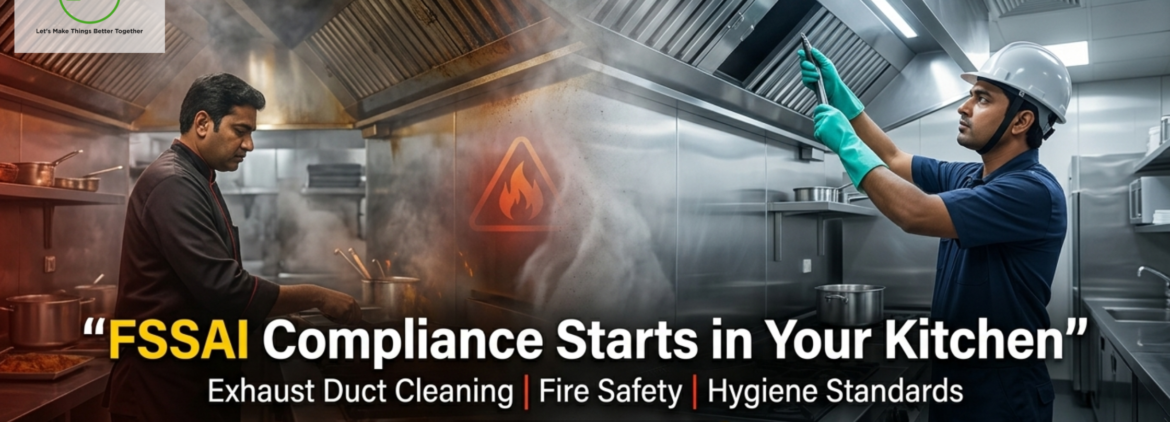
For restaurant owners and food business operators across Delhi NCR, navigating the regulatory landscape of the Food Safety and Standards Authority of India (FSSAI) is not merely a bureaucratic obligation but a strategic imperative. The hospitality industry in the National Capital Region is witnessing unprecedented growth, yet many establishments remain unaware of a critical compliance requirement that lies hidden above their stoves and within their ventilation systems. This comprehensive analysis examines why kitchen exhaust duct cleaning has emerged as a non-negotiable pillar of FSSAI compliance, fire safety, and operational excellence in the modern commercial kitchen.
Understanding FSSAI Compliance Framework for Delhi NCR Restaurants
The FSSAI, operating under the Food Safety and Standards Act of 2006, mandates that every food business operator in India obtain the appropriate license before commencing commercial operations. For restaurants in Delhi NCR, this licensing framework is tiered according to annual turnover and operational scale. Establishments with a turnover of up to ₹12 lakh require basic registration, those between ₹12 lakh and ₹20 crore need a State License, and operations exceeding ₹20 crore must obtain a Central License.
Beyond the initial licensing, FSSAI compliance demands ongoing adherence to rigorous hygiene and sanitary standards as outlined in Schedule 4 of the FSSAI Regulations, 2011. These regulations cover every facet of food safety infrastructure, including structural integrity, waste management, pest control, and ventilation systems.
The FSSAI Schedule 4 Mandate for Kitchen Ventilation
Schedule 4 of the FSSAI Regulations explicitly addresses ventilation requirements within food preparation areas. According to these provisions, all food premises must be equipped with adequate natural or mechanical ventilation systems that effectively remove steam, smoke, odors, and airborne contaminants generated during cooking operations. The regulations specify that ventilation systems must be designed and constructed to prevent air from flowing from contaminated areas to clean areas, thereby safeguarding food from cross-contamination.
The FSSAI hygiene rating checklist further reinforces this mandate, requiring that adequate ventilation be provided within the premises and that the entire ventilation system be maintained in a condition that minimizes condensation and prevents the accumulation of dirt and grease.
Why Kitchen Exhaust Duct Cleaning Is Essential for FSSAI Compliance
The kitchen exhaust system is the most critical yet most neglected component of a commercial kitchen’s ventilation infrastructure. It comprises the hood canopy positioned above cooking equipment, grease filters designed to capture oily vapors, ductwork channeling exhaust air to the exterior, and fan or blower assemblies propelling air through the system. As hot cooking gases pass through this assembly, grease particles condense and adhere to interior surfaces, gradually forming thick, tenacious deposits.
The FSSAI compliance inspection now routinely assesses ventilation hygiene, including exhaust system maintenance logs and third-party cleaning certifications. Failure to produce verifiable duct cleaning records during inspections can result in license suspensions, penalty levies, and mandatory shutdowns until remediation is certified.
The Fire Safety Dimension of Duct Cleaning Compliance
Beyond FSSAI regulations, kitchen exhaust duct cleaning carries profound implications for fire safety. Studies and fire incident reports consistently reveal that up to seventy percent of restaurant fires originate within the kitchen exhaust system. Grease accumulation transforms the ductwork into a highly combustible fuel pathway. A single spark from overheated equipment, an electrical fault, or even static electricity can ignite these deposits, triggering flames that propagate rapidly through the enclosed duct space and escalate into major blazes.
Once ignited, grease fires reach temperatures exceeding one thousand degrees Celsius within confined ductwork, compromising structural integrity and spreading to adjacent areas within minutes. The financial cost extends beyond property damage to encompass business interruption, reputation erosion, insurance premium escalation, and legal liability for maintenance negligence.
FSSAI Inspection Checklist: What Auditors Examine
FSSAI auditors employ a comprehensive checklist that includes specific evaluation criteria for kitchen infrastructure and ventilation systems. Key assessment points include whether the design of food premises provides adequate working space and permits maintenance and cleaning to prevent entry of dirt and dust, whether walls, ceilings, and doors are free from condensation and shedding particles, whether floors are non-absorbent and appropriately sloped, and most critically, whether adequate ventilation is provided within the premises.
Additionally, auditors verify that lighting fixtures are protected to prevent contamination upon breakage, that personnel hygiene facilities are adequate, and that overall cleaning and sanitation protocols are documented and consistently followed. Any deficiency in these areas can result in non-compliance findings, penalty imposition, and mandatory corrective action.
Proactive Duct Maintenance as a Compliance Strategy
Establishing a systematic approach to kitchen exhaust duct cleaning is the most effective strategy for maintaining continuous FSSAI compliance. Restaurant operators should engage qualified, professional cleaning services that employ specialized equipment including high-pressure washing systems, rotary brush assemblies, and video inspection cameras to verify cleanliness. Documentation of each cleaning session, including photographic evidence of pre-cleaning and post-cleaning conditions, certificates from accredited service providers, and integration of ventilation hygiene into the overall food safety management system, should be meticulously maintained for audit presentation.
The Business Case for Compliance
Investment in regular kitchen exhaust duct cleaning delivers multiple returns beyond regulatory compliance. It enhances kitchen efficiency by maintaining optimal airflow, reduces energy consumption by lowering fan strain, extends equipment lifespan by preventing grease-induced corrosion, and most importantly, protects patrons, staff, and property from fire hazards. In an increasingly quality-conscious market where consumers demand transparency and safety, demonstrable FSSAI compliance serves as a powerful competitive differentiator.
Conclusion: A Non-Negotiable Operational Priority
For restaurant owners in Delhi NCR, understanding that FSSAI compliance extends beyond visible surfaces to include hidden infrastructure such as kitchen exhaust ducts is essential for legal operation and business continuity. The convergence of regulatory requirements, fire safety imperatives, and operational efficiency makes professional kitchen exhaust duct cleaning not an optional expense but a fundamental investment in business sustainability.
Delhi NCR (Kitchen Exhaust)
D-SOL Facilities offers comprehensive kitchen exhaust duct cleaning services designed to ensure full FSSAI compliance and fire safety for restaurants, hotels, cloud kitchens, and institutional catering operations across Delhi NCR. The company provides professional cleaning solutions utilizing advanced equipment and techniques to remove hazardous grease accumulation from hoods, filters, ductwork, and exhaust fans. Their services include pre-cleaning and post-cleaning photographic documentation, certified compliance reports, and systematic maintenance schedules aligned with FSSAI inspection requirements. The unique selling proposition lies in their specialized approach to commercial kitchen ventilation hygiene, combining technical expertise with regulatory knowledge to deliver verifiable, audit-ready results. Clients benefit from reduced fire risk, enhanced operational efficiency, and complete peace of mind regarding regulatory compliance.
Contact Us
Call for reservation: +91 84483 96120 | +91 8448396121 |
Email: rohit@dsolfacilities.com | hemraj@dsolfacilities.com