
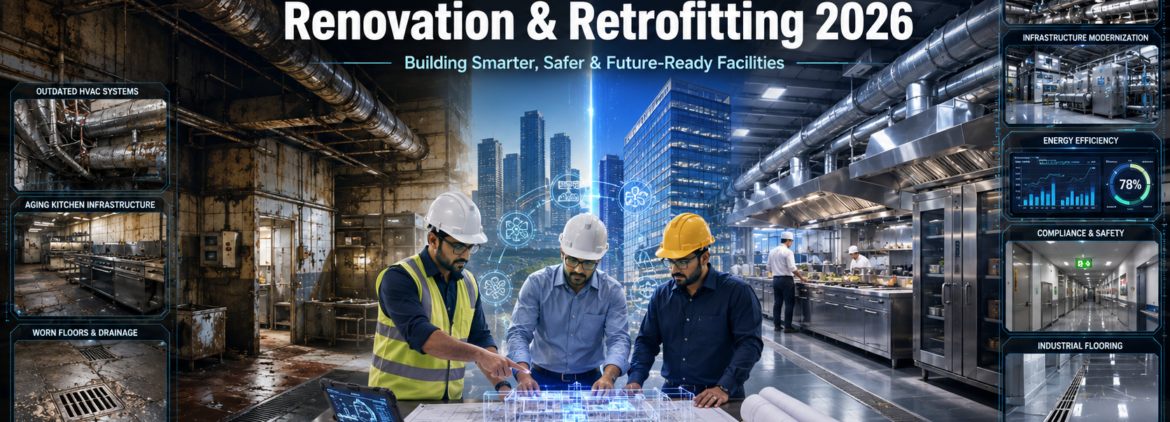
Strategic Imperative for 2026: The Evolution of Commercial Civil Works
The dawn of 2026 marks a pivotal juncture for the hospitality and healthcare sectors across India. As commercial kitchens grapple with heightened safety standards and corporate infrastructures confront the dual challenge of operational continuity and modernisation, the demand for specialised civil works has never been more acute. Renovation and retrofitting, once regarded as periodic maintenance tasks, have now ascended to strategic imperatives. Organisations are no longer merely repairing infrastructure; they are reimagining it. This transformation is particularly evident in two critical domains: commercial kitchen environments and HVAC (Heating, Ventilation, and Air Conditioning) infrastructure, where precision engineering meets regulatory compliance.
Commercial Kitchen Civil Works: Laying the Foundation for Excellence
The heart of any hospitality establishment is its kitchen, but the soul resides in the unseen infrastructure beneath the gleaming equipment. Commercial kitchen civil works encompass a vast spectrum of interventions, from designing robust floor slabs capable of withstanding heavy thermal shocks to installing intricate grease traps and specialised drainage systems. In 2026, the emphasis has shifted decisively toward food safety compliance and operational ergonomics. A poorly conceived civil foundation can compromise hygiene protocols, create hazardous working conditions, and invite regulatory scrutiny. Conversely, a well-executed renovation ensures seamless workflow, reduces cross-contamination risks, and extends the lifecycle of expensive cooking equipment. The challenge lies in executing these upgrades without triggering prolonged shutdowns, a demand that has given rise to sophisticated phasing and modular construction techniques.
Industrial Kitchen Flooring and Drainage Systems
Perhaps no single element determines a commercial kitchen’s longevity and hygiene quotient more than its flooring and drainage infrastructure. Industrial kitchen flooring must resist thermal shock, chemical corrosion, and persistent moisture while providing slip resistance for staff safety. Epoxy and polyurethane screeds have become the gold standard, offering seamless, non-porous surfaces that inhibit bacterial growth. Complementing this is the drainage network, a system that must handle high volumes of effluent laden with oils, solids, and detergents. Modern retrofitting focuses on stainless steel trench drains with integral traps, designed for easy cleaning and odour containment. The integration of sloped floors directing flow to strategically placed drains is a civil engineering art that directly impacts kitchen efficiency and pest control. For 2026, leading facilities are also incorporating water recycling pits and grease separation units within the civil design itself.
HVAC Infrastructure Renovation: Beyond Climate Control
Heating, ventilation, and air conditioning systems in commercial settings are no longer passive amenities; they are active guardians of health and productivity. HVAC infrastructure renovation in 2026 prioritises indoor air quality alongside thermal comfort. For hospitals, this translates to negative pressure rooms and HEPA filtration. For corporate offices, it means demand-controlled ventilation and energy recovery systems. Retrofitting aged ductwork, replacing inefficient chillers, and integrating building management systems are complex civil interventions that demand precise coordination. The civil aspect, creating plenum spaces, reinforcing structural supports for new air handling units, and sealing duct penetrations, is often underestimated yet critically important. Poorly executed civil modifications can lead to air leaks, energy losses, and even structural vulnerabilities.
HVAC Civil Modification Services
The term HVAC civil modification services captures the intersection of mechanical engineering and structural construction. This specialised discipline involves creating new equipment rooms, enlarging existing shafts for upgraded ductwork, and installing vibration isolation foundations for heavy compressors. In retrofit scenarios, civil teams must navigate existing reinforcements, utility lines, and occupancy constraints. For 2026, the trend is toward hybrid solutions: prefabricated mechanical platforms that minimise on-site concrete work, combined with precision coring and cutting for new pipe and duct passages. These modifications must adhere to seismic codes, fire safety regulations, and accessibility standards. Professional execution ensures that the HVAC system operates at its design efficiency, directly translating to energy savings and occupant comfort.
Hospital Infrastructure Renovation: Compliance Meets Compassion
Healthcare facilities present the most exacting environment for renovation works. Hospital infrastructure renovation demands adherence to clinical isolation protocols, infection control measures, and uninterrupted patient care. Civil teams working in active hospitals must employ dust containment barriers, negative air machines, and after-hours scheduling. Common projects include converting general wards into intensive care units with upgraded ventilation, retrofitting operating theatres with laminar airflow systems, and modernising sterilisation departments. Each intervention requires detailed planning to avoid compromising sterile zones. The civil works involved, creating seamless wall-to-floor junctions, installing anti-microbial wall claddings, and upgrading medical gas piping trenches, demands a level of precision seldom seen in general construction. For 2026, the focus is on future-proofing: designing infrastructure that can adapt to emerging medical technologies and pandemic preparedness guidelines.
Corporate Facility Retrofitting: Enhancing Efficiency and Aesthetics
Corporate campuses built in the previous decade often struggle to meet contemporary energy codes and employee wellness expectations. Corporate facility retrofitting addresses these gaps through targeted civil upgrades. This includes replacing fluorescent lighting with LED systems (requiring ceiling modifications), installing underfloor air distribution (demanding raised access flooring), and creating collaborative zones (involving selective demolition and partition reconfiguration). The civil works are typically performed during off-hours to maintain business continuity. Acoustic treatments, raised flooring for data cabling, and upgraded fire-rated partitions are common deliverables. In 2026, sustainability is the driving force: green retrofits that reduce water consumption, improve thermal insulation, and incorporate renewable energy integration are becoming standard. Civil teams must work alongside mechanical and electrical specialists to deliver holistic building upgrades.
Navigating Challenges: Downtime Minimisation and Regulatory Adherence
The single greatest anxiety for any facility manager contemplating renovation is operational disruption. Commercial kitchens cannot afford weeks of closure; hospitals cannot evacuate patients; corporate offices cannot halt productivity. This reality has elevated project phasing and prefabrication to essential methodologies. Leading civil works providers employ modular construction techniques: prefabricating wall panels, floor sections, and mechanical platforms off-site, then installing them during brief night-time or weekend windows. Simultaneously, navigating the labyrinth of municipal building codes, food safety regulations, and fire safety norms requires deep local expertise. A single oversight in permit documentation can derail project timelines. Professional partners mitigate these risks through rigorous pre-construction planning, mock-up testing, and dedicated compliance teams.
The Importance of Specialised Expertise in Civil Retrofitting
Attempting to retrofit a commercial kitchen or healthcare HVAC system with general construction contractors often leads to costly rework and compliance failures. The unique demands, grease-laden wastewater in kitchens, biological containment in hospitals, vibration isolation in laboratories, require specialised knowledge. Professional firms bring not only engineering competence but also institutional memory of what fails and what endures. They understand that a kitchen floor must survive repeated acid washings; that an operating theatre’s ceiling must never shed particles; that a corporate data centre’s cooling system cannot tolerate even minutes of downtime. This expertise translates directly to risk reduction and long-term asset preservation. For 2026, the discerning facility owner seeks partners who offer integrated solutions: civil design, structural engineering, regulatory navigation, and turnkey execution under a single accountable framework.
Conclusion: Building for the Next Decade
As India’s commercial landscape continues its rapid evolution, the quality of underlying civil infrastructure will separate market leaders from laggards. Renovation and retrofitting in 2026 are not about fixing what is broken; they are about anticipating future demands and embedding resilience into the built environment. Whether upgrading a hospital’s ventilation system, modernising a corporate office’s air distribution, or re-engineering a restaurant’s drainage network, the civil works form the unshakeable foundation upon which all operations rest. Investing in professional, compliant, and thoughtfully executed retrofitting today ensures that facilities remain safe, efficient, and competitive for years to come. For organisations ready to embrace this transformation, partnering with a proven specialist is the first and most critical step.
About the Company
Our organisation delivers comprehensive civil engineering solutions tailored to the most demanding commercial environments. We specialise in commercial kitchen civil works, hospital infrastructure renovation, corporate facility retrofitting, HVAC civil modification services, and industrial kitchen flooring and drainage. Our unique service proposition lies in our integrated approach: from initial structural assessment and code compliance verification to turnkey execution with minimal operational disruption. We employ prefabrication techniques, phased construction schedules, and rigorous quality control protocols to deliver durable, regulation-ready infrastructure. With deep expertise in food safety standards, healthcare infection control requirements, and energy efficiency mandates, we ensure every project enhances safety, hygiene, and operational longevity while respecting budget and timeline constraints.
Contact Us
Call for reservation: +91 84483 96120 | +91 8448396121
Email: rohit@dsolfacilities.com | hemraj@dsolfacilities.com
Website: www.dsolfacilities.com