
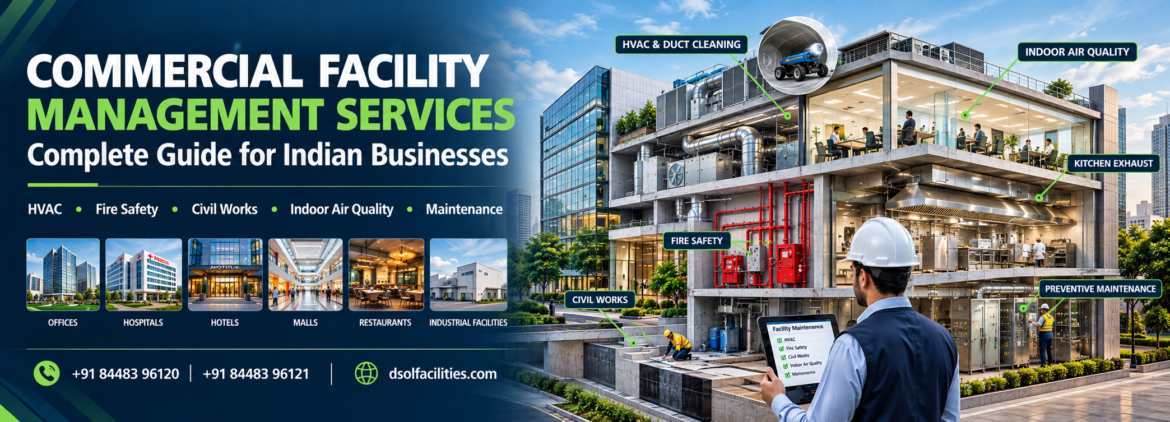
A commercial building is a complex environment where HVAC systems, fire safety infrastructure, civil works, ventilation, indoor air quality and day-to-day maintenance must work together. Managing these requirements separately can make facility operations more difficult, especially for large offices, hospitals, hotels, malls, restaurants and other commercial properties.
Professional commercial facility management services provide a structured approach to maintaining building infrastructure, improving operational reliability and addressing maintenance requirements before they become major problems.
For businesses in India, an effective facility management strategy should combine preventive maintenance, technical inspections, repair services and building-support solutions according to the property’s specific requirements.
What Are Commercial Facility Management Services?
Commercial facility management involves the planning, operation, maintenance and support of a commercial property and its essential building systems.
Depending on the facility, services may include:
- HVAC maintenance and duct cleaning
- Robotic HVAC duct cleaning
- AHU health audits
- Air balancing
- Indoor air quality audits
- Kitchen exhaust duct cleaning
- Laundry duct cleaning
- Fire safety solutions
- Civil works and repair
- Waterproofing
- Office interiors and design-build
- Rainwater harvesting
- Preventive maintenance
- General repair and maintenance
The objective is to keep the building safe, functional, efficient and suitable for its occupants and business operations.
Why Is Commercial Facility Management Important?
A well-maintained building can operate more reliably and provide a better environment for employees, customers and visitors.
Helps Reduce Unexpected Maintenance Problems
Regular inspections and preventive maintenance can identify developing issues before they result in major equipment failure or extensive repair requirements.
Supports Building Safety
Fire safety systems, exhaust infrastructure, HVAC equipment and civil components all require appropriate inspection and maintenance. Coordinated facility management helps ensure that these areas are not overlooked.
Improves Operational Efficiency
Poorly maintained building systems can affect comfort, airflow, equipment performance and daily operations. Planned maintenance helps facility teams address these issues systematically.
Helps Control Long-Term Maintenance Costs
Small defects can become expensive when ignored. Preventive maintenance allows businesses to prioritise repairs and plan expenditure more effectively.
HVAC Maintenance as Part of Facility Management
HVAC systems are among the most important technical systems in commercial buildings. Offices, hospitals, hotels, malls and other facilities often depend on air-conditioning and ventilation systems for long operating hours.
A commercial HVAC maintenance program may include equipment servicing, HVAC duct cleaning, filter inspection, AHU health audits and air balancing.
Robotic HVAC duct cleaning can also be considered for larger or complex duct systems where controlled access and inspection of difficult sections are required.
Maintaining HVAC systems properly can support airflow, indoor comfort and reliable operation while helping facility teams identify potential issues earlier.
Indoor Air Quality and Commercial Facility Management
Indoor air quality is another important consideration for modern commercial properties.
Dust accumulation, inadequate ventilation, poorly maintained HVAC systems, moisture and other indoor sources can affect the quality of the indoor environment.
An indoor air quality audit can help facility managers understand potential air-quality concerns and identify areas requiring improvement.
Depending on inspection findings, solutions may include HVAC maintenance, duct cleaning, ventilation improvements, air balancing and appropriate environmental controls.
Fire Safety Management for Commercial Buildings
Fire safety should be treated as an ongoing facility-management responsibility rather than a one-time installation.
Commercial properties may require regular attention to fire detection systems, firefighting equipment, emergency systems, evacuation infrastructure and other safety provisions.
Specialised exhaust systems also require attention. Kitchen exhaust duct cleaning can help manage grease accumulation in commercial kitchens, while laundry duct cleaning can help manage lint accumulation in commercial laundry operations.
Integrating these activities into a planned maintenance program helps facility managers maintain better control over building safety requirements.
Civil Works and Repair Maintenance
Building infrastructure naturally experiences wear and deterioration over time.
Commercial facility management may therefore include civil repair and maintenance such as:
- Waterproofing
- Leakage and seepage repairs
- Flooring repairs
- Wall and plaster repairs
- Ceiling and partition work
- Painting and finishing
- Drainage-related works
- Masonry repairs
- General building repairs
- External area maintenance
Timely civil maintenance can help prevent minor defects from developing into larger building problems.
Preventive Maintenance vs Reactive Facility Management
Reactive maintenance involves responding after a breakdown or visible defect occurs. While emergency repairs are sometimes unavoidable, relying primarily on reactive maintenance can result in downtime, higher repair costs and operational disruption.
Preventive facility management focuses on planned inspections, servicing and maintenance.
A commercial property can establish preventive schedules for:
- HVAC equipment
- Ductwork
- AHUs
- Exhaust systems
- Fire safety infrastructure
- Civil infrastructure
- Waterproofing
- Common areas
- Other critical building systems
Condition-based inspections can then be used to determine when additional maintenance or specialised cleaning is required.
Facility Management for Different Commercial Properties
Offices and Corporate Buildings
Office facilities commonly require HVAC maintenance, indoor air quality management, fire safety, civil repairs, workplace maintenance and periodic interior modifications.
Hospitals and Healthcare Facilities
Hospitals require carefully coordinated facility management because HVAC, ventilation, indoor air quality, fire safety and building infrastructure can directly affect continuous operations.
Hotels and Hospitality Facilities
Hotels require regular maintenance across guest areas, kitchens, laundry facilities, HVAC systems, common areas and safety infrastructure.
Restaurants and Commercial Kitchens
Commercial kitchens require particular attention to ventilation, kitchen exhaust systems, fire safety and grease accumulation.
Malls and Retail Complexes
Large retail properties require coordinated maintenance across HVAC systems, public areas, fire safety infrastructure, exhaust systems, civil works and other building services.
How to Create an Effective Commercial Facility Management Plan
A practical facility management program should begin with a complete assessment of the property.
Facility teams can identify critical systems, operating requirements, maintenance history and areas requiring immediate attention.
A structured plan can then include:
Asset Assessment: Identify important equipment and building infrastructure.
Preventive Schedule: Establish inspection and servicing frequencies.
Condition Monitoring: Track equipment and building performance.
Corrective Maintenance: Address identified defects before they become larger problems.
Safety Management: Maintain fire safety and other critical safety systems.
Documentation: Record inspections, repairs, cleaning and maintenance activities.
This approach provides facility managers with a clearer understanding of the property’s condition and upcoming maintenance requirements.
How to Choose a Commercial Facility Management Company
Selecting the right commercial facility management company requires more than comparing service prices.
Businesses should consider technical expertise, commercial experience, safety practices, equipment and technology, service coverage and the provider’s ability to coordinate multiple maintenance requirements.
An integrated service provider can be particularly useful for facilities that require HVAC services, duct cleaning, fire safety, civil works, indoor air quality and other technical solutions.
The provider should also understand the importance of working around business operations to minimise unnecessary disruption.
D-SOL Facilities: Integrated Commercial Facility Solutions
D-SOL Facilities provides integrated technical and facility solutions for commercial and institutional environments.
Its services include HVAC duct cleaning, robotic HVAC duct cleaning, HVAC exhaust duct cleaning, kitchen exhaust duct cleaning, laundry duct cleaning, AHU health audits, air balancing, indoor air quality audits, HVAC AMC and repair, fire safety solutions, civil works, repair and maintenance, office interiors, design and build and rainwater harvesting.
D-SOL combines specialised technical teams, advanced cleaning and inspection technology, preventive maintenance expertise and safety-focused execution to support reliable commercial facility operations.
The integrated approach allows businesses to address multiple building requirements through a coordinated facility-services framework.
Contact D-SOL Facilities
For professional commercial facility management services, HVAC maintenance, duct cleaning, fire safety, civil works and integrated building maintenance solutions, contact D-SOL Facilities.
Phone: +91 84483 96120 | +91 84483 96121
Website: dsolfacilities.com
A structured commercial facility management strategy can help businesses maintain safer, more efficient and better-performing properties while reducing avoidable breakdowns, maintenance disruptions and long-term infrastructure costs.