
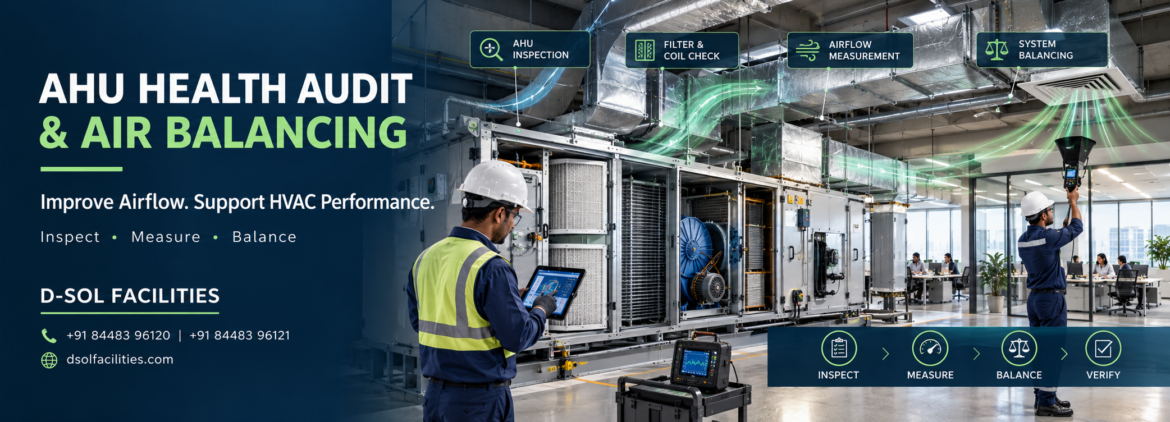
Air handling units (AHUs) are an essential part of commercial HVAC systems. They circulate, filter and condition air before distributing it throughout different areas of a building. In large offices, hospitals, hotels, malls, educational institutions and industrial facilities, the performance of AHUs directly affects indoor air quality, airflow and HVAC efficiency.
However, an HVAC system can continue running while gradually losing performance. Poor airflow, dirty filters, blocked coils, incorrect air distribution and system imbalance may not always be immediately visible. This is why AHU health audits and air balancing are important components of professional commercial HVAC maintenance.
What Is an AHU Health Audit?
An AHU health audit is a systematic assessment of an air handling unit and its operating condition. The objective is to identify performance issues, maintenance requirements and potential factors affecting indoor air quality and HVAC efficiency.
Depending on the system, an AHU health audit may assess filters, coils, fans, motors, belts, dampers, drain systems, airflow, temperature conditions and other operational components.
Regular assessment allows facility managers to identify problems before they develop into expensive equipment failures or persistent indoor comfort issues.
Why Is an AHU Health Audit Important?
Identifies HVAC Performance Issues
An AHU may appear to be functioning normally while delivering inadequate airflow or operating below its intended performance. An audit can help identify airflow restrictions, equipment deterioration and other operational concerns.
Helps Maintain Indoor Air Quality
AHUs play an important role in moving and conditioning indoor air. Dirty filters, contaminated components and inadequate ventilation can affect the quality of air supplied to occupied areas.
Regular AHU inspection and maintenance can therefore form an important part of a broader indoor air quality management program.
Supports Preventive HVAC Maintenance
An AHU health audit provides facility teams with useful information about the current condition of equipment. This allows maintenance requirements to be prioritised instead of relying entirely on reactive repairs.
Helps Reduce Unnecessary Energy Consumption
HVAC systems operating against excessive resistance or poor airflow conditions may require additional energy. Identifying airflow restrictions and performance issues can help facilities take corrective action and improve overall system operation.
What Is Air Balancing in HVAC?
Air balancing is the process of measuring and adjusting airflow throughout an HVAC system so that different areas receive the appropriate amount of conditioned air.
A commercial HVAC system may have multiple ducts, zones, diffusers and air-handling units. If airflow is not properly distributed, some areas may become too warm or too cold while others receive excessive or insufficient air.
Professional HVAC air balancing helps bring airflow closer to the design requirements of the system.
Why Is HVAC Air Balancing Important?
Provides More Consistent Airflow
Air balancing helps distribute conditioned air more evenly across different rooms and zones. This can improve comfort and reduce complaints about temperature variations.
Helps Improve HVAC Performance
An unbalanced system may cause certain components to work harder than necessary. Correct airflow distribution can support more stable HVAC operation.
Supports Better Ventilation
Correct airflow is particularly important in facilities where ventilation requirements are critical. Offices, hospitals, hotels and other high-occupancy buildings can benefit from systematic airflow assessment.
Helps Facility Managers Identify System Problems
Airflow measurements can reveal potential issues such as blocked ducts, incorrect damper positions, fan performance problems or system restrictions.
What Is Included in an AHU Health Audit?
The exact scope depends on the HVAC system and facility requirements. A professional AHU health audit may include:
- Visual inspection of AHU components
- Filter condition assessment
- Cooling coil inspection
- Fan and motor inspection
- Belt and pulley assessment
- Damper inspection
- Drain tray and drainage assessment
- Airflow measurements
- Temperature measurements
- Pressure checks
- Identification of unusual noise or vibration
- Ventilation performance assessment
- Maintenance recommendations
The findings can then be used to develop a corrective or preventive maintenance plan.
What Is the Air Balancing Process?
Professional air balancing services generally involve measuring airflow at selected points throughout the HVAC system.
Technicians may assess supply air, return air, fresh air and exhaust air depending on the building design. Dampers and other control points can then be adjusted where required to achieve the desired airflow distribution.
The process may also identify discrepancies between actual system performance and the original design requirements.
AHU Audit and Air Balancing for Different Commercial Buildings
Offices and Corporate Buildings
Large offices often contain multiple HVAC zones with varying occupancy levels. Air balancing can help maintain more consistent environmental conditions across workspaces and meeting areas.
Hospitals and Healthcare Facilities
Healthcare buildings require careful attention to ventilation and airflow because different areas may have different environmental requirements. AHU health audits can form part of a broader HVAC and indoor air quality maintenance strategy.
Hotels and Hospitality Facilities
Hotels have continuously changing occupancy levels across guest rooms, restaurants, kitchens, lobbies and event areas. Regular HVAC assessment helps maintain system reliability across these different zones.
Malls and Retail Buildings
Shopping centres typically have large and complex HVAC networks. Regular AHU inspections and airflow assessments can help facility teams identify performance issues before they affect larger areas of the property.
When Should an AHU Health Audit Be Conducted?
The appropriate frequency depends on the HVAC system, building occupancy, operating hours, environmental conditions and maintenance history.
An audit may be particularly useful when a facility experiences:
- Uneven cooling
- Poor airflow
- Increasing energy consumption
- Recurring HVAC complaints
- Excessive dust
- Unusual AHU noise or vibration
- Repeated equipment failures
- Changes in building occupancy or layout
- HVAC system modifications
It can also be scheduled as part of a planned preventive maintenance program.
Choosing an AHU Health Audit and Air Balancing Company
A professional provider should have trained technical personnel, appropriate measurement equipment and practical experience with commercial HVAC systems.
Facility managers should also consider whether the provider can address related issues discovered during an audit. For example, restricted airflow may require duct cleaning, while poor indoor air quality may require a detailed IAQ audit. In some cases, HVAC AMC or equipment maintenance may also be required.
An integrated approach can make it easier to identify the root cause rather than treating individual symptoms.
D-SOL Facilities: AHU Audit, Air Balancing and HVAC Solutions
D-SOL Facilities provides commercial HVAC and facility engineering solutions, including AHU health audits, HVAC air balancing, HVAC duct cleaning, robotic HVAC duct cleaning, kitchen exhaust duct cleaning, laundry duct cleaning, indoor air quality audits, HVAC AMC, repair and maintenance, fire safety solutions, civil works, office interiors, design and build, and rainwater harvesting.
With specialised technical teams, advanced inspection and cleaning technology, preventive maintenance expertise and safety-focused execution, D-SOL Facilities supports commercial buildings in maintaining efficient HVAC systems and healthier indoor environments.
Contact D-SOL Facilities
For professional AHU health audits, air balancing, HVAC maintenance and commercial facility solutions, contact D-SOL Facilities:
Phone: +91 84483 96120 | +91 84483 96121
Website: dsolfacilities.com
D-SOL Facilities helps businesses take a proactive approach to HVAC performance, indoor air quality and commercial facility maintenance.