
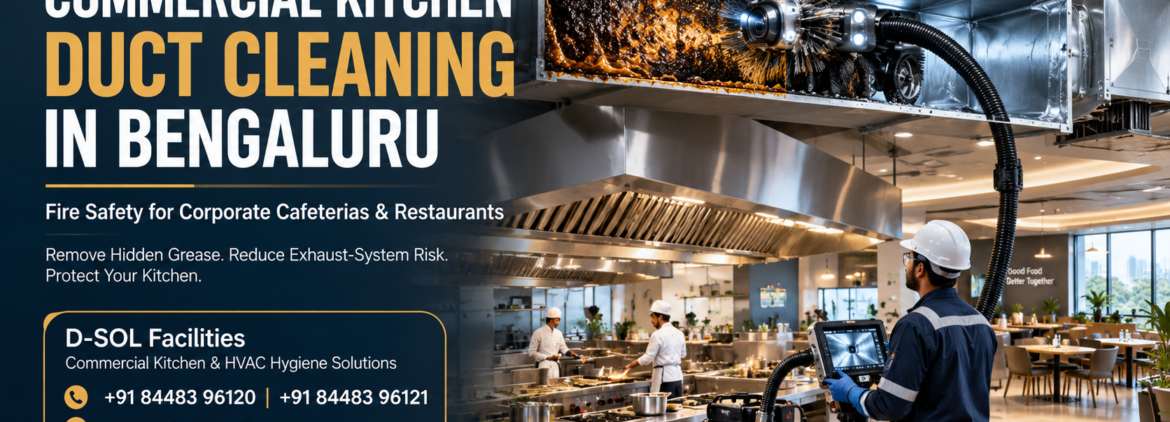
Bengaluru’s commercial food-service environment has changed dramatically. Corporate cafeterias serve thousands of employees every day, restaurants operate extended hours, hotels manage high-volume kitchens, and cloud kitchens work continuously to meet delivery demand. Behind all these operations is a ventilation system that quietly performs one of the most important functions in the kitchen: removing heat, smoke, grease vapours and cooking fumes.
The challenge begins when grease and carbon deposits accumulate inside kitchen exhaust hoods, filters, ducts and exhaust fans. What may initially appear to be a routine maintenance issue can gradually become a serious fire-safety and ventilation concern.
For restaurants, corporate cafeterias and institutional kitchens, commercial kitchen duct cleaning in Bengaluru should therefore be treated as an important part of preventive facility maintenance rather than an occasional cleaning activity.
Why Commercial Kitchen Duct Cleaning Is Important for Fire Safety
During cooking, particularly frying, grilling, roasting and high-temperature food preparation, grease-laden vapours enter the exhaust system. Some of this grease is captured by filters, while fine particles can travel further into the hood, ductwork and exhaust fan.
Over time, deposits can form on internal surfaces.
If these deposits are allowed to accumulate, they create a combustible fuel source within the exhaust pathway. A fire originating around cooking equipment can potentially travel into a contaminated exhaust system, increasing the consequences of an incident.
Professional kitchen exhaust cleaning focuses on removing this accumulated grease before it becomes a significant safety concern. Industry fire-safety guidance such as NFPA 96 addresses commercial cooking ventilation systems and the need for appropriate inspection and cleaning practices.
For a busy Bengaluru restaurant or corporate cafeteria, this makes exhaust-system maintenance an essential component of the wider fire-prevention strategy.
Kitchen Exhaust Cleaning for Corporate Cafeterias in Bengaluru
Corporate cafeterias have a distinctive operational challenge. They may serve hundreds or thousands of meals within a limited period, often relying on frying, grilling, bulk cooking and high-capacity exhaust systems.
Unlike a small kitchen, a corporate cafeteria may have:
- Multiple cooking lines
- Large exhaust hoods
- Long horizontal duct runs
- Vertical duct sections
- Multiple exhaust fans
- High grease generation
- Extended operating hours
- Limited maintenance windows
A partially cleaned hood does not necessarily mean that the complete exhaust system is clean. Grease can remain deeper inside the ductwork, around bends, access points, dampers and fan assemblies.
This is why professional commercial kitchen exhaust cleaning in Bengaluru should evaluate the complete exhaust pathway rather than concentrating only on visible surfaces.
Restaurant Kitchen Duct Cleaning: More Than Hood Cleaning
One of the common misconceptions in commercial kitchens is that cleaning the visible hood and filters is sufficient.
The hood is only one part of the exhaust system.
A professional cleaning programme should consider the condition of the hood, filters, internal duct surfaces, access sections and exhaust fan. The exact scope depends on the design and accessibility of the installation.
A restaurant may have a relatively clean canopy while substantial grease has accumulated farther inside the duct. This hidden contamination can remain unnoticed during routine kitchen cleaning.
Professional restaurant kitchen duct cleaning therefore provides a deeper maintenance solution, particularly for kitchens with heavy frying, grilling or continuous cooking activity.
Signs Your Commercial Kitchen Exhaust System Needs Cleaning
Facility managers and restaurant operators should not wait for a visible emergency before inspecting the exhaust system.
Common warning signs include:
Persistent Cooking Odours
If cooking smells remain inside the kitchen or spread into adjacent areas despite the exhaust system operating, the ventilation system may require inspection.
Reduced Exhaust Airflow
A noticeable reduction in extraction performance can indicate contamination, fan problems, blocked filters or other ventilation issues.
Grease Around Exhaust Components
Visible grease around filters, hood surfaces, access panels or fan areas can indicate that internal cleaning is overdue.
Excessive Smoke in the Kitchen
Smoke lingering around cooking equipment may indicate that the extraction system is not operating effectively.
Heavy Grease Deposits
Dark, sticky or hardened deposits inside accessible sections of the exhaust system are a clear reason to arrange a professional assessment.
Upcoming Fire or Safety Inspection
If a facility is preparing for an internal safety audit, insurance inspection or fire-safety review, documented maintenance records can help demonstrate that the exhaust system is being managed as part of the facility’s preventive maintenance programme.
Commercial Kitchen Duct Cleaning Process in Bengaluru
Professional cleaning should follow a structured process rather than simply spraying chemicals onto visible surfaces.
1. Initial Inspection
The first step is to assess the kitchen exhaust system and identify the hood configuration, duct route, access points, exhaust fan and visible grease accumulation.
The inspection helps determine the cleaning requirements and the safest method of execution.
2. Kitchen and Equipment Protection
Before cleaning begins, surrounding equipment and sensitive areas should be appropriately protected. Electrical components and other vulnerable surfaces must be handled carefully to prevent damage.
For operating restaurants and corporate cafeterias, work can often be scheduled during low-activity or non-operational hours to minimise disruption.
3. Degreasing and Mechanical Cleaning
Specialised cleaning methods are used to loosen and remove accumulated grease and carbon deposits from accessible exhaust components.
Depending on the system condition, professional equipment may include degreasing solutions, mechanical tools, pressure-cleaning systems and other specialised equipment.
4. Exhaust Fan and Hood Cleaning
The hood, filters and exhaust fan assembly should be assessed and cleaned as required. Fan blades and housings are particularly important because grease accumulation can affect both cleanliness and system performance.
5. Duct Interior Cleaning
The internal ductwork is the most important part of the process because it is often difficult to inspect visually during normal kitchen operations.
The cleaning methodology should address accessible sections throughout the exhaust route, including horizontal and vertical duct sections where applicable.
6. Final Inspection and Documentation
After cleaning, the system should be inspected to verify the work completed. Professional service documentation, photographs and maintenance records can provide useful evidence for facility-management teams and internal safety records.
How Often Should Commercial Kitchen Ducts Be Cleaned?
There is no single cleaning interval that is appropriate for every kitchen.
Cleaning frequency depends on factors such as cooking volume, operating hours, type of food preparation, amount of grease produced and the condition of the exhaust system.
A high-volume cafeteria operating every day may require more frequent attention than a small restaurant with limited cooking activity.
Instead of relying only on a fixed calendar schedule, facility managers should combine scheduled maintenance with periodic inspection. D-SOL Facilities’ existing guidance similarly recommends adjusting cleaning frequency according to kitchen usage, cooking volume and grease accumulation rather than treating every facility identically.
Fire Safety and Business Continuity
A commercial kitchen fire does not only threaten equipment and property. It can interrupt business operations, affect employees and customers, damage adjacent areas and create substantial financial consequences.
For corporate cafeterias, the impact can extend to employee welfare and workplace operations. For restaurants and hotels, an unexpected kitchen shutdown can affect customer service, reservations, deliveries and reputation.
Preventive exhaust cleaning is therefore part of a broader business-continuity strategy.
The objective is not simply to make a kitchen look cleaner. It is to reduce avoidable risks within a critical building system and maintain reliable ventilation performance.
Choosing a Commercial Kitchen Duct Cleaning Company in Bengaluru
When selecting a professional service provider, businesses should look beyond price alone.
A suitable contractor should understand commercial exhaust systems, provide a clearly defined scope of work, use appropriate cleaning equipment, protect kitchen assets during service and provide documentation after completion.
For large corporate facilities, it is also valuable to select a provider capable of working around operational schedules and coordinating with facility-management teams.
A professional approach should include inspection, cleaning, verification and maintenance documentation rather than a basic surface-cleaning service.
Commercial Kitchen Exhaust Cleaning for Different Bengaluru Facilities
The requirement extends well beyond conventional restaurants.
Professional kitchen exhaust cleaning can be relevant for:
Corporate cafeterias: High-volume employee meal preparation and large exhaust systems.
Restaurants and QSRs: Continuous cooking, frying and grilling can generate significant grease deposits.
Hotels: Multiple kitchens and extended operating schedules require systematic maintenance.
Cloud kitchens: High delivery volumes can create intensive cooking activity within compact facilities.
Food courts: Multiple food operators can generate different levels of exhaust contamination.
Hospitals: Institutional kitchens require reliable ventilation while maintaining strict operational standards.
Educational institutions: Large-scale kitchens and cafeterias need planned preventive maintenance.
For each facility, the cleaning programme should be adapted to the exhaust design, cooking activity and operational requirements.
A Safer Approach to Kitchen Exhaust Maintenance
Kitchen exhaust systems are often hidden from everyday view, but their condition can directly influence fire safety, ventilation performance and operational reliability.
For Bengaluru’s restaurants and corporate cafeterias, professional duct cleaning should form part of a planned facility-maintenance programme. Regular inspection, appropriate cleaning frequency and clear maintenance documentation can help businesses address grease accumulation before it develops into a more serious operational concern.
The most effective approach is preventive rather than reactive: inspect the system, understand the level of contamination, clean the exhaust pathway professionally and maintain records for future inspections.
About D-SOL Facilities
D-SOL Facilities is a specialised commercial facility and HVAC hygiene service provider serving businesses and large institutions across India. Its service portfolio includes commercial kitchen exhaust duct cleaning, robotic HVAC duct cleaning, HVAC duct cleaning, AHU health audits, indoor air quality audits, air balancing, HVAC AMC, fire-safety solutions, laundry duct cleaning and other specialised facility-maintenance services. The company focuses on technical inspection, specialised cleaning methods, professional execution, documentation and minimal operational disruption, making its services suitable for corporate buildings, restaurants, hotels, hospitals, educational institutions and industrial facilities. Its USP is the combination of technology-driven cleaning, trained technical teams, structured maintenance processes and solutions designed specifically for commercial and institutional environments rather than residential properties.
Contact D-SOL Facilities
Call for Reservation: +91 84483 96120 | +91 84483 96121
Email: tanmay@dsolfacilities.com
Website: dsolfacilities.com