
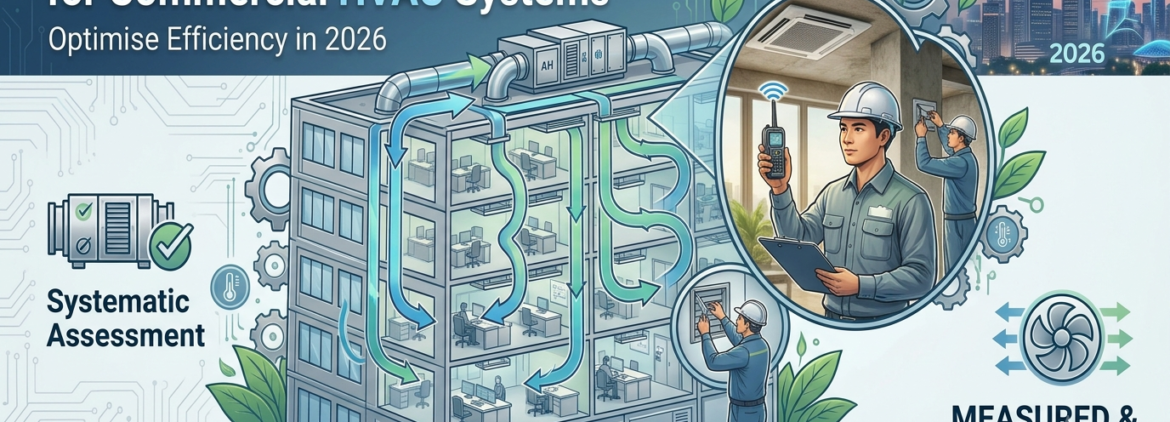
Walk into a modern commercial building on a busy afternoon and the signs of an HVAC problem are rarely dramatic at first.
One meeting room feels warmer than another. Employees complain that certain areas are stuffy. The AHU appears to be running continuously, yet comfort remains inconsistent. Energy bills begin to rise without an obvious explanation. Filters become dirty faster, dampers are adjusted repeatedly, and maintenance teams keep addressing individual symptoms without finding the underlying issue.
The problem may not be the capacity of the HVAC system.
It may be the way the system is performing.
This is where an AHU health audit and air balancing for commercial HVAC systems becomes valuable. In 2026, businesses are increasingly looking beyond routine HVAC maintenance toward measurable system performance, indoor air quality, energy efficiency and operational reliability.
What Is an AHU Health Audit?
An AHU health audit is a systematic assessment of an Air Handling Unit and its associated components to determine whether the system is operating safely, efficiently and according to its intended performance.
An AHU is responsible for conditioning and distributing air throughout a building. Depending on the system design, it may involve filtration, cooling or heating coils, fans, dampers, humidification, ventilation and controls.
Over time, performance can deteriorate because of accumulated dust, clogged filters, coil fouling, fan problems, belt deterioration, incorrect damper positions, sensor issues, leakage or changes in building occupancy.
An AHU health audit looks at these elements as an integrated system rather than inspecting one component in isolation.
The objective is not simply to determine whether the AHU is running. The more important question is whether it is delivering the right quantity and quality of air to the right areas at the right operating conditions.
Why AHU Health Audits Matter for Commercial Buildings in 2026
Commercial buildings have become more complex. Offices, shopping centres, hospitals, hotels, educational facilities and industrial workplaces often depend on HVAC systems for thermal comfort, ventilation and indoor environmental quality.
A system can continue operating while gradually losing its original performance. ASHRAE notes that building systems can change with time and use and may need testing, adjustment and balancing to maintain intended operation.
This performance drift can create several interconnected problems.
An underperforming AHU may consume unnecessary energy while failing to maintain comfortable conditions. Poor airflow distribution can create hot and cold zones. Inadequate ventilation can affect indoor air quality, while excessive airflow in some areas can increase fan and conditioning loads.
A professional audit therefore provides facility managers with evidence rather than assumptions.
What Does an AHU Health Audit Include?
A comprehensive AHU health audit for commercial HVAC systems should consider both equipment condition and operating performance.
AHU Equipment and Component Inspection
The assessment typically begins with a detailed inspection of the AHU.
The auditor may examine filters, cooling and heating coils, drain pans, fans, motors, belts, bearings, dampers, insulation, access doors and other accessible components.
Signs of contamination, corrosion, leakage, vibration, abnormal noise or physical deterioration should be documented.
The purpose is to understand whether equipment condition could be affecting airflow, efficiency or indoor environmental quality.
Filter and Coil Condition Assessment
Filters have a direct relationship with airflow resistance. As filters become loaded with particulate matter, pressure drop can increase and the fan may need to work harder to move air.
Coils also require attention. Dust and debris on coil surfaces can interfere with heat transfer and airflow.
An audit can therefore identify whether cleaning, replacement, repair or operational adjustment is necessary.
Fan and Motor Performance
The fan is central to air distribution. Its operating condition, speed, pressure and airflow should be evaluated against the design or operational requirements.
Unusual vibration, belt wear, bearing problems or motor performance issues can indicate developing mechanical problems.
Rather than waiting for a breakdown, an AHU audit can help facility teams identify performance deterioration at an earlier stage.
What Is Air Balancing in HVAC?
Air balancing in HVAC is the process of measuring and adjusting airflow throughout a system so that different zones receive the required air quantities according to the design or established operational requirements.
Imagine an office where the AHU produces sufficient air but the distribution system sends too much to one section and too little to another.
The central equipment may appear healthy, but occupants will still experience discomfort.
This is why testing and balancing should be considered at the system level.
ASHRAE recommends testing, adjusting and balancing systems to produce repeatable results that meet design intent and owner requirements.
How Commercial HVAC Air Balancing Works
A professional commercial HVAC air balancing service generally involves field measurements followed by controlled adjustments.
Technicians may measure airflow at supply outlets, return points and other relevant locations. Static pressure and differential pressure may also be evaluated depending on the system configuration.
The measured values are then compared with design criteria, available documentation or agreed operational targets.
Where discrepancies are identified, dampers, fan settings, control parameters or other appropriate components may be adjusted.
The process is not simply about increasing airflow everywhere. Increasing fan output without understanding the distribution problem can increase energy consumption without solving the underlying imbalance.
Effective balancing seeks to achieve the required airflow with appropriate system operation.
The Connection Between AHU Health and Air Balancing
AHU auditing and air balancing are closely connected, but they are not the same activity.
An AHU health audit focuses heavily on the condition and performance of the air-handling equipment.
Air balancing focuses on the distribution and adjustment of airflow throughout the HVAC system.
Together, they provide a much clearer picture.
For example, if airflow at several outlets is below target, the cause might be a dirty filter, fouled coil, incorrect damper position, excessive duct resistance, fan performance issues or another system-level problem.
Testing helps distinguish between these possibilities.
Benefits of HVAC Air Balancing for Energy Efficiency
One of the most important reasons businesses consider HVAC air balancing for energy efficiency is operational control.
An HVAC system should deliver the required environmental conditions without unnecessarily operating beyond what the building needs.
ASHRAE’s facility operation guidance highlights three practical principles: operate systems when needed, operate them only to the extent required, and turn them off when no longer needed.
Correct balancing supports this philosophy by helping ensure that conditioned air is distributed appropriately.
It can contribute to:
- More consistent temperature distribution
- Better airflow management
- Reduced unnecessary fan operation
- Improved occupant comfort
- Better HVAC control
- Earlier identification of system problems
- More reliable building operation
- Better maintenance planning
The actual energy savings will depend on the existing condition, system design, controls, operating schedule and corrective actions implemented. A professional assessment should therefore measure the opportunity rather than promise a fixed percentage of savings.
Air Balancing and Indoor Air Quality
Airflow is also closely connected with indoor air quality in commercial buildings.
Ventilation requirements depend on building type, occupancy, system design and applicable standards. If airflow is poorly distributed, some areas may not receive the intended ventilation while other areas receive more than necessary.
A balanced system can support more predictable ventilation performance when combined with appropriate filtration, outdoor-air control, equipment maintenance and building operation.
For this reason, AHU audits should not be viewed solely as energy-efficiency exercises. They can also form part of a broader indoor environmental quality strategy.
When Should a Commercial HVAC System Be Audited?
Businesses should consider an AHU health audit and HVAC air balancing when there are recurring comfort complaints, unexplained energy increases, major occupancy changes or modifications to the HVAC system.
It can also be valuable after office renovations, changes in floor layouts, duct modifications, equipment replacement or expansion.
ASHRAE guidance identifies recommissioning and retrocommissioning as useful approaches for existing buildings where occupancy, design strategies, equipment performance, comfort or indoor air quality requirements have changed.
Regular assessment is particularly valuable for large commercial facilities where small inefficiencies can accumulate into significant operational costs.
Why HVAC Commissioning and Recommissioning Matter
An HVAC system should not be considered permanently optimised simply because it was commissioned when the building first opened.
Buildings evolve.
Tenants change. Floor plans are modified. Equipment ages. Controls are adjusted. Occupancy patterns change. New areas may be connected to existing systems.
This is why HVAC recommissioning and ongoing performance verification have become increasingly relevant.
ASHRAE describes commissioning as a quality-focused process that verifies and documents whether systems meet defined operational requirements, while existing-building commissioning involves investigating and adjusting systems to achieve required energy, comfort and indoor air quality performance.
What Should a Professional AHU Audit Report Include?
A useful AHU health audit report should provide more than a list of observations.
It should clearly document the equipment assessed, measured conditions, identified deficiencies, relevant performance data and recommended corrective actions.
Where applicable, the report should distinguish between urgent maintenance requirements, performance improvements and longer-term recommendations.
Clear documentation allows facility managers to prioritise work according to operational importance and budget.
It also creates a useful baseline for future comparison.
AHU Health Audit and Air Balancing Services by D-SOL Facilities
D-SOL Facilities approaches AHU health audits, air balancing and commercial HVAC performance as part of a structured facility-performance strategy rather than treating them as isolated maintenance activities. Its services focus on assessing HVAC equipment condition, airflow performance and operational issues so commercial facilities can make better-informed decisions regarding maintenance, cleaning, balancing and system optimisation.
The company provides specialised HVAC-related services including AHU health audits, HVAC duct cleaning, robotic HVAC duct cleaning, laundry duct cleaning, indoor air quality audits and related HVAC hygiene and performance services. Its USP lies in combining technical assessment with practical facility solutions, helping businesses identify the source of HVAC performance problems rather than repeatedly addressing symptoms. The approach is particularly relevant for commercial buildings where occupant comfort, indoor air quality, system reliability, hygiene and energy-conscious operation need to work together.
For service enquiries, D-SOL Facilities can be contacted at +91 84483 96120 | +91 84483 96120. Email: rohit@dsolfacilities.com or hemraj@dsolfacilities.com, tanmay@dsolfacilities.com .
Conclusion
A commercial HVAC system does not become inefficient overnight. Performance usually changes gradually through equipment ageing, contamination, airflow restrictions, altered occupancy, control adjustments and changes to the building itself.
That is why AHU health audit and air balancing for commercial HVAC systems should be viewed as proactive performance management rather than simply another maintenance task.
In 2026, businesses have a stronger reason to understand what their HVAC systems are actually delivering. A properly assessed and balanced system can support better comfort, more predictable airflow, improved indoor environmental quality and more informed energy-management decisions.
The goal is simple: not merely to keep the HVAC system running, but to ensure that it is performing intelligently, efficiently and in line with the needs of the building.