
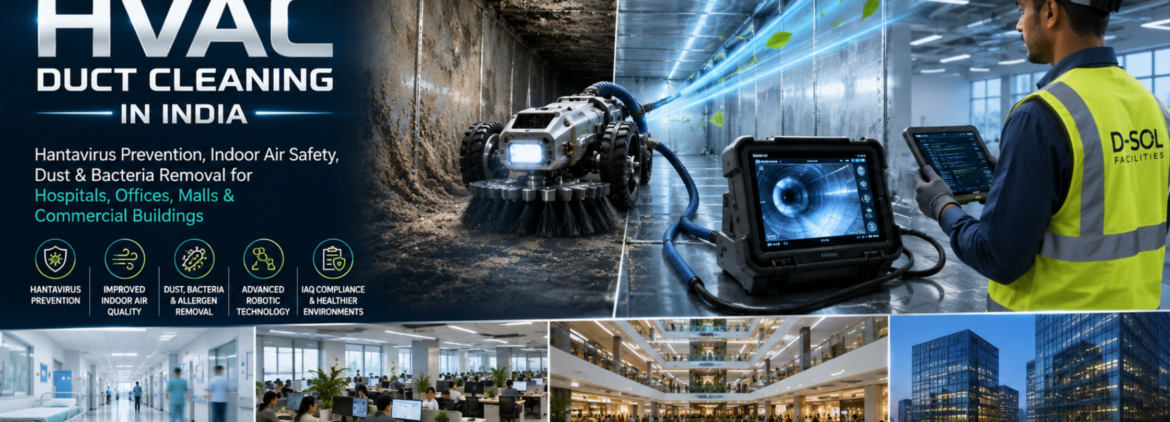
As the world becomes increasingly aware of airborne health threats, a vital conversation is emerging among facility managers and business owners across India, from the bustling corridors of Mumbai’s corporate towers to the sterile environments of Delhi’s surgical theaters. The air we breathe indoors is no longer a passive element of comfort; it is an active determinant of health, safety, and operational efficiency. In this context, robotic HVAC duct cleaning in India is rapidly transitioning from a luxury maintenance option to an absolute necessity.
This article explores the intersection of modern technology, environmental hygiene, and public health, focusing on hantavirus prevention, indoor air safety, and the meticulous removal of dust and bacteria for high-stakes environments such as hospitals, offices, and malls.
Hantavirus and Indoor Air: A Hidden Threat to Commercial Spaces
While public discourse in India is dominated by outdoor air pollution, a silent and potentially fatal threat may be lurking within the air conditioning ducts of neglected buildings, storage rooms, and under-ventilated commercial complexes.
Understanding the Rodent-Borne Risk
Hantavirus is a rare but severe zoonotic disease transmitted primarily through the aerosolized urine, droppings, or saliva of infected rodents. According to the National Center for Biotechnology Information (NCBI), any infection caused by a virus of the genus Hantavirus can result in severe clinical manifestations, ranging from hemorrhagic fever with renal syndrome to a life-threatening pulmonary syndrome.
The primary mode of infection is not through human contact, but through inhalation. As explained by Dr. Aravinda SN, a lead consultant at Aster RV Hospital, “Individuals contract the infection because they breathe in particles which contain the virus that become airborne during the process of cleaning spaces which lack proper ventilation,” such as sheds, storerooms, and unused cabins.
Why HVAC Systems Are a High-Risk Zone
In the context of commercial buildings, neglected HVAC systems create a perfect storm for this risk to materialize. If rodent infestations occur in false ceilings, service shafts, or air handling units, their contaminated nesting materials and dried droppings can accumulate within ductwork over time.
When the air conditioning system turns on, the airflow can dislodge these dry, infected particles, turning them into aerosolized viral dust that is then circulated throughout the entire building. Standard filtration levels in non-medical cabins are often insufficient to capture these sub-micron viral particles if they become effectively aerosolized within the ducting.
The Indian Context and Aerosolized Risks
While no large outbreaks of hantavirus have been reported in India, experts stress the importance of preemptive action. As India faces rapid urbanization and seasonal monsoon fluctuations, which often drive rodents indoors, the underlying risk factors are present. To protect against this, health experts warn against common cleaning habits that actually increase risk. “One should avoid using dry sweeping or vacuuming methods to clean rodent waste because these methods will spread infectious materials into the surrounding air,” explains Dr. Aravinda.
For occupied commercial spaces, vacating the building to clean ducts manually is impractical. This is where engineering intervention is required. Instead of simply turning on the AC and hoping for the best, building owners must opt for professional, source-removal cleaning methods to ensure that any rodent-contaminated debris is removed without aerosolizing the pathogens into the breathing zone of employees.
The Evolution of HVAC Duct Cleaning: From Manual to Robotic Precision
Traditional manual duct cleaning methods have become outdated and insufficient for the complex duct geometries found in modern commercial buildings. Human access is limited, and conventional brush systems often fail to reach the majority of pipeline blind areas. This has paved the way for the technological supremacy of robotics.
How Robotic Duct Cleaning Works
Robotic duct cleaning technology is revolutionizing HVAC maintenance by offering precision, efficiency, and safety that manual methods cannot match. This advanced approach deploys specialized robotic devices equipped with high-definition cameras, rotary brushes, and high-powered vacuum systems.
These agile robots navigate through intricate duct pathways, meticulously scouring the interior walls to remove layers of accumulated dust, mold, and hazardous debris. The integrated camera provides real-time visual feedback, allowing technicians to verify the cleanliness of the duct network without cutting into walls or disturbing ceiling tiles.
The Benefits of Robotic Intervention
The adoption of robotic technology offers several distinct advantages for commercial entities:
- Comprehensive Cleaning: Robots clean every inch of the duct interior, reaching bends and narrow passages beyond the scope of manual tools.
- Minimal Downtime: The robotic process is faster and less invasive, significantly reducing disruption to daily business operations.
- Energy Savings: Cleaner ducts improve airflow and system efficiency, resulting in lower electricity bills.
- Health Benefits: The removal of mold, allergens, and dust reduces indoor pollutants, promoting healthier working spaces.
- Extended Equipment Life: Proper maintenance prevents premature wear and costly repairs of HVAC components.
Dust, Bacteria, and Sick Building Syndrome: The Cost of Negligence
The accumulation of dust in air ducts is more than just an aesthetic issue; it is a direct contributor to Sick Building Syndrome (SBS) . This condition describes scenarios where building occupants experience acute health effects linked to time spent in a particular building.
The Invisible Danger of Bioaerosols
Bioaerosols are airborne particles that are either living, such as bacteria, viruses, and fungi, or originate from living organisms. In an office environment, these particles are continuously generated from human occupancy, dust, paper fibers, and external pollution.
When these particles are drawn into the return air intakes of an HVAC system, they settle and proliferate within the ductwork, especially in the presence of moisture, creating a breeding ground for microbial colonies. In India, where the excessive use of centralized AC systems often leads to insufficient air ventilation, the rapid buildup of infectious aerosols is a widespread issue.
Symptoms and Productivity Loss
The health effects of poor IAQ are severe across three categories: infectious diseases, allergic responses, and acute toxicity. Research indicates that Sick Building Syndrome in centrally air-conditioned buildings manifests with alarming frequency, with reports showing headache in 51% of occupants, lethargy in 50%, and dryness in mucous membranes in 33%.
For employers, this translates directly to reduced cognitive function, increased absenteeism, and lower overall productivity. Studies have found that indoor air can be two to five times more polluted than outdoor air if not managed correctly. This crisis is compounded by the fact that India does not yet have separate, fully enforced indoor air quality standards for all sectors, though the National Building Code 2016 is increasingly being referenced in audits.
Sector-Wise Imperatives: Why Every Building Requires Robotic Duct Cleaning
The need for robotic duct cleaning transcends industry verticals. Different environments require unique standards of air purity, but the common denominator remains health and safety.
Hospitals and Healthcare Facilities
In operation theaters, ICUs, and patient wards, sterile air is a matter of life and death. Contaminated HVAC systems can spread antibiotic-resistant bacteria and fungal spores, leading to hospital-acquired infections (HAIs). Robotic duct cleaning ensures that these critical environments remain compliant with the highest infection control standards.
Corporate Offices and IT Parks
For the modern workforce, IAQ directly impacts cognitive performance. A clean HVAC system ensures that employees are breathing fresh, oxygen-rich air, free from the volatile organic compounds (VOCs) and dust mites that trigger headaches and “afternoon fatigue.” Given that these facilities operate 24/7, robotic cleaning offers the non-disruptive solution necessary to avoid halting business operations.
Malls and Commercial Complexes
High footfall brings high levels of dust, lint, and biological contaminants from hundreds of thousands of visitors. Without regular robotic cleaning, malls often develop “stuffiness” and unpleasant odors, directly affecting customer experience and tenant retention rates.
About D-SOL Facilities
D-SOL Facilities stands at the forefront of this industry, offering a comprehensive suite of advanced facility management solutions tailored specifically to the rigorous demands of the Indian commercial landscape. As a proud member of the National Air Duct Cleaners Association (NADCA), the company adheres to globally recognized standards for HVAC inspection, cleaning, and restoration.
By employing state-of-the-art robotic duct cleaning technology and conducting thorough Indoor Air Quality (IAQ) audits, D-SOL Facilities ensures the complete removal of dust, toxins, and microbial deposits. Their service approach emphasizes minimal disruption to daily operations, making them the partner of choice for corporate offices, healthcare facilities, hospitality giants, and industrial complexes across India. Their commitment to ethical standards and professional source removal methods guarantees healthier, safer, and more energy-efficient indoor environments for every client.