
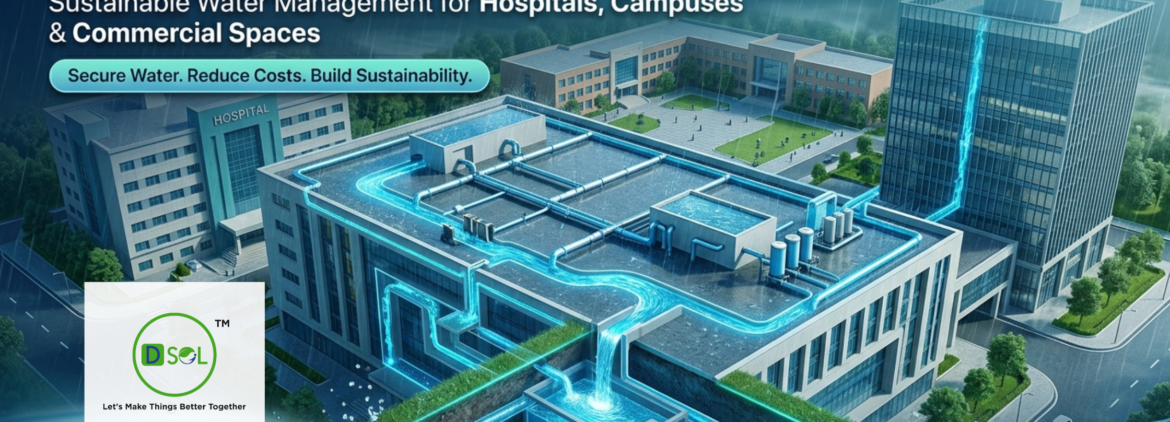
The Imperative for Water Security
India faces a paradoxical water crisis. The country receives approximately 4,000 billion cubic meters of rainfall annually, yet only a mere 8 percent of this precious resource is captured efficiently . This stark inefficiency stems from ageing infrastructure, inadequate harvesting systems, and rapid urbanization that has replaced permeable surfaces with concrete landscapes. With 18 percent of the global population but only 4 percent of the world’s freshwater resources, the nation’s water security demands immediate and sustained action .
For hospitals, educational institutions, and commercial buildings, facilities that operate round the clock with substantial water requirements, the need for reliable water sources is particularly acute. Advanced rainwater harvesting solutions offer a path toward water independence, operational resilience, and environmental stewardship.
Understanding Advanced Rainwater Harvesting Systems
Modern rainwater harvesting has evolved far beyond simple collection barrels. Contemporary systems integrate sophisticated filtration, storage, and recharge mechanisms designed to maximize capture efficiency while ensuring water quality meets stringent standards.
Core Components of Advanced Systems
A comprehensive rainwater harvesting installation typically includes catchment surfaces, primarily rooftops, that channel water through PVC gutters and downpipes. A first-flush system diverts the initial runoff containing accumulated dust and debris, preventing contaminants from entering storage. Advanced filtration employs disc filters and mesh screens to remove particulate matter, while atmospheric ozone generators can purify water to meet quality standards for various applications .
Storage solutions have also advanced significantly. Patented modular tanks made from recycled polypropylene now offer underground installation options that maximize space utilization while providing robust structural integrity . These modular systems can be assembled to construct underground structures capable of storing substantial volumes of harvested rainwater.
Recharge vs. Storage Strategies
Advanced rainwater harvesting encompasses two complementary approaches: storage for direct use and groundwater recharge. The optimal balance depends on site-specific factors including space availability, soil permeability, and water demand patterns. Recharge structures such as percolation pits, injection wells, and recharge shafts direct filtered rainwater into aquifers, helping restore depleted groundwater tables that serve as critical reserves during dry periods .
Rainwater Harvesting for Hospitals: Clinical Precision in Water Management
Hospitals present unique water management challenges. Beyond basic sanitation needs, medical facilities require reliable water supplies for sterilization, laundry, kitchen services, and cooling systems. The consequences of water shortage in a hospital setting can be severe, affecting patient care and operational continuity.
Regulatory Drivers
Municipal authorities increasingly mandate rainwater harvesting for large healthcare facilities. In Coimbatore, the district administration launched a comprehensive drive requiring rooftop harvesting systems in all large constructions, with particular emphasis on hospitals and industries . Government buildings, private institutions, and commercial establishments throughout the district are being brought under this initiative.
Technical Implementation
For hospital applications, advanced rainwater harvesting systems are often integrated with wastewater treatment plants to create comprehensive water recycling infrastructure. A pilot project at a subdivisional hospital in Kharagpur demonstrated the feasibility of combining moving bed biofilm reactors, constructed wetlands, and disinfection modules to treat hospital wastewater alongside harvested rainwater . The treated effluent meets discharge standards suitable for restricted agricultural reuse and toilet flushing.
Quality Assurance
Hospitals require rigorous water quality protocols. Multi-stage filtration systems incorporating UV treatment and on-site chlorine generation ensure harvested rainwater meets safety standards for non-potable applications . Regular monitoring and maintenance protocols are essential to prevent microbial growth and maintain system integrity.
Educational Institutions: Campuses as Models of Sustainability
Universities and schools across India are embracing rainwater harvesting as both a practical solution and an educational opportunity. These institutions serve as living laboratories where students witness sustainability principles in action.
Institutional Leadership
The National Law School of India University (NLSIU) in Bengaluru has implemented a phased rainwater harvesting program covering 2,683 square meters across hostels, learning centres, and training facilities . With a storage capacity of 1.6 lakh litres at the Training Centre alone, these systems yield over 18 lakh litres of harvested rainwater annually, reducing water pumping requirements by an estimated 25 percent.
Beyond rooftop collection, NLSIU has strategically located harvesting pits opposite administrative buildings and staff quarters, directing rainwater from roads into recharge structures that restore groundwater levels. This integrated approach combines immediate water availability with long-term aquifer sustainability.
Amrita Vishwa Vidyapeetham’s Comprehensive Approach
Amrita Vishwa Vidyapeetham has established a formal Water Reuse Policy that integrates rainwater harvesting into campus planning across its multiple locations, including Amaravati, Bengaluru, Chennai, Coimbatore, and Kochi . The university’s policy targets meeting 40 to 50 percent of total campus water demand through recycled wastewater and harvested rainwater by 2025.
The institution collects rainwater from rooftops and paved surfaces, utilizing it for landscape irrigation, cooling towers, and fire suppression systems. Groundwater recharge structures complement storage systems, ensuring long-term water availability and ecological balance.
Student Engagement
Educational institutions possess a unique advantage: the ability to engage students in water conservation efforts. Campus sustainability programs often include student participation in monitoring, maintenance, and awareness campaigns, fostering a generation of water-conscious citizens.
Commercial Buildings: Business Case for Water Conservation
For commercial buildings, rainwater harvesting represents both environmental responsibility and economic prudence. The business case has strengthened considerably as water scarcity increases operational risks and regulatory requirements tighten.
Green Building Certifications
Major developers increasingly seek Indian Green Building Council (IGBC) certifications that mandate water efficiency measures. A commercial development on Bengaluru’s Sarjapur Road, for instance, incorporates full on-site wastewater treatment and reuse systems alongside rainwater harvesting, achieving significant reductions in freshwater demand .
Green-certified commercial spaces command premium tenant interest, particularly from global occupiers with environmental, social, and governance mandates. Platinum-rated projects demonstrate stronger long-term occupancy stability and tenant retention.
Economic Benefits
The financial returns from rainwater harvesting are measurable and substantial. A Bengaluru apartment complex implemented a rainwater harvesting system for under ₹3 lakh, recovering ₹2 lakh in water bills within two months . Beyond direct savings, systems reduce dependence on expensive water tankers, a particularly critical advantage during periods of water scarcity when tanker prices escalate dramatically.
Urban Flood Mitigation
In rapidly urbanizing cities, rainwater harvesting serves a dual purpose: capturing water for use while reducing stormwater runoff that contributes to urban flooding. By slowing and capturing rainfall, these systems reduce peak flows into overburdened drainage networks, providing community-wide resilience benefits .
Key Considerations for Implementation
Site Assessment
Professional rainwater harvesting begins with comprehensive site assessment. This includes analyzing roof slope and catchment area, conducting soil testing to determine infiltration rates, evaluating groundwater tables, and mapping rainfall patterns. Such assessments inform system design, ensuring optimal balance between storage capacity and recharge capability .
Compliance and Regulatory Alignment
Rainwater harvesting installations must comply with local building bylaws and municipal regulations. Many urban centers now mandate rainwater harvesting for new constructions above specified sizes. In Ahmedabad, for instance, systems must conform to municipal corporation regulations, with compliance handling forming part of professional installation services .
Maintenance Requirements
Long-term system performance depends on regular maintenance. This includes cleaning filters before monsoon seasons and after heavy rains, inspecting gutter and downpipe integrity, monitoring storage tank conditions to prevent algae growth, and maintaining recharge pits to ensure continued infiltration capacity.
Integration with Broader Water Management
Rainwater harvesting achieves maximum impact when integrated with other water efficiency measures. Complementary strategies include installing waterless urinals, which can reduce water consumption by 75 to 80 percent ; adopting aerated taps that minimize flow rates; and implementing sewage treatment plants that recycle wastewater for non-potable applications.
D-SOL Facilities
D-SOL Facilities stands as a comprehensive facility management and environmental solutions provider, delivering specialized services across India. The company’s expertise encompasses advanced rainwater harvesting system design, installation, and maintenance for hospitals, educational institutions, commercial buildings, and industrial facilities. With a team of trained technicians and access to advanced equipment, D-SOL Facilities ensures compliance-ready solutions tailored to site-specific requirements. The organization’s integrated approach addresses the complete water management cycle, from rainwater capture and filtration to storage and recharge, delivering systems that optimize resource efficiency while reducing operational costs. Their commitment to quality is reflected in thorough site assessments, custom design development, professional installation practices, and dependable aftercare programs that ensure sustained system performance.
Contact Us
Call for consultation: +91 8527548444 | +91 9717881177 | +91 8448396120
Email: rohit@dsolfacilities.com | hemraj@dsolfacilities.com