
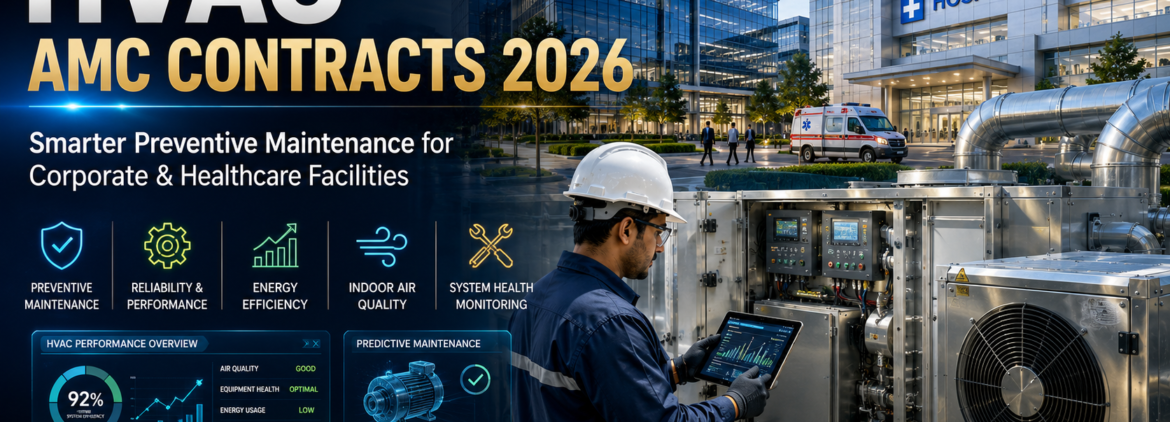
Modern buildings no longer view HVAC systems simply as equipment that provides cooling. In large corporate campuses and healthcare facilities, HVAC infrastructure directly influences indoor air quality, energy consumption, occupant comfort, equipment reliability, operational continuity, and the overall performance of the building.
As facilities become larger and more technology-driven, the traditional approach of calling technicians only after an air-conditioning system breaks down is becoming increasingly inadequate. Organisations are moving towards structured HVAC AMC Contracts that focus on preventive maintenance, system performance, energy management, documentation, and long-term asset reliability.
This shift is particularly relevant in 2026, when facility managers are dealing with rising expectations around energy efficiency, indoor environmental quality, operational resilience, and data-driven maintenance. In healthcare environments, HVAC management is even more critical because ventilation and environmental conditions can form part of infection-control, patient-care, and life-safety considerations. ASHRAE’s current healthcare guidance specifically addresses ventilation, temperature, humidity, outdoor air, odour control, and asepsis in healthcare environments.
What Is an HVAC AMC Contract?
An HVAC AMC (Annual Maintenance Contract) is a structured agreement between a facility owner or operator and an HVAC service provider for planned inspection, preventive maintenance, servicing, troubleshooting, and repair of HVAC equipment over an agreed period.
Instead of depending entirely on emergency breakdown calls, an AMC establishes a maintenance schedule based on the facility’s equipment, operating conditions, usage patterns, and business requirements.
A comprehensive agreement may cover air-conditioning units, AHUs, chillers, cooling towers, pumps, ventilation systems, ductwork, filters, controls, exhaust systems, and associated components.
For large campuses, the objective is not merely to repair individual machines. It is to maintain the entire HVAC ecosystem as a connected building asset.
Why Corporate Campuses Need Professional HVAC Maintenance Contracts
Corporate campuses can contain hundreds of HVAC assets distributed across offices, meeting rooms, server areas, cafeterias, common areas, reception zones, conference facilities, and support buildings.
A failure in one section can affect employee comfort, productivity, meetings, technology infrastructure, or business operations.
A structured Office HVAC Maintenance Contract helps facility teams transition from reactive repairs towards planned maintenance. Scheduled inspections can identify dirty filters, abnormal vibration, refrigerant issues, electrical problems, drainage blockages, airflow restrictions, deteriorating components, and other developing faults before they become major failures.
For multi-building campuses, centralised maintenance records also help management understand equipment condition and plan replacements more effectively.
2026 Trend: HVAC Preventive Maintenance Is Becoming More Strategic
One of the most important trends in 2026 is the movement from basic servicing towards HVAC Preventive Maintenance Plans designed around asset performance and lifecycle management.
Instead of asking only whether an AC unit is currently functioning, facility managers are increasingly interested in questions such as:
Is the equipment consuming more energy than expected? | Is airflow declining? | Are filters loading too quickly? | Is the compressor showing abnormal behaviour? | Is the AHU maintaining required conditions? | Is the system approaching the end of its useful life?
This approach makes maintenance more proactive and can help reduce unexpected breakdowns.
ASHRAE’s Standard 180 provides a recognised framework for inspection and maintenance of commercial building HVAC systems, reinforcing the importance of structured maintenance practices rather than purely reactive servicing.
2026 Trend: Energy Efficiency Is Moving to the Centre of HVAC AMC
HVAC systems are major contributors to building energy consumption. Consequently, maintenance is increasingly being viewed as an energy-management activity as well as an engineering function.
Poorly maintained filters, coils, fans, motors, heat-transfer surfaces, and controls can affect system performance. A preventive maintenance programme can identify conditions that may contribute to unnecessary energy consumption.
This aligns with India’s wider emphasis on energy efficiency. The Bureau of Energy Efficiency works to reduce energy intensity across the economy and promote sustained adoption of energy-efficient practices.
A modern Commercial HVAC AMC India programme should therefore consider equipment condition, operating efficiency, maintenance history, and opportunities for optimisation not simply whether equipment is running.
2026 Trend: Indoor Air Quality Is Becoming a Facility Management Priority
Indoor air quality has moved beyond being a comfort-related discussion. Corporate occupants, healthcare professionals, patients, visitors, students, and facility managers increasingly expect buildings to provide appropriately managed indoor environments.
HVAC maintenance can contribute to this objective through filter management, ventilation checks, coil and AHU maintenance, duct inspection, airflow management, and appropriate cleaning practices.
ASHRAE’s current guidance recognises the connection between properly designed and maintained ventilation systems, acceptable indoor air quality, occupant comfort, and reduced risks associated with indoor contaminants.
For large corporate buildings, this can support employee comfort and workplace experience. For healthcare facilities, the requirements are more specialised.
Hospital HVAC Repair Services Require a Different Approach
Hospitals cannot treat HVAC maintenance in exactly the same way as a standard office building.
Patient rooms, operating rooms, isolation areas, intensive care units, laboratories, pharmacies, diagnostic areas, and other clinical environments may have different ventilation and environmental requirements.
ASHRAE/ASHE Standard 170-2025 establishes ventilation requirements for healthcare facilities and considers factors including temperature, humidity, outdoor air, ventilation rates, odour control, asepsis, and contaminants that may affect patients, healthcare workers, and visitors.
This makes Hospital HVAC Repair Services more than a conventional air-conditioning repair activity. Maintenance teams need to understand the operational sensitivity of healthcare environments and coordinate work carefully around clinical schedules and infection-control requirements.
A suitable healthcare AMC should therefore include documented maintenance procedures, planned intervention schedules, rapid response arrangements, equipment records, and appropriate escalation procedures.
Corporate AC Maintenance Agreements Are Becoming Data-Driven
Another important 2026 trend is greater use of technology in HVAC maintenance.
Large facilities can collect information about operating hours, temperature, pressure, energy use, equipment alarms, filter condition, maintenance history, and recurring faults.
When this information is organised effectively, maintenance teams can identify patterns that would otherwise remain hidden.
For example, repeated compressor faults in one building may indicate a deeper issue rather than several unrelated breakdowns. Similarly, rising energy consumption can trigger investigation before equipment performance deteriorates significantly.
This creates a pathway from conventional maintenance towards condition-based and predictive maintenance.
HVAC AMC Contracts Are Moving Beyond AC Servicing
A modern AMC should not be limited to cleaning filters and checking refrigerant levels.
For large facilities, the maintenance scope may include AHUs, chillers, pumps, cooling towers, ventilation systems, exhaust systems, controls, motors, electrical components, ductwork, filters, sensors, thermostats, and other supporting infrastructure.
Depending on the contract, the service provider may also conduct performance inspections, equipment health assessments, breakdown support, emergency response, maintenance reporting, and recommendations for replacement or refurbishment.
This broader approach allows facility managers to treat HVAC as a complete operational system rather than a collection of individual machines.
HVAC AMC Documentation Is Becoming More Important
In a large campus or healthcare facility, verbal updates are not enough.
A professional maintenance programme should generate clear records covering equipment identification, inspection dates, service activities, faults identified, corrective actions, parts replaced, outstanding issues, and recommendations.
Digital reporting can make this information easier to access and analyse.
Good documentation helps facility managers understand maintenance trends, verify service delivery, prepare budgets, support audits, and make informed decisions about equipment replacement.
For healthcare facilities in particular, documentation can become an important part of demonstrating that critical building systems are being managed systematically.
Duct Cleaning and HVAC AMC Should Work Together
One commonly overlooked issue is the relationship between HVAC equipment and ductwork.
Even when AHUs and cooling equipment are serviced regularly, accumulated dust or contamination inside duct systems can affect the overall ventilation environment.
For large campuses, an integrated maintenance programme may therefore include HVAC duct inspection and cleaning, AHU maintenance, filter management, airflow assessment, and other relevant ventilation services.
Where commercial kitchens, laundry facilities, laboratories, or specialised exhaust systems exist, these should also be assessed according to their specific operating conditions.
The result is a more comprehensive facility-wide approach.
How to Choose a Commercial HVAC AMC Provider in India
Choosing an AMC provider should not be based only on the lowest annual quotation.
Corporate and healthcare facilities should evaluate the provider’s technical capability, manpower strength, response time, equipment coverage, preventive maintenance methodology, reporting system, safety practices, escalation process, and experience with complex facilities.
It is also important to clarify what the AMC actually includes.
Preventive visits | breakdown response | spare parts | consumables | emergency support | equipment inspection | performance reporting | duct-related services | specialised HVAC equipment should be clearly defined in the agreement.
A transparent scope reduces misunderstandings and enables facility managers to compare proposals on genuine service value.
The Future of HVAC AMC in 2026 and Beyond
The future of HVAC maintenance is increasingly focused on reliability, efficiency, indoor air quality, data, sustainability, and lifecycle management.
Corporate campuses are looking for HVAC systems that support employee experience without unnecessary energy consumption. Healthcare facilities need reliable ventilation and environmental control that align with the specialised requirements of patient-care areas.
The role of the AMC provider is consequently evolving. A service partner is no longer simply expected to arrive after equipment fails. The stronger model is one where the provider continuously monitors system condition, identifies potential problems, documents performance, recommends improvements, and helps facility management teams make better long-term decisions.
This is the direction in which professional Commercial HVAC AMC India services are increasingly moving.
Conclusion
HVAC maintenance in 2026 is becoming more strategic, preventive, data-driven, and performance-oriented. For corporate campuses, a professional Corporate AC Maintenance Agreement can help reduce reactive breakdowns, improve equipment reliability, support occupant comfort, and provide greater visibility into long-term HVAC performance.
For healthcare facilities, the importance is even greater because ventilation and environmental control are closely connected with specialised patient-care requirements.
The strongest HVAC Preventive Maintenance Plan is therefore not simply a list of service visits. It is a structured asset-management strategy that combines preventive inspection, timely repairs, equipment performance monitoring, indoor air quality considerations, documentation, and long-term planning.
For organisations managing large and complex buildings, investing in a professionally structured AMC can transform HVAC maintenance from a recurring operational problem into a controlled, measurable, and strategic facility-management function.
D-SOL Facilities: Professional HVAC AMC & Facility Maintenance Services
D-SOL Facilities provides professional Commercial HVAC AMC India solutions for corporate campuses, healthcare facilities, hospitals, hotels, educational institutions, industrial facilities, commercial buildings, and other large-scale properties. Its services cover HVAC preventive maintenance, office HVAC maintenance contracts, hospital HVAC repair services, corporate AC maintenance agreements, AHU maintenance, HVAC duct cleaning, robotic HVAC duct cleaning, kitchen exhaust cleaning, industrial laundry duct cleaning, indoor air quality assessments, ventilation maintenance, and facility-focused HVAC support. The company combines trained technical professionals, structured preventive maintenance programmes, systematic inspections, advanced cleaning technology, detailed service reporting, and responsive breakdown support to help organisations improve HVAC reliability, indoor environmental quality, energy performance, and equipment lifecycle management. Its approach focuses on long-term facility performance rather than one-time repair work, making D-SOL Facilities a suitable maintenance partner for organisations seeking a more professional and preventive approach to HVAC management.
Contact D-SOL Facilities
Call for service: +91 84483 96120 | +91 84483 96121
Email: rohit@dsolfacilities.com | hemraj@dsolfacilities.com