
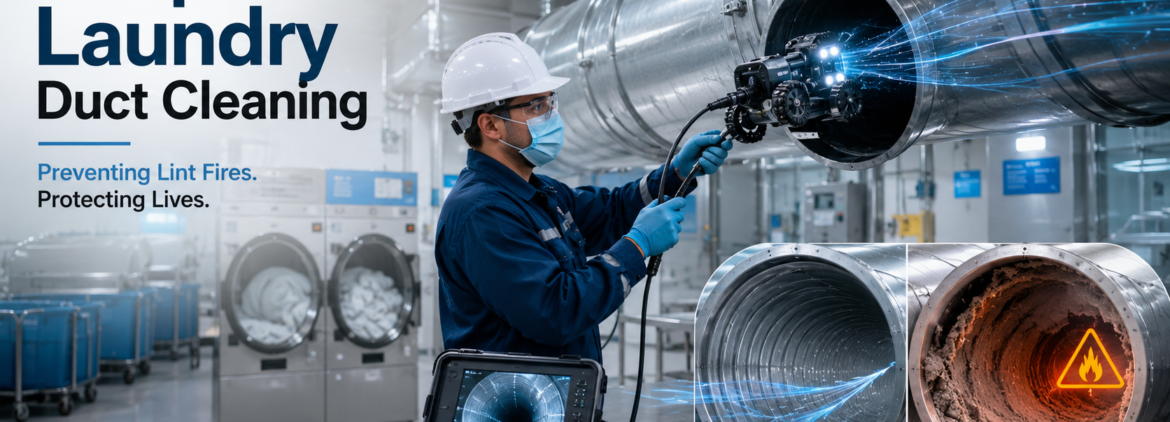
In the high-stakes environment of modern healthcare, fire safety is not merely a regulatory obligation but a fundamental pillar of patient protection and operational integrity. While hospitals invest heavily in fire alarms, sprinklers, and emergency protocols, one of the most insidious and often overlooked hazards lurks within the laundry ventilation system. Across India, from tier‑one metropolitan hospitals to district healthcare centres, the accumulation of lint in laundry dryer ducts presents a clear and present fire risk. This article examines the critical importance of professional hospital laundry duct cleaning, the science behind lint‑related fires, and why healthcare administrators must prioritise this maintenance task as a non‑negotiable component of facility risk management.
The Hidden Danger: Why Lint Accumulation Demands Immediate Attention
Hospital laundry operations are vastly different from domestic or commercial laundries. The sheer volume of linens patient gowns, bed sheets, surgical drapes, towels, and staff uniforms processed daily in a healthcare facility generates an enormous quantity of lint. Lint consists of tiny, highly combustible fibres that detach from fabrics during the drying cycle. When warm, moist air carrying these fibres passes through dryer exhaust ducts, a portion of the lint adheres to the interior duct walls.
Over weeks and months, this layer of lint accumulates, narrowing the duct’s cross‑section and restricting airflow. The consequences are twofold. First, restricted airflow forces dryers to work harder and longer, increasing energy consumption and reducing equipment lifespan. Second, and far more critically, lint is exceptionally flammable. A single spark—whether from a static discharge, an overheating dryer motor, or a malfunctioning heating element—can ignite the accumulated lint, sending flames rapidly through the ductwork and into the laundry area. In a hospital setting, where oxygen lines and vulnerable patients are present, such a fire can escalate to catastrophic proportions within minutes.
Regulatory Landscape and Fire Safety Standards for Indian Healthcare Facilities
Indian healthcare facilities operate under the guidelines of the National Building Code (NBC) of India, the Electrical Inspectorate, and various state‑level fire safety regulations. Additionally, accreditation bodies such as the National Accreditation Board for Hospitals & Healthcare Providers (NABH) mandate rigorous fire safety protocols. However, the specific requirement for regular laundry duct cleaning is often buried within broader maintenance clauses, leading to inconsistent compliance.
A review of fire incident data from Indian hospitals reveals a troubling pattern: a significant number of laundry‑related fires are attributed to neglected duct cleaning schedules. The common narrative involves a routine drying cycle, a sudden temperature spike, and a rapid spread of fire through uncleaned ducts. These incidents, while often contained before causing casualties, represent near‑miss events that should serve as wake‑up calls. The financial costs—equipment damage, operational downtime, and potential litigation—are substantial, but the reputational damage to a healthcare institution can be even more severe.
The Science of Lint Fire Risk: Understanding the Combustion Triangle
To appreciate the necessity of professional duct cleaning, one must understand the combustion triangle: fuel, heat, and oxygen. Lint provides the fuel in abundance. The heat source is typically the dryer’s heating element, which can reach temperatures well above the ignition point of cotton‑based lint (approximately 255°C or 490°F). Oxygen is continuously supplied by the dryer’s forced‑air system. When all three elements converge, fire is inevitable.
What makes hospital laundry ducts uniquely dangerous is the presence of fine, floating lint particles within the duct. These particles have a high surface‑area‑to‑volume ratio, making them exceptionally reactive to heat. Furthermore, hospitals often dry linens treated with various detergents and softeners, some of which may leave chemical residues that lower the ignition temperature of the lint. Without routine mechanical cleaning using specialised rotary brushes, high‑pressure vacuum systems, and often dry‑ice blasting for stubborn deposits, the risk multiplies exponentially.
Why Professional Duct Cleaning Is Non‑Negotiable
In‑house maintenance teams, however skilled, typically lack the specialised equipment and training required for thorough laundry duct cleaning. Standard vacuum cleaners cannot navigate the bends, vertical runs, and long horizontal stretches of commercial ductwork. Moreover, without access to robotic cameras and inspection tools, a visual assessment from the duct opening is rarely sufficient to reveal the true extent of lint accumulation.
Professional duct cleaning services employ a multi‑step methodology. Initially, a comprehensive inspection using closed‑circuit television (CCTV) cameras identifies the thickness, location, and density of lint deposits. Following this, mechanical agitation using specialised brushes loosens adhered lint, while industrial‑grade HEPA‑filtered vacuum systems capture the debris before it can re‑enter the laundry environment. For ducts with heavy grease or chemical residues, advanced techniques such as dry‑ice blasting may be employed, which cleans without introducing secondary moisture or chemical waste. Finally, a post‑cleaning video inspection provides verifiable proof of a clean, unobstructed duct system.
Operational and Financial Benefits Beyond Fire Prevention
While fire risk mitigation is the primary driver, regular hospital laundry duct cleaning delivers substantial secondary benefits. Clean ducts allow dryer exhaust systems to operate at designed airflow rates, reducing drying times by 15–25 per cent. This translates directly into lower electricity and natural gas bills, as well as extended life for expensive commercial drying equipment. In a typical Indian hospital processing several tonnes of laundry weekly, these savings can cover the cost of annual professional cleaning multiple times over.
Additionally, clean ducts improve indoor air quality. Partially blocked ducts can force lint‑laden air back into the laundry area or, worse, into patient corridors. Airborne lint particles are known irritants that can exacerbate respiratory conditions in vulnerable patients. Maintaining clean ductwork is therefore an indirect but meaningful contributor to patient comfort and health outcomes.
Best Practices for Healthcare Facility Managers
For hospital administrators and facility managers across India, implementing a robust laundry duct cleaning regimen involves several key steps. First, conduct a baseline inspection of all dryer exhaust ducts to document current lint accumulation levels. Second, establish a cleaning schedule based on laundry volume and dryer usage; for large hospitals, quarterly cleaning is often recommended, while smaller facilities may suffice with bi‑annual cleaning. Third, maintain a digital log of all cleaning activities, including pre‑ and post‑cleaning inspection videos, to demonstrate compliance during NABH or fire safety audits. Fourth, train laundry staff to recognise early warning signs of duct blockage, such as unusually long drying cycles, excessive heat in the laundry area, or visible lint escaping from duct joints.
The Role of Specialised Service Providers Across India
Given the geographical breadth of India, from Jammu to Chennai and from Mumbai to Guwahati, access to qualified duct cleaning professionals has historically been inconsistent. However, a new generation of specialised facility management companies now offers nationwide coverage, using mobile teams equipped with advanced cleaning technology. These providers understand the unique constraints of healthcare environments, including the need to perform cleaning during off‑peak hours without disrupting critical laundry operations. For hospitals without in‑house expertise, partnering with a verified, experienced contractor is the most reliable path to sustained safety.
About the Company
We are a premier provider of specialised facility management and industrial cleaning services across India, with a proven track record in healthcare, hospitality, and commercial sectors. Our core offerings include hospital laundry duct cleaning, kitchen exhaust cleaning, HVAC duct sanitation, and comprehensive fire risk prevention solutions. What sets us apart is our unwavering commitment to verifiable quality: every cleaning project begins with a video inspection and ends with a detailed post‑cleaning report, including visual evidence of results. Our teams are trained in healthcare‑sensitive protocols, ensuring minimal disruption to patient care areas. We operate a pan‑India service network, combining local responsiveness with national standards of excellence. For hospital administrators seeking to eliminate lint fire risks, optimise laundry efficiency, and demonstrate regulatory compliance, we offer not just a service but a long‑term partnership in safety. Call for reservation: +91 84483 96120 | +91 8448396121, or email rohit@dsolfacilities.com and hemraj@dsolfacilities.com. Visit our website at www.dsolfacilities.com to learn more about how we protect healthcare facilities across India.