
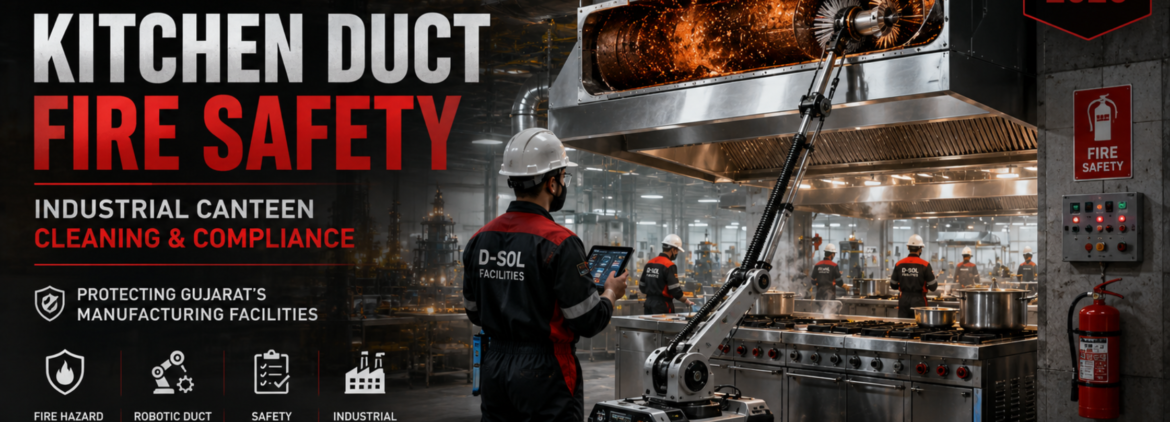
Industrial canteens are the lifeline of Gujarat’s manufacturing hubs, from Ahmedabad’s textile zones to Vadodara’s petrochemical complexes and Rajkot’s engineering clusters. These high-volume kitchens operate daily, preparing hundreds of meals under tight schedules. Yet, one overlooked hazard lurks within their exhaust systems: grease-laden kitchen ducts. In 2026, as Gujarat intensifies its industrial safety audits under the Factories Act and Gujarat Fire Prevention and Life Safety Measures Rules, kitchen duct cleaning has moved from a mere maintenance task to a statutory necessity. This article outlines authoritative best practices to prevent devastating duct fires, protect workers, and ensure regulatory compliance.
Why Industrial Canteen Fire Safety Demands Urgent Attention in Gujarat
Gujarat accounts for over 15% of India’s large-scale industrial units, with canteens operating in nearly every facility. The risk is simple yet severe: cooking oils and grease vapours travel through exhaust hoods and settle inside ducts as sticky, flammable deposits. When a spark, from an overheated fryer, damaged fan motor, or even a spark from metal-against-metal contact, ignites this grease, flames can spread through the duct system in seconds, reaching roof tops and adjacent areas. In 2025 alone, several minor industrial kitchen fires were reported across Ahmedabad and Surat, many traced to neglected duct hygiene. For 2026, proactive fire safety is not optional; it is a legal and moral imperative.
Understanding the Hidden Danger of Grease Accumulation in Kitchen Exhaust Systems
The kitchen exhaust system comprises the hood, filters, ductwork, and exhaust fan. While filters capture large grease particles, microscopic grease droplets pass through and coat the interior of the ducts. Over time, this layer becomes thick, carbonised, and highly combustible. According to the National Fire Protection Association (NFPA) Standard 96, widely referenced by Gujarat’s fire departments, if the grease layer exceeds 0.1 inches (2.5 mm), the risk of ignition becomes critical. In many industrial canteens, where cooking volumes are high and cleaning cycles are irregular, deposits can reach several millimetres within three to six months. The hidden nature of these deposits makes regular professional inspection indispensable.
Statutory Requirements for Industrial Canteen Fire Safety in Gujarat
Under the Gujarat Factories Rules, 1963 (amended up to 2023), any factory employing more than 250 workers must maintain a canteen. The same rules, read with the Gujarat Fire Prevention and Life Safety Measures Rules, 2019, mandate that all cooking areas and exhaust systems be kept free of grease accumulation to prevent fire. Furthermore, the Chief Inspector of Factories has issued circulars emphasising periodic cleaning of kitchen ducts as part of the annual safety audit. Non-compliance can lead to hefty fines, suspension of canteen operations, and even criminal liability in case of a fire causing injury.
Key Compliance Deadlines for 2026
From January 2026, Gujarat’s Industrial Safety and Health Directorate has announced surprise inspections targeting high-risk canteens. Facilities must maintain a documented cleaning log, including dates, methods, and before-after photographs of duct interiors. Failure to produce such records is treated as a violation. Therefore, aligning with best practices now is essential.
Kitchen Duct Cleaning Best Practices for 2026
To achieve both safety and compliance, industrial canteen managers should adopt the following evidence-based practices.
1. Determine the Correct Cleaning Frequency
The frequency of cleaning depends on the cooking volume. As a rule of thumb derived from NFPA 96 and adapted for Indian industrial kitchens:
- Heavy-volume cooking (24/7 canteens, multiple shifts, deep-frying daily): Clean every 1 to 2 months.
- Moderate-volume cooking (single shift, varied menu): Clean every 3 to 4 months.
- Low-volume cooking (only reheating or light cooking): Clean every 6 months.
For 2026, the Gujarat Fire and Emergency Services recommends a baseline of quarterly cleaning for all industrial canteens, regardless of volume, given the region’s ambient heat and dust that can accelerate grease hardening.
2. Use Professional Mechanical Cleaning Methods
Chemical spray-and-rinse methods are insufficient for thick grease deposits. Best practice involves mechanical scraping with specialised tools, followed by steam cleaning or high-pressure hot water washing. The duct interior must be manually accessed through inspection hatches installed every 3 to 4 metres. Rotating brush systems and vacuum extraction of loosened debris ensure no residue remains. For horizontal ducts, special care is needed as grease pools at low points.
3. Enforce Access Panel Installation and Inspections
Many older industrial canteens in Gujarat lack adequate access panels in their ductwork. Without them, thorough cleaning is impossible. The 2026 best practice includes retrofitting all ducts with access panels at every change of direction and every 3 metres of straight run. These panels allow internal inspection using a borescope camera. Regular internal imaging provides proof of cleanliness and early detection of wear or corrosion.
4. Train Kitchen Staff on Fire Prevention and Emergency Response
Cleaning alone is insufficient without behavioural controls. All canteen staff should receive annual training on:
- Daily cleaning of hood filters and drip trays.
- Recognising signs of grease fires (orange flames, black smoke from exhaust).
- Using a Class K (wet chemical) fire extinguisher, never water on a grease fire.
- Emergency shutdown procedures for exhaust fans (running fans can fan the flames).
5. Maintain Detailed Documentation for Audits
Create a fire safety logbook specifically for the kitchen exhaust system. Record each cleaning date, duration, cleaning agency name, any repair work, and attach photos of duct interiors before and after. Also log filter cleaning (daily) and inspection hatch checks. This document becomes your primary defence during a factory inspector’s visit.
Consequences of Neglecting Duct Cleaning: Real Risks for Gujarat Industries
The aftermath of a duct fire is catastrophic. Beyond the direct cost of fire damage to the canteen roof and equipment, the facility may face weeks of downtime while insurance investigations proceed. Workers lose access to meals, morale drops, and contract labour may refuse to work without canteen services. In severe cases, a fire can spread to the main factory building or chemical storage areas, causing loss of life. Gujarat’s industrial areas are densely packed; a single fire can endanger neighbouring units. Legal penalties under the Factories Act can reach ₹5 lakh per violation, with possible imprisonment for wilful negligence. Insurance claims for fire damage may be denied if the facility cannot produce evidence of regular duct cleaning. Thus, best practices are also sound financial risk management.
How to Select a Qualified Kitchen Duct Cleaning Service Provider
Not all cleaning agencies deliver fire-safety-grade results. A competent provider for 2026 should:
- Provide a written methodology aligned with NFPA 96 or Indian Standard 14489 (Fire Safety).
- Use mechanical scraping and high-pressure hot water extraction, not just degreaser spray.
- Offer pre- and post-cleaning video inspection reports.
- Carry liability insurance and workmen’s compensation for their staff.
- Have experience with industrial kitchens, not just restaurant ducts.
For industrial canteens across Gujarat, from Ankleshwar to Mehsana, partnering with a specialised industrial cleaning company ensures compliance and peace of mind.
D-SOL Facilities
D-SOL Facilities is a trusted industrial hygiene and fire safety services provider operating across Gujarat, with a strong focus on Ahmedabad’s industrial canteens. The company specialises in professional kitchen duct cleaning, exhaust hood cleaning, grease trap maintenance, and comprehensive fire risk assessments for factories and large-scale catering units. Their USP lies in combining advanced mechanical cleaning equipment, certified safety protocols, and transparent reporting, including high-definition duct interior imaging before and after every service. With a dedicated team trained in NFPA 96 guidelines and Gujarat factory safety norms, D-SOL Facilities ensures that your industrial canteen meets 2026 compliance standards while minimising fire hazards. They also offer tailored maintenance contracts that align cleaning frequencies with your cooking volume, helping you avoid costly penalties and operational disruptions.
Contact Us
Call for reservation: +91 8527548444 | +91 97178 81177 | +91 84483 96120 | +91 84483 96121
Email: rohit@dsolfacilities.com | hemraj@dsolfacilities.com