
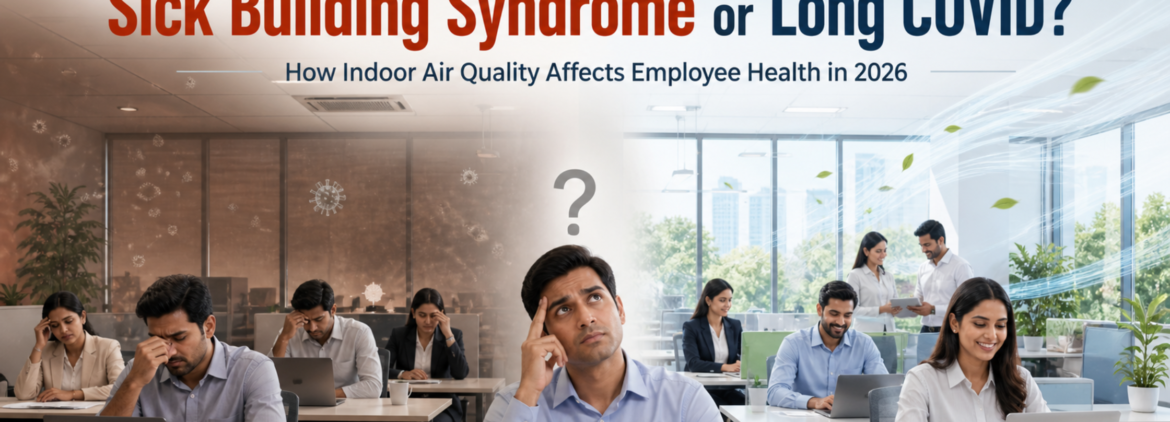
The Occupational Health Conundrum of the Decade
Three years into the post-pandemic workplace transformation, corporate medical officers and facility managers face an unprecedented diagnostic challenge. Employees presenting with persistent fatigue, cognitive fog, respiratory irritation, and recurring headaches walk into occupational health clinics with a singular question: Is this Long COVID, or is my workplace making me sick?
The answer, increasingly illuminated by environmental health research in 2026, lies not in binary diagnostics but in a complex interplay between viral sequelae and the built environment. Indoor Air Quality has emerged as the critical variable that separates recovery from recurrence, productivity from presenteeism, and employee retention from attrition.
Differentiating the Symptoms: Why Misdiagnosis Prolongs Suffering
Sick Building Syndrome and Long COVID share a remarkably convergent symptom profile. Both conditions manifest as fatigue that sleep does not resolve, concentration deficits that impair complex task execution, mucosal irritation affecting eyes and respiratory passages, and unpredictable symptom flares triggered by environmental stressors.
However, critical distinctions exist. Long COVID typically presents with a known or suspected prior SARS-CoV-2 infection and may include orthostatic intolerance, palpitations, or parosmia distortions of smell and taste. Sick Building Syndrome, by contrast, consistently improves when the affected individual leaves the workplace, often resolving completely within hours to days away from the building. This spatial pattern of symptom relief remains the most reliable differentiator available to occupational physicians.
Yet hybrid work schedules have complicated this picture. Employees spending three days in the office and two at home may never achieve the prolonged absence necessary to distinguish building-related symptoms from persistent post-viral illness. The result is a diagnostic grey zone where thousands of workers continue suffering without clear attribution.
The Hidden Variables: Volatile Organic Compounds and Carbon Dioxide Accumulation
Modern office environments concentrate airborne contaminants in ways that natural ventilation historically prevented. Open floor plans, energy-efficient building envelopes, shared mechanical systems, and prolonged occupancy hours create conditions where pollutant levels consistently exceed health-based thresholds.
Carbon dioxide accumulation serves as the most accessible indicator of inadequate ventilation. When CO₂ concentrations exceed 800 parts per million, cognitive function declines measurably. At levels above 1,200 ppm, common in meeting rooms and open-plan areas during afternoon hours decision-making capacity diminishes by approximately 50 percent compared to baseline. These are not speculative figures but replicated findings from controlled environmental studies.
Volatile organic compounds present a more complex challenge. Office furniture manufactured with engineered wood products releases formaldehyde continuously. Carpet adhesives, cleaning chemicals, printer emissions, and even personal care products worn by occupants contribute to the total VOC burden. When ventilation rates fall below American Society of Heating, Refrigerating and Air-Conditioning Engineers standards, these compounds accumulate to concentrations that trigger inflammatory responses in susceptible individuals.
Particulate Matter and Biological Contaminants: The Respiratory Burden
Fine particulate matter measuring 2.5 micrometres or smaller penetrates deeply into alveolar tissue, where it initiates inflammatory cascades. Inadequate filtration allows outdoor pollution traffic emissions, industrial discharges, and seasonal pollen to infiltrate indoor spaces. Additionally, indoor sources including paper dust, textile fibres, and printer toner contribute to the total particulate burden.
Biological contaminants amplify these effects. Humidification systems maintained improperly become reservoirs for fungal growth. Condensate drain pans, cooling coils, and duct linings harbour microbial communities that aerosolize directly into occupied spaces. Legionella species, endotoxins from bacterial biofilms, and fungal spores trigger both allergic responses and non-allergic inflammatory reactions.
For employees recovering from COVID-19 infection, these biological contaminants represent a particular vulnerability. Post-viral immune dysregulation means that levels of exposure previously tolerated now produce symptomatic responses. The employee diagnosed with Long COVID may in fact be experiencing building-related exacerbation of underlying viral sequelae, a recursive relationship that demands integrated environmental and medical management.
Long COVID as an IAQ Amplifier: Heightened Susceptibility in 2026
Evidence accumulated through 2025 indicates that prior COVID-19 infection reduces the threshold at which indoor pollutants produce symptoms. The mechanisms involve persistent mast cell activation, autonomic nervous system dysfunction, and impaired pulmonary clearance. These physiological changes mean that buildings previously considered healthy now generate symptoms in employees with post-viral conditions.
This finding transforms facility management from a compliance exercise to a clinical intervention. Ventilation rates that met pre-pandemic standards no longer protect the current workforce, as an estimated 15 to 20 percent of employees carry some form of post-viral vulnerability. The building that did not cause illness before 2020 may now produce disabling symptoms in a substantial proportion of its occupants.
Quantifying the Economic Imperative: Productivity and Presenteeism
The financial argument for IAQ investment has matured considerably since 2020. Lost productivity from Sick Building Syndrome-related presenteeism employees physically present but functioning at reduced capacity costs organisations approximately three times what absenteeism costs. When employees cannot determine whether their symptoms originate from the building or from Long COVID, they tend to remain at work rather than file formal complaints, compounding performance deficits across teams.
Measured improvements in ventilation and filtration produce demonstraible returns. Organisations upgrading to MERV-13 filtration, increasing outdoor air fractions to 50 percent or higher, and maintaining relative humidity between 40 and 60 percent consistently document 15 to 25 percent reductions in sick leave utilisation and 8 to 12 percent improvements in cognitive task performance. These benefits apply across the workforce, not only to employees with documented vulnerabilities.
Implementing an IAQ Investigation Protocol
Organisations uncertain whether building conditions contribute to employee symptoms should conduct structured environmental assessments. Real-time monitoring of CO₂, temperature, relative humidity, and particulate matter across multiple zones and time periods establishes baseline conditions. Targeted VOC sampling identifies specific pollutant sources. Airflow visualisation using smoke tubes or tracer gases reveals distribution patterns and dead zones where contaminant accumulation occurs.
Medical surveillance complements environmental monitoring. Tracking symptom patterns in relation to building occupancy, shift times, and specific work locations distinguishes building-related illness from other causes. When symptoms correlate with time spent in particular zones or with specific mechanical system operating schedules, the evidence for building causation strengthens considerably.
A Path Forward: Integrated Environmental Health Management
The confusion between Sick Building Syndrome and Long COVID ultimately serves a useful purpose. It forces recognition that indoor environments profoundly influence human health and that the distinction between building-related illness and other conditions matters less than the identification of actionable environmental interventions.
For organisations committed to employee well-being, the path forward includes continuous IAQ monitoring protocols, ventilation systems designed for variable occupancy and enhanced outdoor air delivery, filtration capable of removing both particulate and gaseous contaminants, humidity management that suppresses biological growth, and regular building walkthroughs that identify and remediate pollutant sources.
About D-SOL Facilities
D-SOL Facilities delivers comprehensive integrated facility management solutions with specialised expertise in indoor environmental quality assessment and remediation. The company provides HVAC system optimisation, ventilation audits, air quality monitoring implementation, mould inspection and remediation, and post-remediation verification services. Their distinct advantage lies in combining engineering rigour with occupational health principles, offering clients evidence-based interventions rather than generic recommendations. D-SOL Facilities maintains particular proficiency in post-pandemic workplace assessments, helping organisations distinguish between building-related illness and other health conditions through systematic environmental investigation. Their multidisciplinary team includes certified industrial hygienists, mechanical engineers, and indoor air quality professionals who deliver turnkey solutions from initial assessment through system upgrade implementation. Clients benefit from their proprietary IAQ investigation protocol developed specifically to address the diagnostic complexity of contemporary workplace health complaints.
Contact Us
Call for reservation: +91 84483 96120 | +91 8448396121
Email: rohit@dsolfacilities.com | hemraj@dsolfacilities.com
www.dsolfacilities.com