
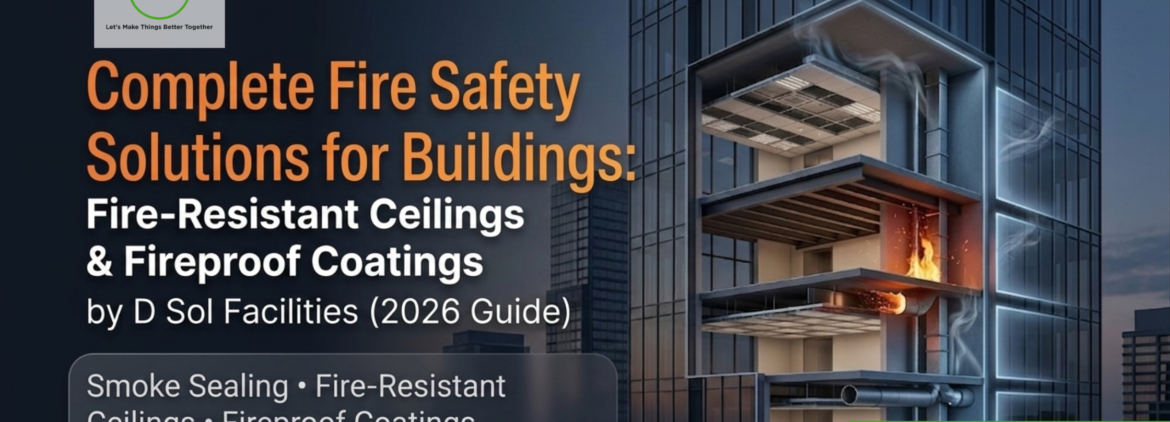
In the evolving landscape of building safety, fire protection has transcended basic alarms and sprinklers. Today, passive fire protection systems built into the structure determine whether a minor incident becomes a catastrophic loss. As we move through 2026, building owners, facility managers, and architects are seeking integrated solutions that address every vulnerable point: ceilings that fail under heat, ductwork that funnels smoke across floors, and structural steel that buckles without warning. This comprehensive guide explores the complete spectrum of fire safety solutions, from smoke sealing to fire-resistant ceilings and advanced fireproof coatings.
Why 2026 Demands a Holistic Fire Safety Strategy
Recent building code updates and high-profile fire incidents have shifted regulatory focus toward compartmentation and containment. Smoke, not flames, causes the majority of fire-related casualties. Additionally, modern construction materials lightweight steel, engineered wood, synthetic insulation behave differently under fire than traditional masonry. A holistic strategy combines three essential layers: smoke sealing to block toxic fumes, fire-resistant ceilings to halt vertical spread, and fireproof coatings to preserve structural integrity. When these elements work together, a building gains critical minutes for evacuation and firefighting.
Smoke Sealing in Buildings: The First Line of Defence
Smoke sealing is often overlooked, yet it is arguably the most life-critical component of passive fire protection. During a fire, smoke travels through the path of least resistance: gaps around pipes, cable trays, duct joints, and wall penetrations. Once smoke enters stairwells and corridors, visibility drops to near zero within minutes, and toxic gases such as carbon monoxide and hydrogen cyanide incapacitate occupants long before flames reach them.
Professional smoke sealing involves applying intumescent sealants, firestop pillows, and specialised mastics to every penetration in a fire-rated assembly. These materials expand when exposed to heat, creating an airtight barrier that prevents smoke migration. The benefits extend beyond life safety. Containing smoke in the source compartment protects sensitive equipment, reduces property damage, and maintains tenable conditions for firefighters. Furthermore, properly sealed building envelopes improve HVAC efficiency by reducing unwanted air leakage a valuable secondary advantage for energy-conscious facilities.
Fire-Resistant Ceilings: Horizontal Fire Barriers That Save Structures
Ceilings are not merely overhead surfaces; in fire safety engineering, they are horizontal barriers that prevent flames and heat from rising to upper floors. A fire-resistant ceiling system is designed to withstand intense temperatures for a specified duration, typically 60 to 120 minutes, while maintaining structural support for the floor above.
Types of Fire-Resistant Ceiling Constructions
Self-supporting membrane ceilings are ideal for large open spaces such as atriums, auditoriums, and warehouse mezzanines. These systems do not rely on additional hangers; instead, they integrate fire-resistant boards into a rigid framework. Access hatches with equivalent fire ratings allow maintenance without compromising safety.
Suspended membrane ceilings are installed from below using a grid system of metal channels. They are common in office towers and commercial buildings where quick installation and aesthetic flexibility are priorities. The suspension height and fixing rigidity must be carefully calculated, as sagging under heat can create openings for fire penetration.
Trafficable ceiling systems represent the premium tier. These robust assemblies allow light maintenance traffic from above, making them suitable for mechanical floors, plant rooms, and service corridors. A trafficable ceiling uses high-density fire boards supported by steel framing that can bear the weight of technicians and equipment.
All fire-resistant ceilings must be tested to global standards. The systems maintain integrity even under high-pressure hose streams used during firefighting, preventing water damage from cascading through multiple floors.
Fireproof Coatings: Defending Every Substrate
Not every building element can be wrapped in boards or encased in concrete. This is where fireproof coatings, intumescent paints, cementitious sprays, and specialised formulations, provide versatile protection for diverse materials.
Fireproof Paints for Structural Steel
Structural steel loses 50% of its strength at approximately 550°C. Intumescent coatings applied to steel beams and columns swell when heated, forming an insulating char that delays temperature rise. These coatings can achieve fire ratings from 30 to 120 minutes while leaving the steel’s profile visible, preserving architectural aesthetics.
Fire Retardant Coatings for Wood and Plywood
Wooden elements, mezzanine decks, wall panelling, decorative beams—require surface treatment that alters combustion chemistry. Fire retardant coatings for wood generate a non-flammable char layer that reduces flame spread and smoke development. For plywood used in false ceilings or cabinetry, a fire retardant polish finish provides Class A protection without hiding the natural grain.
Fire Resistant Coatings for GI Ducts and HVAC Systems
Ductwork is a hidden highway for fire. GI ducts coated with intumescent or ceramic-based fire resistant coatings can withstand direct flame exposure for up to two hours, preventing the duct from acting as a chimney. These coatings also protect cable trays, ventilation shafts, and air handling units.
Specialised Applications
The range of fireproof coatings extends to nearly every building material. For corrugated boxes and paper storage, fire proof coatings prevent rapid ignition. For gypsum boards and walls, fire resistant coatings enhance the inherent fire performance of drywall. For fabrics in auditorium curtains or upholstery, fire retardant coatings meet strict flame spread standards. Even bamboo, increasingly used in sustainable construction—can be treated with fire retardant bamboo coating to achieve code compliance.
Fire Stop Barriers for HT and LT Cables
Electrical risers in high-rise buildings contain bundles of high-tension and low-tension cables. In a fire, these cables can melt and spread flames vertically through the shaft. Fire stop barriers—intumescent pillows, wraps, and mortars, are installed at every floor level around the cable bundle. When heat is sensed, the barrier expands to seal the opening completely. This prevents fire from jumping floor to floor, containing damage to a single compartment.
Fire Safety for Mezzanines and Protected Zones
Mezzanines introduce special risks because they create horizontal surfaces that can bridge compartment walls. Fire-resistant mezzanine design involves coating structural steel, installing fire boards under the deck, and sealing all penetrations. Protected zones—areas where fire-resistance is concentrated, such as stairwells, plant rooms, and server centres—require a combination of fire-resistant ceilings, walls, doors, and smoke sealing. These zones serve as a refuge during evacuation and as a base for firefighting operations.
The 2026 Compliance Landscape
Building codes in India (NBC 2016 with 2023 amendments) and internationally have raised requirements for passive fire protection. Smoke sealing is now mandatory in all high-rise buildings for any penetration through fire-rated assemblies. Fire-resistant ceilings must maintain integrity under realistic fire curves, not just standard furnace tests. Fireproof coatings must have third-party certifications from recognised laboratories. Navigating this landscape demands a partner with certified products and documented expertise.
Why Professional Implementation Matters
Fire safety is not a DIY project. Gaps as small as one millimetre in a smoke seal can compromise an entire compartment. Incorrectly applied intumescent coating, too thin, too thick, or on unprepared steel, will fail when needed most. Professional providers bring certified applicators, project-specific engineering, and ongoing maintenance programs to ensure that the systems installed today will perform in a fire years later.
D Sol Facilities
D Sol Facilities is a specialised provider of complete fire safety solutions for commercial, industrial, and residential buildings. The company’s service portfolio encompasses smoke sealing using advanced intumescent sealants and firestop systems, installation of fire-resistant ceilings for compartmentation, and application of a comprehensive range of fireproof coatings. These include fire proof paints for wood and structural steel, fire stop barriers for HT and LT cables, fire resistant coatings for GI ducts, gypsum boards, fabrics, corrugated boxes, and bamboo, as well as fire retardant polish finishes for plywood. Beyond fire safety, D Sol Facilities offers conductive coatings, anti-magnetic coatings, fusion bond epoxy coatings, stainless steel coatings, barium chromate coatings, mastic sealants, vapour barrier sealants, alkali resistant coatings, anti-radiation coatings (RFID), silver heat resistant paint, heat transfer cement, electrical and heat conductive paints, epoxy and polyurethane paints, insulating varnish, heat resistant coatings for marine and pool applications, acid fume resistant coatings, silicon epoxy paint, dielectric epoxy paint, insulating epoxy varnish, epoxy fire proof paints, rust protective oil for metals, and food grade epoxy paints. The company’s unique selling proposition lies in its end-to-end service model: consultation, customised system design, professional installation using certified products from global leaders such as Hilti and Ameetuf, and ongoing maintenance. With decades of combined expertise and a customer-centric approach, D Sol Facilities delivers solutions that blend uncompromising safety with functional aesthetics and cost-effectiveness.
Contact Information
Call for reservation: +91 84483 96120 | +91 8448396121
Email: rohit@dsolfacilities.com | hemraj@dsolfacilities.com
Visit the official website: https://dsolfacilities.com/