
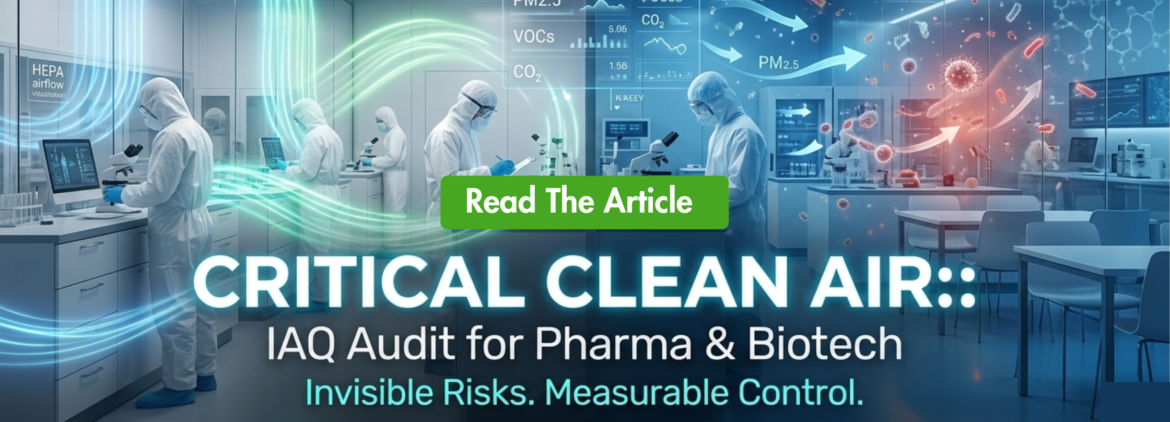
In the pharmaceutical and biotechnology industries, contamination is not merely a quality deviation, it is a direct threat to patient safety and product integrity. While stringent controls govern cleanrooms and manufacturing suites, two areas often remain dangerously overlooked: staff cafeterias and support laboratories. These spaces, if not properly managed, can become silent vectors of airborne contamination, compromising the very standards that Good Manufacturing Practices (GMP) seek to uphold.
The Hidden Contamination Risk: Why Pharma Cafeterias Demand IAQ Audits
A pharmaceutical manufacturing facility operates under rigid cleanroom classifications. Yet, the cafeteria, where hundreds of employees eat, converse, and move freely, often lacks comparable air quality oversight. This disparity creates a significant vulnerability.
Food handling areas generate bioaerosols, including bacteria and fungal spores, which can attach to clothing, hair, and personal belongings. Employees returning to production areas after breaks can inadvertently transport these contaminants into classified zones. A robust indoor air quality (IAQ) audit programme for pharma cafeterias therefore serves as a critical barrier between support spaces and sterile environments.
Key parameters for cafeteria IAQ audits include:
- Particulate matter (PM2.5 and PM10): Elevated levels from cooking and human activity
- Volatile organic compounds (VOCs): Generated from cleaning agents and food preparation
- Carbon dioxide (CO2): An indicator of ventilation effectiveness and occupancy density
- Microbiological air sampling: Detection of airborne moulds, yeasts, and bacteria
- Temperature and relative humidity: Factors influencing microbial proliferation
Regular IAQ audits in cafeterias, conducted quarterly or semi-annually depending on risk assessment, ensure that support zones do not become contamination sources.
The Silent Threat: When Laboratories Compromise Clean Environments
Biotechnology and quality control laboratories present a different but equally serious challenge. These spaces often handle live microorganisms, chemical reagents, and volatile solvents. Without proper containment and air handling, contaminants can escape into adjacent areas, including manufacturing suites.
The consequences extend beyond product contamination. Laboratory workers face chronic exposure to airborne hazards ranging from formaldehyde to acetonitrile vapours and biological agents. An effective IAQ audit programme addresses both product protection and personnel safety.
Critical compliance frameworks for biotech labs include:
- ISO 14644-1:2015: Defines cleanroom classification based on airborne particle concentration, ranging from ISO Class 1 (strictest) to ISO Class 9
- ISO 14698-1: Establishes principles for biocontamination control in cleanroom environments
- ANSI Z9.5 – Laboratory Ventilation: Establishes minimum control requirements for laboratory air contaminant removal
Biotech laboratories must undergo routine IAQ audits, typically annually for comprehensive assessments, with more frequent monitoring of high-risk zones where open handling of hazardous materials occurs.
Filtration Standards: The Technical Backbone of Clean Air
The effectiveness of any IAQ strategy hinges on proper filtration. For pharmaceutical and biotech facilities, this means deploying multi-stage filtration systems tailored to specific risk profiles.
HEPA filtration requirements:
High-efficiency particulate air (HEPA) filters must achieve a minimum efficiency of 99.97 per cent for particles of 0.3 micrometres, making them indispensable for cleanroom air management. In ISO Class 5 environments, where sterile compounding occurs, terminal HEPA modules or fan filter units deliver final-stage filtration directly at air entry points.
Air change rates per hour:
Cleanliness classification directly correlates with air change requirements. ISO Class 8 environments typically require 15 to 25 air changes per hour (ACH). ISO Class 7 buffer rooms require a minimum of 30 ACH under USP guidelines, though a robust design may reach 50 ACH. ISO Class 5 zones demand 240 to 600 ACH to maintain sterility.
Cascading air pressure:
Facilities must operate with cascading air quality, maintaining higher pressure in cleaner zones to prevent infiltration from adjacent areas of lower classification.
Beyond Compliance: Protecting What Matters Most
The pharmaceutical and biotechnology sectors operate under some of the most demanding regulatory frameworks in industry. Yet compliance alone does not guarantee safety. A proactive IAQ audit programme achieves three essential outcomes:
- Contamination control strategy integration: Identifying sources, people, surfaces, utilities, materials, equipment, and air, then implementing physical and procedural barriers
- Worker health protection: Preventing chronic occupational exposures that lead to respiratory illness
- Operational continuity: Reducing costly downtime from contamination events, product recalls, or regulatory citations
A well-structured contamination control programme strengthens audit readiness, minimises costly downtime, and supports uninterrupted manufacturing.
When Clean Air Is Not Optional
For pharmaceutical cafeterias and biotech laboratories, IAQ audits are not optional enhancements, they are fundamental to the integrity of the entire operation. The air that circulates through break rooms, corridors, and support labs eventually reaches cleanrooms. Every compromised cubic metre is a potential pathway for contamination.
Industry best practice requires comprehensive IAQ audits at least annually, with more frequent reviews of monitoring data and trend analyses performed on a monthly or quarterly basis. High-risk areas, such as sterile production zones or laboratories handling hazardous substances, may require inspections every three to six months based on risk assessment.
Investing in rigorous IAQ audit programmes signals a commitment beyond regulatory minimums. It protects patients who depend on sterile products. It safeguards employees who spend decades working in these environments. And it preserves the reputation and operational viability of organisations dedicated to life-saving science.
D Sol Facilities
D Sol Facilities is a specialised provider of comprehensive air quality and fire safety solutions for pharmaceutical, biotechnology, and industrial environments. The company delivers IAQ audit services, smoke sealing systems, fire-resistant ceilings, fire stop barriers for high-tension and low-tension cables, and a complete range of fireproof coatings. Their service portfolio includes intumescent and fire proof paints for structural steel, wood, GI ducts, gypsum boards, fabrics, corrugated boxes, and bamboo, as well as fire retardant polish finishes for plywood. Beyond fire safety, D Sol Facilities offers conductive coatings, anti-magnetic coatings, fusion bond epoxy coatings, stainless steel coatings, barium chromate coatings, mastic sealants, vapour barrier sealants, alkali resistant coatings, anti-radiation coatings, heat transfer cement, electrical and heat conductive paints, epoxy and polyurethane paints, insulating varnish, marine and pool grade epoxy paints, acid fume resistant coatings, silicon epoxy paint, dielectric epoxy paint, insulating epoxy varnish, epoxy fire proof paints, rust protective oil for metals, and food grade epoxy paints. The company’s unique selling proposition is its end-to-end service model: consultation, customised system design, professional installation using certified products, and ongoing maintenance. With decades of combined expertise, D Sol Facilities delivers solutions that blend uncompromising safety with functional integrity.
Contact Information
Call for reservation: +91 84483 96120 | +91 8448396121
Email: rohit@dsolfacilities.com | hemraj@dsolfacilities.com
Visit the official website: www.dsolfacilities.com