
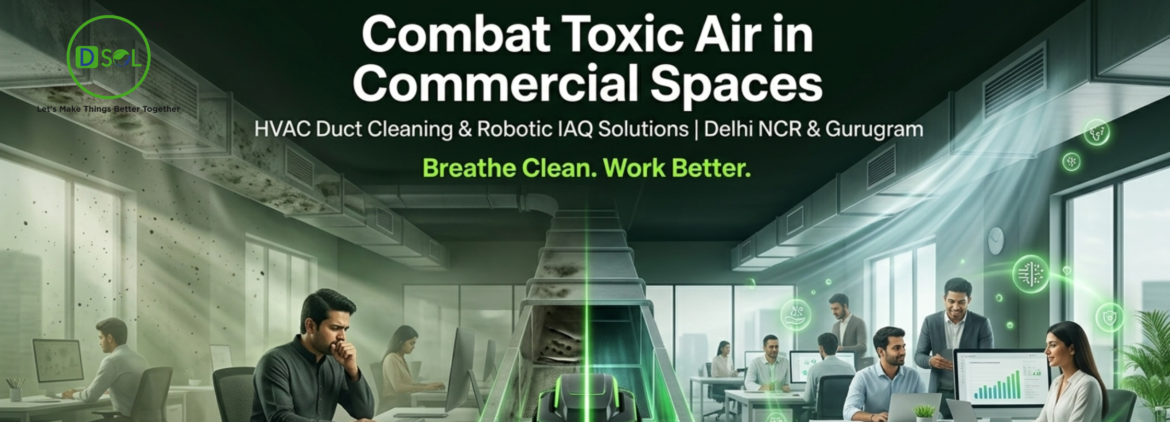
In the bustling commercial corridors of Delhi NCR and Gurugram, where glass facades pierce the sky and workspaces hum with productivity, an invisible adversary compromises both health and operational efficiency. The region’s notorious air quality challenges have transformed indoor environments from sanctuaries into potential hazard zones. For businesses, this presents a critical imperative: ensuring the air circulating within commercial spaces is not merely conditioned, but genuinely clean. The convergence of escalating pollution levels and heightened health awareness has elevated HVAC duct cleaning from routine maintenance to a strategic necessity, with robotic indoor air quality (IAQ) solutions emerging as the gold standard for modern facility management.
The Imperative for Clean Air in Commercial Environments
Delhi NCR consistently ranks among the world’s most polluted regions, with particulate matter infiltrating even the most sophisticated commercial buildings. Gurugram’s rapid urbanization has further intensified this challenge, as construction activity, vehicular emissions, and seasonal smog combine to create a persistent assault on indoor air quality. Within commercial spaces, offices, retail establishments, hospitality venues, and healthcare facilities, HVAC systems serve as the lungs of the building. When these systems accumulate dust, allergens, mold, and microbial contaminants, they recirculate these pollutants throughout the workspace, directly impacting occupant health, cognitive function, and absenteeism rates.
The consequences extend beyond health concerns. Contaminated HVAC systems operate under increased strain, consuming more energy while delivering diminished performance. For commercial enterprises in Gurugram’s competitive landscape, this translates to elevated operational costs and potential compliance risks with evolving workplace safety regulations. The economic case for rigorous duct maintenance has never been more compelling.
Limitations of Traditional Duct Cleaning Approaches
Conventional duct cleaning methods, reliant on manual brushes and basic vacuum systems, often fail to address the complex architecture of modern HVAC infrastructure. Commercial ductwork frequently features narrow passages, sharp bends, and extensive linear footage that resist thorough manual cleaning. Inadequate cleaning not only leaves contaminants in place but can also redistribute them throughout the system, exacerbating rather than resolving IAQ concerns.
Furthermore, traditional approaches lack the diagnostic capability to assess cleaning effectiveness. Without visual confirmation, facility managers must accept cleaning outcomes on faith, an untenable position when occupant health and regulatory compliance hang in the balance. This gap between necessity and verification has driven the adoption of more sophisticated solutions.
Robotic IAQ Solutions: Precision Meets Accountability
The emergence of robotic HVAC duct cleaning technology represents a paradigm shift in how commercial spaces approach indoor air quality management. These advanced systems combine high-resolution cameras, precision-controlled brushes, and powerful vacuum extraction within compact, maneuverable platforms capable of navigating the most complex ductwork configurations.
The robotic approach delivers several distinct advantages for commercial applications. First, visual documentation transforms cleaning from an invisible process into a verifiable outcome. Facility managers receive comprehensive before-and-after imagery, providing irrefutable evidence of contaminant removal and system restoration. This transparency builds confidence among building occupants and stakeholders while establishing clear documentation for compliance purposes.
Second, robotic systems achieve levels of cleaning thoroughness unattainable through manual methods. Rotating brushes operating under controlled pressure dislodge adhered contaminants, while high-powered extraction ensures removal rather than redistribution. For commercial kitchens, where grease accumulation poses serious fire hazards, this precision is particularly critical. Robotic cleaning reaches deep into exhaust systems, eliminating flammable residues that manual methods often miss.
Third, robotic solutions minimize disruption to commercial operations. These systems operate through existing access points, eliminating the need for extensive duct disassembly or workspace intrusion. For Gurugram’s 24-hour commercial environments, where downtime translates directly to revenue loss, this non-invasive approach proves invaluable.
Comprehensive IAQ Audits: The Foundation of Effective Intervention
Effective air quality management begins not with cleaning but with understanding. Comprehensive IAQ audits employ sensitive detection equipment to identify specific pollutants, allergen concentrations, and microbial activity within HVAC systems and occupied spaces. These assessments reveal not only the presence of contaminants but also their sources, enabling targeted remediation rather than generic intervention.
For commercial facilities, IAQ audits serve as both diagnostic tool and strategic asset. They establish baseline conditions against which cleaning effectiveness can be measured, identify systemic issues such as inadequate filtration or improper humidity control, and provide the data necessary to prioritize investments in air quality improvement. In an era where environmental, social, and governance (ESG) considerations increasingly influence corporate reputation, documented IAQ management demonstrates commitment to occupant wellbeing.
Air Handling Unit Health and System Optimization
While ductwork carries conditioned air throughout a facility, the air handling unit (AHU) serves as its heart. AHU health audits evaluate critical components, filters, coils, fans, and dampers—for performance degradation that compromises both air quality and energy efficiency. Air balancing ensures that conditioned air reaches all zones as designed, preventing pressure imbalances that can draw unfiltered outdoor air into the building envelope.
For commercial spaces in Delhi NCR, where outdoor air quality frequently falls below acceptable standards, ensuring that HVAC systems maintain positive pressurization and effective filtration is essential. Neglected AHUs become sources of contamination rather than solutions, distributing mold, bacteria, and particulate matter throughout the facility.
Beyond Air Quality: Fire Safety and Sustainability
The benefits of professional duct cleaning extend beyond respiratory health to encompass critical safety considerations. Commercial kitchens, in particular, face significant fire risks from accumulated grease within exhaust ducts. Regular cleaning by certified professionals reduces this hazard, protecting both property and personnel. Similarly, laundry facilities, prevalent in hospitality and healthcare settings, require specialized duct cleaning to prevent lint accumulation that can ignite under elevated temperatures.
Sustainability represents an additional dimension of value. Clean HVAC systems operate more efficiently, reducing energy consumption and associated carbon emissions. For commercial enterprises pursuing sustainability certifications or seeking to demonstrate environmental responsibility, optimized HVAC performance contributes meaningfully to these objectives. Rainwater harvesting and other water management initiatives further support comprehensive facility sustainability strategies.
The Business Case for Professional IAQ Management
For commercial stakeholders in Gurugram and across Delhi NCR, the decision to invest in professional HVAC duct cleaning and IAQ solutions reflects sound business judgment. Improved air quality correlates with enhanced cognitive performance, reduced sick leave, and higher occupant satisfaction, factors that directly influence productivity, retention, and brand perception. For real estate asset managers, documented IAQ management enhances property valuation and tenant retention.
The operational efficiencies gained through clean, balanced HVAC systems deliver measurable return on investment through reduced energy costs and extended equipment lifespan. Moreover, proactive maintenance prevents the emergency failures that disrupt business operations and incur premium repair costs.
Selecting Qualified IAQ Partners
The sophistication of modern robotic cleaning and IAQ assessment technologies demands equally sophisticated service delivery. Qualified partners bring not only advanced equipment but also technical expertise in HVAC system dynamics, contaminant identification, and regulatory compliance. Facility managers should seek providers who offer comprehensive service portfolios encompassing audit, cleaning, verification, and ongoing maintenance support.
Transparency serves as a reliable indicator of service quality. Providers who offer visual documentation, detailed reporting, and clear communication demonstrate confidence in their work and commitment to client partnership. For commercial facilities with complex operational requirements, providers capable of delivering services outside standard business hours minimize operational disruption.
D-SOL Facilities Pvt. Ltd.
D-SOL Facilities Pvt. Ltd. stands as a comprehensive facility management partner specializing in advanced HVAC duct cleaning, robotic IAQ solutions, and integrated infrastructure services. The company’s expertise spans kitchen exhaust duct cleaning for fire safety compliance, robotic AC duct cleaning utilizing precision camera systems and high-pressure steam technology, IAQ audits that identify and eliminate indoor pollutants, and AHU health audits with air balancing for optimized HVAC performance. Beyond air quality solutions, D-SOL delivers civil works, repair and maintenance, design and build services, office interior solutions, fire safety systems for buildings and protected zones, and rainwater harvesting for sustainable water management. Distinguished by their use of innovative robotic technology, commitment to transparent before-and-after documentation, methodical cleaning protocols, and customer-centric approach, D-SOL Facilities serves residential, commercial, and industrial clients across the region with a singular focus on safety, efficiency, and environmental sustainability.