
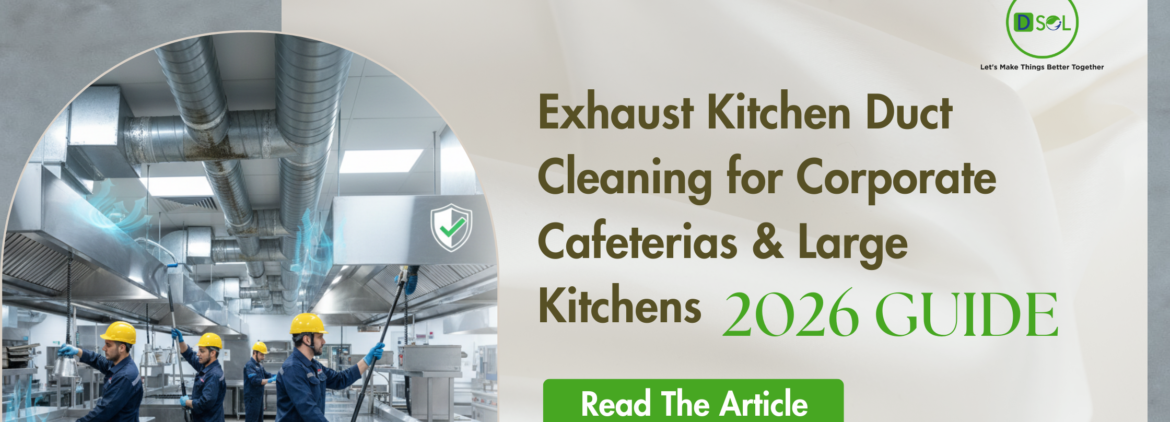
The Engine Room of Commercial Food Service
Behind every corporate cafeteria, hospital kitchen, and large-scale catering operation lies an extensive network of exhaust ductwork engineered to extract heat, smoke, and airborne grease. This system operates continuously under demanding conditions, often remaining out of sight and consequently out of mind until critical failure occurs.
In 2026, the paradigm has shifted. Exhaust kitchen duct cleaning is no longer regarded as a peripheral maintenance activity. It is recognised as a core operational discipline that determines fire safety compliance, insurance validity, and indoor environmental quality. For facility managers overseeing corporate food service operations, the stakes have never been higher.
This guide examines the specialised requirements of exhaust duct maintenance for large kitchens, the distinct challenges posed by corporate and institutional environments, and the verification standards that distinguish adequate cleaning from genuine risk mitigation.
Corporate Cafeterias: The High-Volume, High-Visibility Challenge
Corporate cafeterias occupy a unique position within the commercial kitchen landscape. They serve thousands of meals daily across compressed service windows, operating with industrial-scale equipment while remaining highly visible to an organisation’s workforce.
Kitchen exhaust duct cleaning for corporate facilities presents specific complexities:
Continuous Operation: Unlike restaurants with defined closure periods, many corporate cafeterias operate five to six days weekly with limited downtime. Cleaning interventions must be executed during narrow windows typically post-dinner or pre-breakfast shifts requiring service providers capable of rapid mobilisation and execution.
Brand Perception: Corporate occupiers increasingly recognise that cafeteria hygiene reflects organisational standards. Lingering cooking effluents, visible grease traces, or odour migration into office areas erode employee confidence in workplace amenities.
Multi-Tenant Coordination: In shared commercial precincts, cafeteria exhaust systems may integrate with building-wide ventilation infrastructure. Cleaning protocols must accommodate occupier confidentiality, security protocols, and building management system interfaces.
Forward-thinking corporate facility teams now schedule duct cleaning as a fixed quarterly commitment, recognising that preventive intervention costs represent a fraction of emergency remediation expenses.
Commercial Range Hood Cleaning: Beyond Surface Appearance
The range hood and its immediate exhaust plenum constitute the most accessible segment of any kitchen ventilation system. Yet surface-level cleaning, however meticulous, does not address the extensive duct network beyond.
Commercial range hood cleaning must be distinguished from comprehensive exhaust system maintenance. While daily hood wipe-down and filter replacement are essential operator responsibilities, they do not remove grease deposits adhered to duct interiors, fan blades, or vertical risers.
Professional intervention targets:
- Grease Extraction Surfaces: Baffle filters, extractor modules, and internal hood baffles receive deep degreasing using food-safe, biodegradable solvents.
- Plenum Chambers: The transition area between hood and ductwork accumulates dense grease layers requiring mechanical agitation and negative-pressure vacuum recovery.
- Ductwork Entrances: Immediately downstream of hood connections, turbulent airflow promotes rapid deposit formation.
For large kitchens serving corporate populations or institutional residents, the distinction between hood cleaning and duct cleaning carries material safety implications. Insurance engineers and fire safety auditors now routinely request photographic evidence of duct interior conditions, not merely hood appearance.
Industrial Kitchen Exhaust System Cleaning: Engineering-Scale Interventions
Large-scale catering facilities central production units, banquet kitchens, and healthcare food service operations operate exhaust systems of considerable physical magnitude. Duct diameters may exceed one metre, horizontal runs can extend fifty metres or more, and vertical risers may ascend multiple storeys.
Industrial kitchen exhaust system cleaning demands:
Access Engineering: Unlike modular restaurant installations, industrial systems often lack factory-fitted access panels. Service providers must fabricate custom access openings at strategic intervals, subsequently restoring duct integrity with airtight, fire-rated closures.
Confined Space Protocols: Extended horizontal ducts, underground extraction networks, and ceiling voids require technicians trained in confined space entry, atmospheric monitoring, and emergency retrieval procedures.
High-Capacity Recovery: Industrial grease volumes necessitate specialised vacuum recovery units capable of extracting several hundred kilograms of accumulated deposits per intervention.
Facility managers responsible for large institutional kitchens should verify that their service partners possess demonstrated experience in industrial-scale systems, not merely light-commercial installations.
Exhaust Duct Maintenance for Restaurants: Frequency, Verification, Accountability
For standalone restaurants and quick-service chains, exhaust duct maintenance intersects directly with trading continuity. Unplanned duct cleaning emergencies invariably occur during peak trading periods, forcing inconvenient closures and revenue disruption.
Exhaust duct maintenance for restaurants in 2026 is governed by three accountability pillars:
1. Frequency Determination: The National Fire Protection Association (NFPA) Standard 96 provides baseline frequency recommendations based on cooking volume and effluent characteristics. However, Indian conditions prolonged cooking durations, specific cuisine profiles, and ambient particulate levels often necessitate accelerated schedules. Professional risk assessments now customise frequency recommendations based on deposit thickness measurements rather than calendar intervals alone.
2. Verification Rigour: Reputable service providers furnish comprehensive documentation including pre-cleaning deposit thickness logs, photographic records geotagged and timestamped, and post-cleaning clearance certificates referencing measurable cleanliness standards.
3. Audit Trail Integrity: Insurance underwriters and municipal fire authorities increasingly require digitally verifiable cleaning histories. Establishments maintaining cloud-hosted, third-party-validated service records secure preferential premium treatment and expedited inspection clearances.
Grease Removal for Hospital Kitchens: Infection Control and Patient Safety
Hospital kitchens operate within uniquely demanding parameters. They serve patients with compromised immune systems, adhere to rigorous infection control protocols, and function as critical support services within healthcare delivery systems.
Grease removal for hospital kitchens addresses parallel safety imperatives:
Fire Risk Mitigation: Healthcare facilities cannot tolerate evacuation events. Patient relocation during fire incidents introduces clinical risks and operational strain. Exhaust system hygiene is therefore integrated into hospital-wide fire prevention strategies.
Airborne Contaminant Control: Inefficient grease extraction permits cooking effluents to infiltrate ventilation systems serving patient wards, diagnostic areas, and critical care units. Modern healthcare engineering protocols mandate IAQ-integrated exhaust hygiene monitoring.
Regulatory Compliance: State health departments and accreditation bodies now inspect kitchen ventilation hygiene during facility audits. Verified exhaust cleaning credentials are prerequisite for continued licensing.
Leading hospital facility teams now deploy robotic inspection systems for quarterly duct interior assessments, scheduling comprehensive cleaning during planned maintenance windows coordinated with clinical activity cycles.
The 2026 Methodology: Precision, Documentation, Minimal Disruption
Exhaust duct cleaning technology has advanced significantly. Manual scraping and chemical application remain necessary for heavily encrusted deposits, but contemporary protocols integrate multiple intervention modalities:
Robotic Duct Cleaning: Self-propelled crawler platforms equipped with rotating brush assemblies and integrated vacuum recovery access extended horizontal runs without requiring technician entry or extensive access fabrication.
Remote Visual Inspection: High-resolution pan-and-tilt cameras navigate duct interiors, transmitting real-time footage to surface monitors. This technology enables precise deposit measurement, targeted cleaning, and incontrovertible verification.
Negative Pressure Containment: Entire duct sections are isolated under vacuum during cleaning, preventing loosened deposits from migrating downstream or escaping into occupied spaces.
These technologies transform exhaust duct cleaning from an opaque, disruptive activity into a transparent, verifiable, and operationally considerate intervention.
The Cost Calculus: Prevention Versus Remediation
Facility managers confronting duct cleaning expenditures must consider complete risk exposure rather than line-item cost alone.
A comprehensive cleaning intervention for a large commercial kitchen represents a fraction of:
- Fire remediation expenses: Structural repair, equipment replacement, business interruption
- Regulatory penalty exposure: FSSAI sanctions, municipal fines, licence suspension costs
- Insurance consequences: Claim denials, premium escalation, coverage restrictions
- Reputational injury: Trading disruption, brand perception damage, tenant dissatisfaction
In 2026, the distinction between organisations that treat exhaust duct cleaning as discretionary expenditure and those that recognise it as strategic investment is increasingly evident.
Conclusion: Engineering Resilience into Commercial Kitchen Operations
Exhaust kitchen duct cleaning has matured from a reactive maintenance task into a verifiable safety discipline. For corporate cafeterias serving workforce populations, restaurants dependent on trading continuity, industrial kitchens supporting institutional food service, and hospitals safeguarding patient care environments, duct hygiene is inseparable from operational resilience.
The organisations that distinguish themselves in 2026 will be those that demand more than superficial cleaning. They will insist on verifiable outcomes, engineering-grade interventions, and service partnerships grounded in technical competence rather than transactional convenience.
In commercial kitchens where thousands of meals are prepared daily and thousands of occupants depend on safe environments, exhaust duct cleanliness is not optional. It is foundational.
D-SOL Facilities Pvt. Ltd.
D-SOL Facilities Pvt. Ltd. is a specialised commercial hygiene and infrastructure maintenance firm serving corporate enterprises, healthcare institutions, hotels, and industrial kitchens across India. The company delivers end-to-end solutions encompassing exhaust kitchen duct cleaning, commercial range hood maintenance, industrial exhaust system cleaning, and grease removal services for hospital kitchens. Its unique value proposition lies in the integration of advanced robotic intervention systems, compliance-documented workflows, and FSSAI-aligned cleaning protocols. D-SOL’s service methodology prioritises operational minimal intrusion, verifiable outcomes, and strict adherence to fire safety and food safety regulations. By combining technical precision with regulatory insight, D-SOL enables institutional clients to meet the highest standards of kitchen hygiene, workplace safety, and asset performance.
Contact Us
Call for reservation: +91 84483 96120 | +91 8448396121
Email: rohit@dsolfacilities.com | hemraj@dsolfacilities.com
Website: www.dsolfacilities.com