
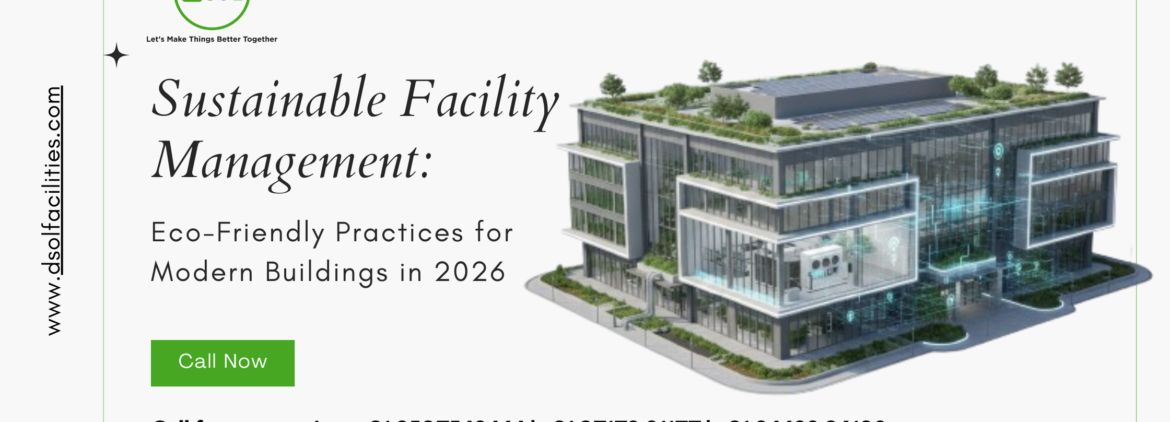
As India accelerates toward smarter urbanisation and climate-responsible development, sustainable facility management has evolved from a compliance requirement into a strategic business advantage. In 2026, modern buildings commercial, industrial, healthcare, and hospitality are expected to operate not only efficiently, but responsibly. Facility managers now play a pivotal role in reducing environmental impact while enhancing occupant well-being, operational efficiency, and long-term asset value.
This article explores eco-friendly facility management practices shaping modern buildings in 2026, offering a professional and forward-looking perspective for organisations committed to sustainability, safety, and performance.
What Is Sustainable Facility Management?
Sustainable facility management refers to the integration of environmental responsibility, resource efficiency, and lifecycle optimisation into the daily operations and maintenance of buildings. It balances three critical pillars:
- Environmental stewardship
- Economic efficiency
- Health, safety, and comfort of occupants
Rather than focusing solely on cost reduction, sustainable FM prioritises long-term value creation, regulatory preparedness, and reduced carbon footprint.
Why Sustainable Facility Management Matters in 2026
With stricter environmental regulations, rising energy costs, and growing awareness around indoor air quality, organisations can no longer afford traditional, reactive maintenance models.
Key drivers making sustainability essential in 2026 include:
- Net-zero and ESG commitments
- Increased energy and water scarcity
- Higher expectations for healthy indoor environments
- Rising operational risks linked to inefficient systems
Modern buildings demand intelligent, preventive, and eco-conscious facility strategies to remain competitive and compliant.
Energy-Efficient Building Operations
Smart Energy Management Systems
Energy consumption remains one of the largest contributors to operational costs and carbon emissions. Sustainable facilities leverage:
- Building Management Systems (BMS)
- Smart meters and sensors
- AI-driven energy analytics
These tools enable real-time monitoring, predictive adjustments, and reduced energy wastage across HVAC, lighting, and power systems.
Optimised HVAC Performance
Eco-friendly HVAC management includes:
- Regular duct cleaning to reduce energy load
- Air balancing for uniform temperature distribution
- Preventive maintenance to improve system lifespan
Efficient HVAC systems reduce electricity consumption while significantly improving indoor comfort and air quality.
Indoor Air Quality as a Sustainability Priority
In 2026, indoor air quality (IAQ) is recognised as a core sustainability metric. Poor IAQ impacts health, productivity, and regulatory compliance.
Sustainable IAQ practices include:
- Professional HVAC and exhaust duct cleaning
- IAQ audits to identify pollutants and allergens
- Filtration upgrades and airflow optimisation
Clean air strategies are especially critical in hospitals, commercial kitchens, offices, and industrial environments where airborne contaminants pose serious risks.
Water Conservation and Responsible Usage
Water sustainability is a growing concern across India. Modern facility management integrates:
- Rainwater harvesting systems
- Leak detection and water audits
- Efficient plumbing fixtures and reuse systems
Water-efficient buildings not only reduce environmental impact but also lower utility costs and support long-term operational resilience.
Eco-Friendly Cleaning and Maintenance Practices
Green Cleaning Solutions
Sustainable facilities are shifting away from harsh chemicals to:
- Biodegradable cleaning agents
- Low-VOC products
- Environmentally safe degreasers
These practices protect indoor air quality and reduce chemical exposure for occupants and maintenance staff.
Targeted Duct and Exhaust Cleaning
In commercial kitchens, laundries, and industrial setups, grease and lint accumulation pose fire and pollution risks. Eco-friendly duct cleaning:
- Reduces fire hazards
- Improves airflow efficiency
- Extends equipment life
- Lowers energy consumption
Fire Safety with Sustainability in Focus
Fire safety and sustainability are no longer separate objectives. Modern fire safety solutions emphasise:
- Non-toxic fireproofing materials
- Long-life passive fire protection systems
- Minimal disruption during installation
By integrating sustainable fire safety measures, buildings enhance occupant protection while reducing material waste and maintenance frequency.
Preventive Maintenance and Asset Longevity
Sustainable facility management prioritises preventive over reactive maintenance. This approach:
- Reduces unexpected breakdowns
- Extends equipment lifecycle
- Minimises resource wastage
- Enhances operational continuity
Advanced tools such as predictive diagnostics, digital maintenance logs, and AMC frameworks help facilities operate efficiently with lower environmental impact.
Waste Reduction and Responsible Disposal
Modern facilities are adopting structured waste management practices, including:
- Segregation at source
- Recycling and composting programs
- Safe disposal of hazardous and electronic waste
These initiatives align with circular economy principles and support regulatory compliance while reducing landfill dependency.
Technology-Driven Sustainable Facility Management
In 2026, sustainability is powered by technology. Key advancements include:
- IoT-enabled monitoring of utilities
- Digital facility audits
- Robotics in HVAC duct cleaning
- Data-driven decision-making for maintenance planning
Technology enables transparency, accountability, and measurable sustainability outcomes.
The Business Benefits of Sustainable Facility Management
Beyond environmental responsibility, sustainable FM delivers tangible business advantages:
- Lower operational costs
- Improved asset value
- Enhanced employee productivity
- Stronger brand reputation
- Regulatory readiness
Organisations that invest in eco-friendly facility management position themselves as responsible, future-ready, and resilient.
Preparing Buildings for the Future
Sustainable facility management is not a one-time initiative; it is an ongoing commitment. As buildings become smarter and regulations more stringent, facility strategies must continuously evolve.
The future belongs to facilities that are:
- Energy-efficient
- Health-focused
- Technologically enabled
- Environmentally responsible
About the Company and Its Sustainable Expertise
D-SOL Facilities delivers comprehensive facility management solutions designed to support clean air, operational efficiency, fire safety, and long-term sustainability. The company’s services include HVAC and exhaust duct cleaning, IAQ audits, fire safety solutions, rainwater harvesting, AMC repair and maintenance, and eco-conscious facility operations across commercial, industrial, and institutional spaces.
With a strong focus on advanced technologies, preventive maintenance, safety compliance, and environmentally responsible practices, D-SOL Facilities helps modern buildings operate efficiently while meeting sustainability goals and regulatory standards.
Contact Us
Call for reservation:
+91 8527548444 | +91 97178 81177 | +91 84483 96120
Email: rohit@dsolfacilities.com | hemraj@dsolfacilities.com
Website: https://dsolfacilities.com/