
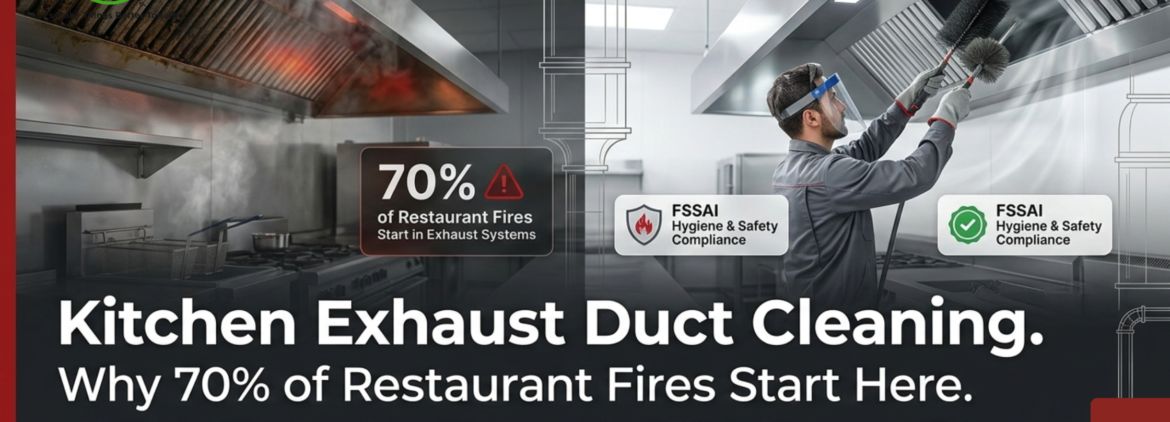
Restaurant kitchen safety is a critical concern for every food business operator, yet one risk often goes underestimated until it becomes a disaster: the kitchen exhaust duct. Studies and fire incident reports consistently reveal that up to 70% of restaurant fires originate in the kitchen exhaust system. This alarming statistic underscores a vital reality: neglecting kitchen exhaust duct cleaning is not just a maintenance oversight, it is a direct threat to lives, property, and business continuity.
In India’s burgeoning foodservice industry, restaurants, cloud kitchens, hotels, and institutional kitchens are under increasing scrutiny for food safety and operational compliance. Among these, the Food Safety and Standards Authority of India (FSSAI) has issued clear guidelines that include hygiene standards for kitchen ventilation systems. Yet many establishments are unaware of how kitchen exhaust cleanliness plays a role both in fire prevention and regulatory compliance.
This professional guide explores why kitchen exhaust ducts are high-risk zones for fires, how grease accumulation contributes to hazards, what FSSAI compliance requires, and why proactive duct cleaning is a non-negotiable investment for every food business.
Understanding the Kitchen Exhaust System and Fire Risk
Commercial kitchens rely on powerful ventilation systems to remove heat, smoke, odors, and airborne contaminants generated during food preparation. The kitchen exhaust system typically includes:
- A hood or canopy above cooking equipment
- A grease filter to capture oily vapors
- Ductwork that channels exhaust air outside
- A fan or blower that propels air through the system
As hot cooking gases pass through the hood and ductwork, grease particles condense on interior surfaces. Over time, these residues build up in layers. Grease is highly flammable; its ignition temperature is relatively low compared with most building materials.
This is why installed exhaust systems become the primary location for fire ignition and rapid flame spread in commercial kitchens. A single spark from overheated equipment, open flames, or electrical faults can set grease deposits alight. Once ignited, fire travels quickly through the ductwork, drawing in fresh oxygen and escalates into a major blaze.
Restaurant owners and kitchen managers searching for “why do most kitchen fires start in the exhaust” will find consistent answers: it is the accumulated grease that becomes fuel, and the enclosed duct space that accelerates fire spread.
Statistics: The Prevalence of Kitchen Exhaust Fires
Fire safety data from fire departments and risk assessment agencies indicate:
- Nearly 70% of restaurant fires begin in the kitchen exhaust system
- A significant proportion of these fires trace back to uncleaned or poorly maintained ducts
- Fire incidents escalate when ducts are not cleaned as per recommended schedules
These statistics are not arbitrary; they reflect a longstanding global pattern. Grease accumulation in exhaust systems is a universal phenomenon, and without diligent cleaning, small risks can quickly become catastrophic events.
The financial cost of a kitchen fire extends beyond property damage. It includes business interruptions, loss of reputation, insurance premium hikes, and legal liabilities especially if negligence in maintenance contributed to the incident.
How Grease Accumulation Happens and Why It Matters
Grease in exhaust systems comes from cooking oils, fats, and vapors produced during frying, grilling, sautéing, and other high-temperature processes. While grease filters in hoods capture larger particles, they do not stop all oily vapors. Finer residues pass through and adhere to duct walls.
Over time, this results in:
- Sticky, tar-like deposits on duct surfaces
- Reduced airflow and ventilation efficiency
- Increased static fuel load for fires
- Higher strain on exhaust fans and motors
As this residue thickens in bends, transitions, and fan chambers, even a small ignition source can trigger flames that spread rapidly through the exhaust pathway.
For restaurant owners who search for “commercial kitchen ventilation maintenance best practices”, understanding grease dynamics is essential. Regular duct cleaning does not merely improve hygiene; it eliminates combustible material that fuels many of the most dangerous kitchen fires.
FSSAI Compliance: Safety, Hygiene, and Maintenance Standards
In India, the Food Safety and Standards Authority of India (FSSAI) sets hygiene and operational standards for food establishments. While FSSAI regulations focus primarily on food quality and sanitation, the scope of compliance also extends to physical infrastructure including ventilation systems because they influence overall food safety and worker health.
Key expectations include:
- Maintaining a clean, functional ventilation system
- Ensuring grease filters are cleaned and replaced regularly
- Documenting maintenance schedules and cleaning activities
- Demonstrating proactive fire prevention measures during inspections
An unclean exhaust duct system can lead to non-compliance findings, which may result in show-cause notices, penalties, or suspension of license. FSSAI auditors increasingly include kitchen infrastructure and safety systems in evaluations, especially in high-risk operations such as institutional kitchens, hotels, and high-capacity restaurants.
Restaurants searching for “FSSAI kitchen hygiene guidelines” should note that neglected exhaust systems not only create fire risk but also reflect poorly on a facility’s commitment to overall safety and cleanliness, which can directly impact compliance status.
Recommended Kitchen Exhaust Duct Cleaning Frequency and Best Practices
Establishments vary in size, volume of cooking, and type of cuisine, but general recommendations for exhaust cleaning include:
- Monthly cleaning: For high-volume operations such as 24/7 restaurants, cloud kitchens, or heavy frying/grilling facilities
- Quarterly cleaning: For moderate usage kitchens
- Biannual cleaning: For low usage or light cooking operations
These frequencies are aligned with international fire safety standards and industry best practices. However, actual cleaning schedules should be customized based on:
- Volume of cooking
- Type of oils and fats used
- Observed grease buildup
- Inspection results
Best practices for duct cleaning include:
- Pre-cleaning video inspection to assess grease load
- Manual scrubbing of internal duct surfaces
- High-pressure washing where applicable
- Cleaning of hood filters, fans, and blower units
- Post-cleaning verification
- Documentation of the entire process
Professional cleaning eliminates hidden grease in bends and inaccessible areas that routine hood cleaning cannot address.
The Cost of Neglect vs. Investment in Regular Duct Cleaning
Many restaurant owners underestimate the value of exhaust duct cleaning because the threat is invisible. Grease buildup is not always obvious until it becomes a hazard.
The real costs of neglect include:
- Fire damage to kitchen infrastructure
- Closure during repairs
- Loss of revenue
- Increased insurance premiums
- Legal liability and compensation claims
- License suspension or non-compliance penalties
Conversely, a documented schedule of professional duct cleaning:
- Reduces fire risk significantly
- Improves air quality in the kitchen
- Enhances worker comfort and safety
- Extends the lifespan of HVAC and exhaust equipment
- Demonstrates compliance readiness for audits
When searching for “benefits of commercial kitchen exhaust cleaning”, operators should consider prevention costs as investments in business continuity and safety assurance.
Choosing the Right Duct Cleaning Service Provider
Selecting a competent duct cleaning partner requires careful evaluation of:
- Experience working with commercial kitchens
- Certified technicians trained in ventilation and fire safety
- Use of appropriate cleaning tools and methods
- Detailed pre- and post-cleaning reporting
- Compliance documentation support
- Minimal disruption to kitchen operations
Professional providers perform thorough site assessments and customize cleaning plans rather than applying generic approaches.
In India’s growing restaurant ecosystem, informed operators often reference service providers with strong track records in industrial and commercial exhaust cleaning to meet safety and compliance expectations.
Kitchen Exhaust Duct Cleaning: A Non-Negotiable for Safe Kitchens
Restaurants, hotels, cafeterias, and food courts must view kitchen exhaust cleaning not as a discretionary expense but as a critical safety practice embedded in operational hygiene and risk management.
Fires originating from kitchen exhaust ducts are preventable with regular cleaning, documented maintenance, and adherence to safety standards, including FSSAI expectations. Beyond protecting property, these practices safeguard human lives, preserve licenses, and sustain business reputation.
About the Services
D-SOL Facilities provides professional commercial duct cleaning, kitchen exhaust duct cleaning, HVAC maintenance, robotic inspection, AHU cleaning, and comprehensive air quality improvement services across India. With advanced cleaning technology, systematic inspection, and documented reporting, their services ensure measurable results with minimal operational disruption. Designed for restaurants, hotels, cloud kitchens, and institutional facilities, their approach enhances safety, supports compliance readiness, and extends equipment lifespan while enabling healthier work environments.Contact Us:
To schedule a professional kitchen exhaust duct cleaning and ensure your establishment meets all safety and compliance standards, please contact:
Call: +91 8527548444 | +91 97178 81177 | +91 84483 96120
Email: rohit@dsolfacilities.com | hemraj@dsolfacilities.com